


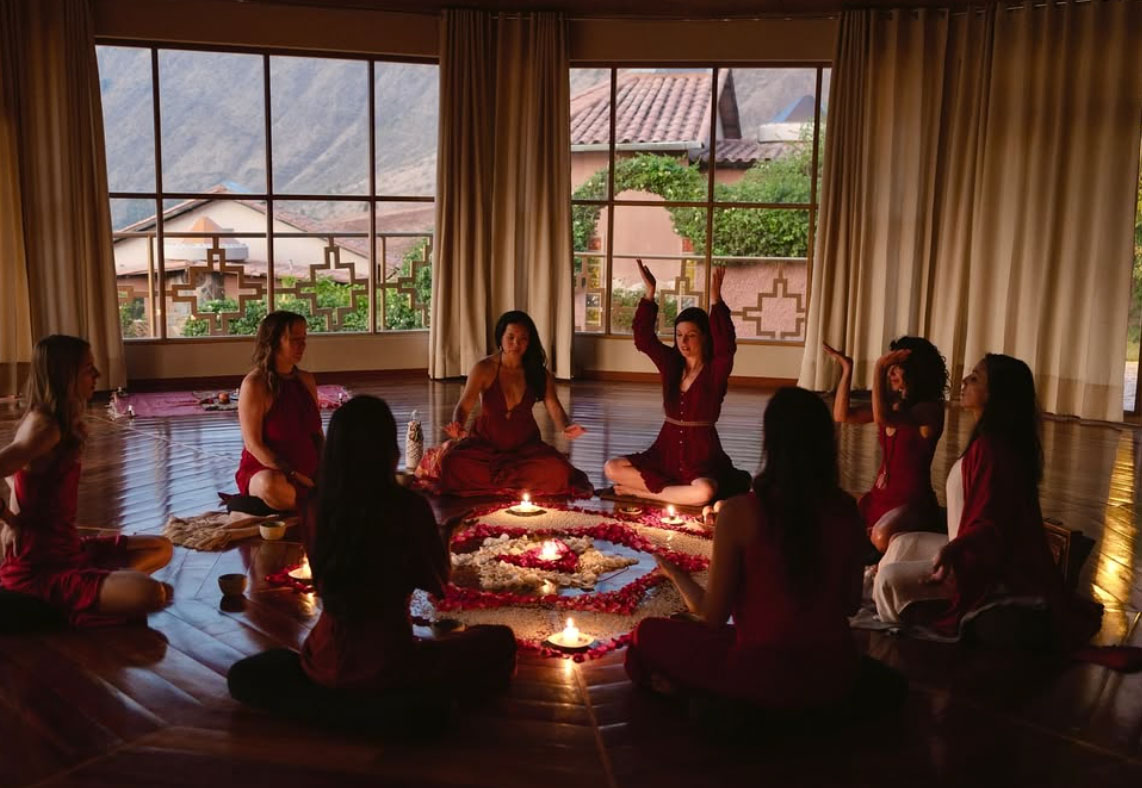


(RNS) — In her early teens and early 20s, Halo Seronko struggled with an eating disorder and bodily insecurities.
“I’ve been a woman who’s overcome so many challenges just because I’m a woman, and I think all of us women can relate to the struggles of being a female in a masculine-driven world,” said Seronko, now 39. “This adversarial relationship to our bodies, the way that we are taught to essentially hate ourselves, and then we spend most of our lives recovering from that conditioning.”
But something — or someone, according to Seronko — pulled her to start moving her body. With no prior experience, Seronko started dancing at clubs and underground music festivals, at Burning Man, at Middle Eastern belly dance and in fire dancing classes. Eventually, she discovered Indian temple dance — the eight classical forms of movement that in ancient India allowed women to serve as intermediaries to the gods.
“It was a slow process, like I’d been frozen and I slowly started thawing, and I’d start dancing, and pretty soon I would just feel this aliveness in my body and these streams of energy and this deeper intelligence informing my movement,” said Seronko. “And that’s how I first met her.”

Halo Seronko dances. (Photo courtesy of Seronko)
That “her” is Shakti, often called Ma or Devi, the divine feminine life force that has been worshipped for centuries in Hindu traditions. The spirit behind the many incarnations of goddesses in the Hindu pantheon, Shakti is complementary to the masculine Shiva — dynamic and active, rather than still and static — and the fundamental energy that makes the universe function. In Tantric traditions, Shakti lies dormant as Kundalini, a coiled energy at the base of the spine that can be awakened through movement.
For a growing number of women in the West, Shakti, found especially through dance, is the embodied feminism that is just the right antidote to modern woes.
“Most religions, most spiritual practices, are dominated by men,” said Seronko. “They actually don’t work for women’s bodies or women’s emotional matrix of energy and consciousness. We live in a world that is just so masculine, so patriarchal, and women have been made to feel less than in so many ways, and yet something in us is like, ‘No, I’m powerful beyond measure, but it’s a jewel that I have to uncover.'”
Seeking a more spiritual relationship to her body, Seronko dove into the world of Shakti, traveling alone to India to study Odissi dance, one of the oldest surviving classical dances, known for its graceful and sensuous poses. She visited temples of Durga, a widely worshipped form of Shakti, and several of the country’s 51 Shakti Peethas — powerful temples dedicated to Shakti, where parts of the goddess Sati, Shiva’s first wife, came to rest after being divided by Lord Vishnu.
“Where else in the world is there that the face of the Divine that is in my likeness?” she said. “Thank Goddess!”
Even in the goddess temples of India, said Seronko, male priests are in charge. The “masculine practice” of spirituality, involving solo contemplation and meditation, has long taken precedence over the “feminine path of relationship” like that expressed in dance.
But Seronko found out the sensual and the spiritual coexists in much of India’s dance history: the Devadasis, or the dancing servants to the gods; the Maharis, or Southern Indian temple dancers; the Yoginis, female enlightened beings; and the Dakinis, or “sky dancers” in Tantra.
“I think women dancing together is just one of the most beautiful experiences of connection and exaltation of feminine energy,” said Seronko. “If I do my dance practice alone, sure, it’s still powerful. It’s amazing. But to share it with other women, it elevates it to a higher octave of energy.”
When she returned to California in 2015, she created Shakti Temple Arts, a school of yoga, dance and embodied spirituality, where she draws students from all cultural backgrounds and stages of life.
These women are often on a similar journey to Seronko’s: looking for a healthier relationship to themselves and their bodies, as well as each other. “They’re seeking to rest back into their femininity. They want to feel themselves. They want to express their beauty and uncover their power.”
Tenley Wallace, a California native and founder of Temple Tribal Fusion, a sacred feminine dance group that blends Indian classical dance with flamenco, belly dance and other forms, teaches her students what she calls the “herstory” behind divine femininity, starting with the Indian temple dancers.
“There’s something that clicks for a lot of ladies, or just flips the switch on in the right direction when women have some of the backstory to affirm what they’re experiencing in their body, energy and mind,” Wallace, 53, told Religion News Service. “There’s a resonance when we’re drawing back to what women have always been doing.”

The Aarti Dance Ensemble includes Tenley Wallace of Temple Tribal Fusion. (Photo courtesy of Wallace)
One of the job titles of a temple dancer, said Wallace, was to “tell the stories, secrets and mysteries of the universe,” embodying the language of dance when not everyone spoke the same language or was literate. There was a science behind what they did, she added, as the dancer was to “embody these sacred symbols, these sacred geometric forms, these mudras, these hand gestures, to communicate. There is a resonance when the body, the bones, the energy, the fluids, line up in certain shapes.”
Since 2006, Wallace teaches her fusion dance classes online and in person in Oregon, performs at festivals and leads women’s Shakti Yoga retreats in India — her own form of yoga asana practice that centers what she identifies as the “energetic systems of a woman,” or the belly and pelvic region, which is different from the creative center of a man. “Ninety-nine percent of the yoga classes in the USA will not talk about that,” she said.
One of her students, Wendee Daniels, is a 57-year-old holistic nutritionist in Oregon who started dancing in her early 50s. Picking up choreography as a new dancer is not easy, said Daniels, but something about dancing — whether hip-hop, heels or chair — just feels natural.
“Your brain has to learn how to make the movements, and you’re not good at it at first, right?” she said. “But doing some of those ancient dances that come from the old world, for women’s bodies, it’s easy for us to move our hips in a figure eight, it’s easy for us to shake our booty, because we’re designed for that.”
Once Daniels is able to get to the “no-mind place,” she said, “then it’s a pure body movement, and that’s when the Shakti comes through. It moves through you, and there’s just a flood of emotions, and, you know, hormones that get all released. I think that’s why I feel so much joy that I almost always drive home after dance class smiling. I feel just so alive.”
Cultivating Shakti, or vitality, has long been part of Daniels’ work, as she teaches how healthy and nourishing food is essential to being an “embodied woman.”
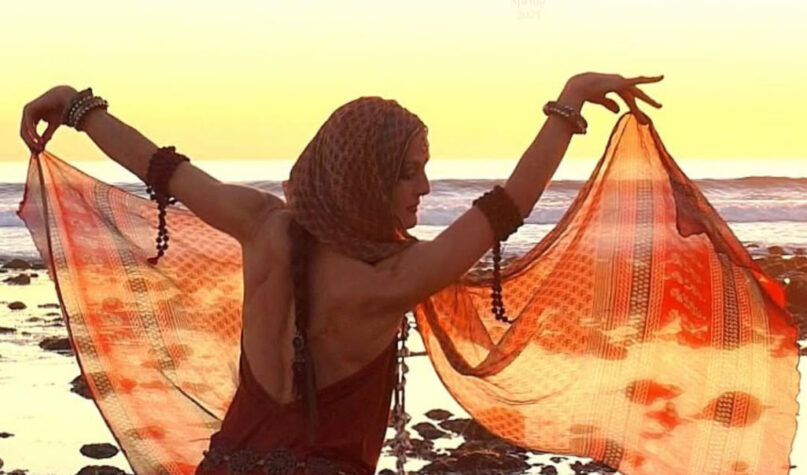
Tenley Wallace of Temple Tribal Fusion. (Photo courtesy of Wallace)
“When you’re an embodied woman, when you don’t have emotions pent up in your body, and when you learn how to release them in healthy ways, Shakti flows more,” she said. “And when Shakti is flowing, we get to bring our brightest light to the world. It might be a checker at the grocery store with the most sparkly eyes that changes your day. Solutions are born. Community is born. There’s a harmonizing that happens.
“I think it’s just a beautiful thread that I get to access being a woman.”