




BEIRUT (RNS) — On Aug. 4, 2020, Melvine Khoury and her brother watched curiously from the window of their home in Achrafieh as smoke and fire rose from the port of Beirut. Just as they started to evacuate, Khoury saw her brother being thrown to the other side of the house and crashing through a glass door while she was blasted to the opposite wall and covered in furniture and debris.
“I still cannot remember the sound of the explosion or how exactly I was injured, but I remember that after my brother pulled me out from under all the debris, everything was dark, filled with dust and rubble. I remember being in severe pain all over my body,” Khoury said.
The door of her house had been destroyed, and she could hear her neighbor screaming as panic rose everywhere. She said that in the hospital, where she underwent eight surgeries, the walls and floor were covered in blood. “Those were terrifying moments that cannot be forgotten,” she told RNS this week in Beirut.
The two explosions that devastated the city five years ago killed more than 200 people, wounded more than 7,000 and left 300,000 displaced without a home. The second explosion is considered to be among the strongest nonnuclear explosions in history.
Years earlier, in 2014, the government had stored a massive amount of confiscated ammonium nitrate at the port of Beirut without the necessary safety measures. Clarity about what happened or how the explosion occurred is still lacking as families of the victims wait for justice, even after a U.N. investigation into the bombing was called for in 2022. Government leaders and officials have refused to appear before the judges, and the investigation remains in limbo, though there have been some signs the new administration in Lebanon will pick it back up.
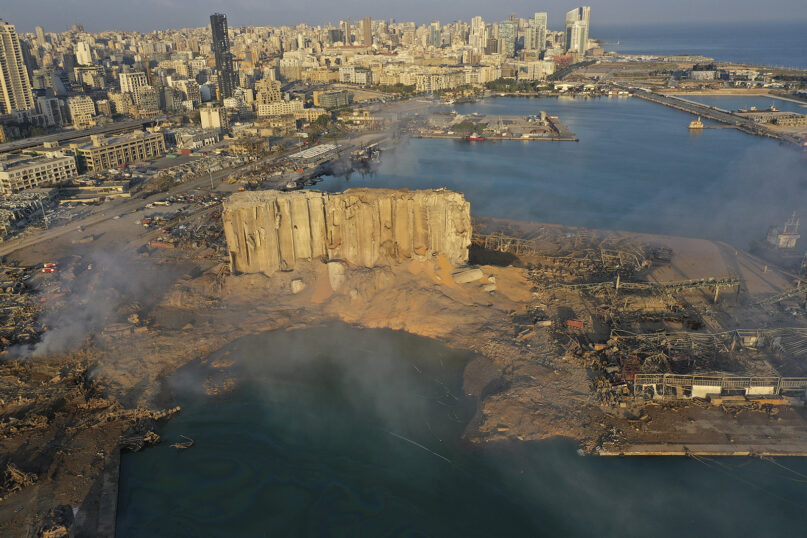
A drone picture shows the scene after a massive explosion hit the seaport of Beirut, Aug. 5, 2020. (AP Photo/Hussein Malla)
“Successive governments since the explosion did not handle this horrific crime responsibly, and the proof is that we are still, to this day, waiting for the truth to be said,” Khoury said. She said she is hopeful the government established two years ago will uncover the truth and hold those responsible accountable.
Pope Leo XIV’s trip to Lebanon was meant as an encouragement to the beleaguered country, including the 30% of the population who are Christian, to hold on to hope despite the country’s enormous challenges, from economic stagnation to renewed conflict in its southern border between Hezbollah militants and Israeli forces.
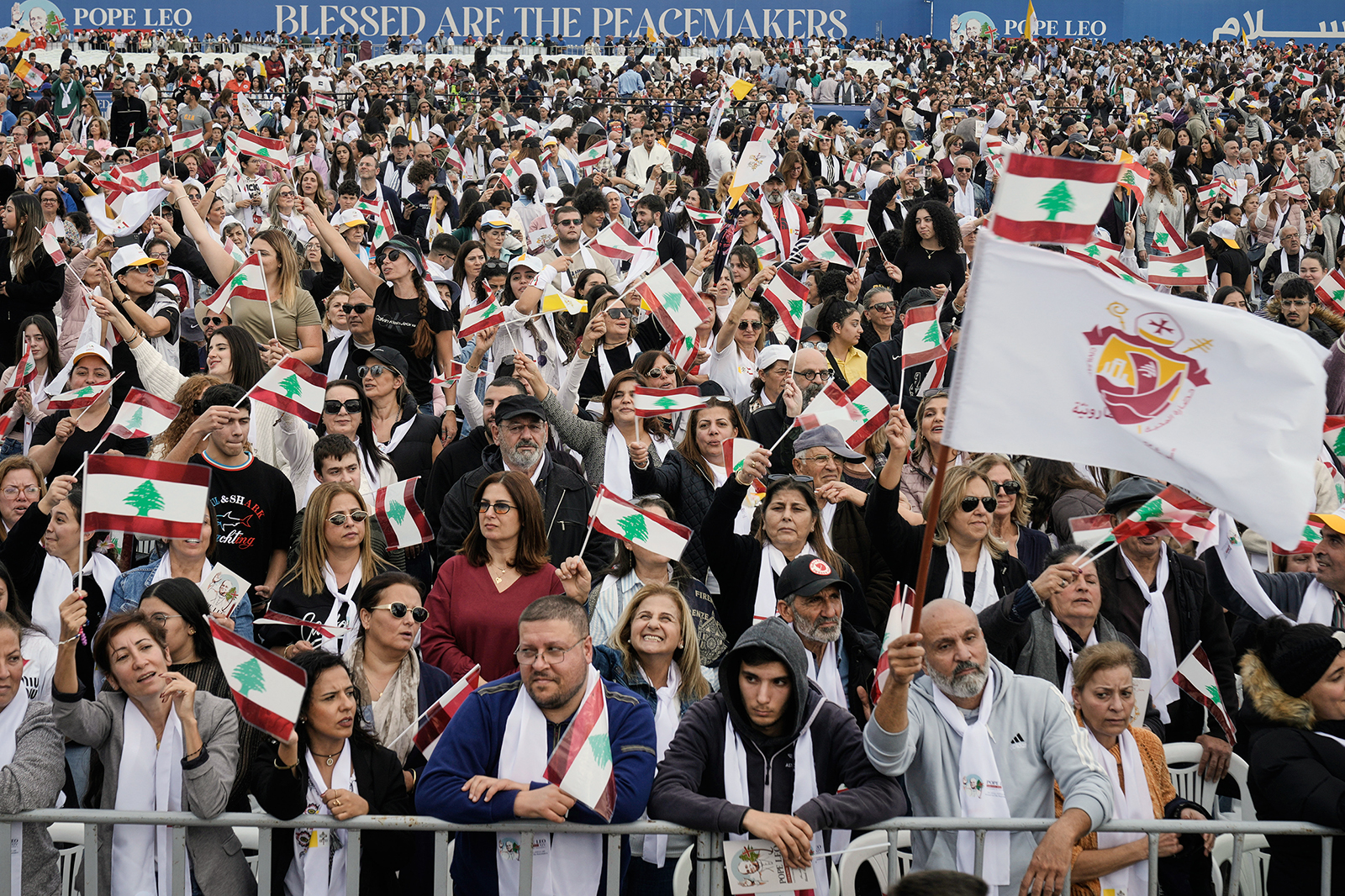
Leo concluded his first international trip as pope — which began in Turkey and ended in Beirut on Tuesday (Dec. 2) — with a silent prayer at the site of the port explosions. He placed a crown of flowers on a monument commemorating the victims and later met with their families as well as with survivors of the explosion. Leo then left to greet a crowd of 10,000 faithful from his bulletproof popemobile, before celebrating Mass at the Beirut waterfront.
“Everyone must do their part, and we must unite our efforts so that this land can return to its former glory,” Leo said in his homily, adding that this can only be done by “disarming our hearts” and casting off the armor of ethnic and political divisions.
“Lebanon, stand up! Be a home of justice and fraternity! Be a prophetic sign of peace for the whole of the Levant!” the pope said.

Pope Leo XIV holds a moment of prayer at the site of the 2020 Beirut port explosion in Beirut, Dec. 2, 2025. (AP Photo/Domenico Stinellis)
During his homily, the pope recognized the “many problems” afflicting the country’s economic, political and religious landscape, but he also urged its people to hold on to hope and find gratitude for the richness of Lebanon.
“Here and now, we can see small lights that shine in the night, small shoots that sprout forth and small seeds planted in the arid garden in this era of history,” he said, pointing to the positive impact that faith, churches, clergy and laypeople have in the country.
The Christians in the country have been a consistent voice in seeking justice and reparations for the victims of the Beirut port explosion, Khoury said. “We have seen only the church standing by the families of the victims, the wounded, and the afflicted, tirelessly demanding, even to this day, the truth and justice.”
Khoury, a journalist when the explosion occurred and now the press officer for the Maronite church, said the Maronite Archdiocese in Beirut, which is in communion with Rome, has taken a leading role in helping those affected by the explosion, including with reconstruction of homes and lives.
The Rev. Antonio Douaihy, a Lebanese Maronite priest and a student of ecclesial sciences at the Pontifical Gregorian University in Rome, said that “after the explosion, Lebanese from all over the country — Christians and non-Christians — came immediately to help. It was a powerful symbol of unity.”
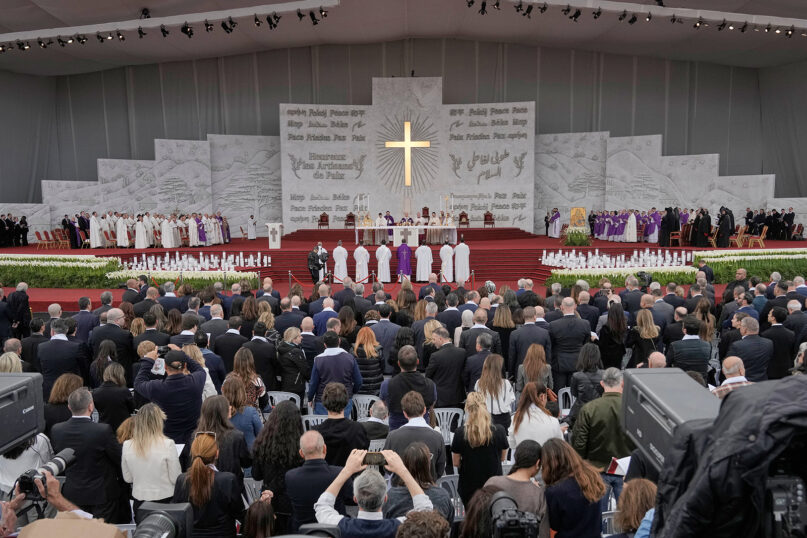
Pope Leo XIV celebrates a Holy Mass at the Beirut waterfront, in Beirut, Dec. 2, 2025. (AP Photo/Bilal Hussein)
He said he hopes Leo’s words “will be a balm that will heal the wounds of the Christians in the Middle East through the Christians in Lebanon,” promoting peace in a region roiled by the Israel-Hamas war and Israel’s ongoing conflict with Hezbellah in Lebanon.
“The visit of Pope Leo XIV to Lebanon means a lot to me,” said Khoury, adding that she hopes the pope’s words “will urge political leaders to always remember that responsibility is a service, not a privilege.” She said his visit will also promote unity among the Christian traditions in the country “to move away from sectarian conflicts in order to build real bridges strengthened with solid foundations.”
After the Mass, Pope Leo boarded the papal plane to return to Rome, closing his eight-day papal visit to Turkey and Lebanon — the first foreign visit of his papacy.