

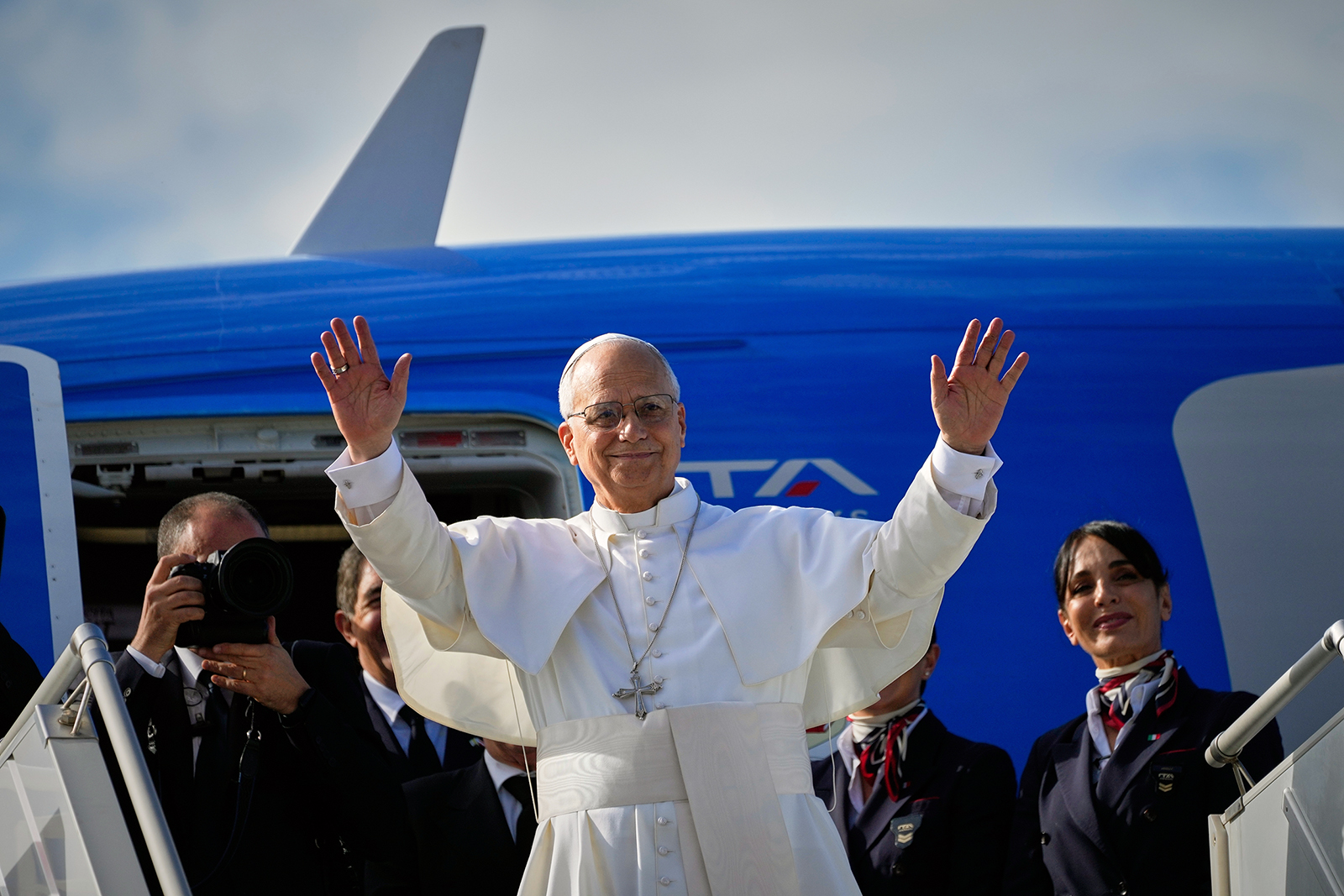


ISTANBUL, Turkey (RNS) — While returning from his first apostolic visit to Turkey and Lebanon, Pope Leo XIV delivered his first press conference aboard the papal flight on Tuesday (Dec. 2), offering insight into his impressions and feelings after becoming pope.
The pope quipped that he had thought about retiring before he realized the cardinals were going to elect him as the new pope on May 8. “I resigned myself to the fact when I saw how things were going, and I said that this could be a reality. I took a deep breath, and I said, ‘Here we go, Lord, you’re in charge, you lead the way,’” Leo said.
While he admitted his face is very expressive, he cautioned journalists who might try to use it to interpret his thoughts and feelings. They are “not always correct,” he said.
If people want to know what guides the pope’s thoughts, he said, it’s his trust in God.
“In the midst of great challenge, living in Peru during years of terrorism, being called to several places where I never thought I would be called to serve to … I trust in God, and that message is something that I share with all people,” he said.
The new pope, who turned 70 in September, said he loves the enthusiasm of crowds, especially youth, as they gather to celebrate Jesus. That they would view Leo as a “messenger of peace” is “awe-inspiring” to him.
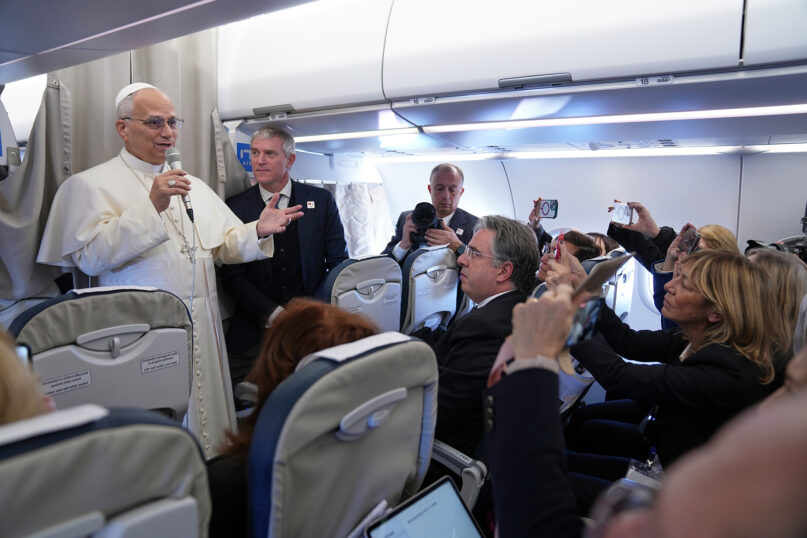
Pope Leo XIV greets reporters aboard a flight on his way to Ankara, Turkey, for a six-day trip to Turkey and Lebanon, Nov. 27, 2025. (AP Photo/Domenico Stinellis, Pool)
Leo’s comments focused especially on the themes of peace and unity, which, he said, were the words animating his six-day journey abroad. In Turkey, Leo celebrated the 1,700th anniversary of the First Ecumenical Council of Nicaea, and in Lebanon he offered words of encouragement to the country’s Christian and Muslim communities, who face conflict and economic stagnation.
The pope said he started “a few conversations” with the leaders of Israel, Lebanon and the United States “to raise that call for peace” in the Middle East. Israel and Hezbollah are embroiled in a bloody conflict in the South Lebanese border. The pope also said he received a message sent by Hezbollah upon his arrival in Lebanon, adding that the church seeks dialogue with Hezbollah as well and asked that the group lay down its arms, but he declined to comment more.
Moving his comments away from the Middle East to Ukraine, Leo observed that President Donald Trump is promoting a peace plan without Europe’s involvement. “But Europe’s presence is important,” the pope said, adding he believes that Italy, led by Prime Minister Giorgia Meloni, could act as an intermediary among Ukraine, Russia and the United States.
“I could suggest that the Holy See encourages this kind of mediation, and that we would seek together — a solution that could truly offer peace, a just peace, in this case in Ukraine,” he said.
Answering questions by reporters, Leo confirmed he might travel to Africa next, possibly Algeria, where St. Augustine, the founder of his religious order, was a bishop. Leo also said he would like to visit Latin America, including Argentina, Uruguay and Peru. He spent many years as a missionary and a bishop in Peru.
The pope spoke about the conflict in Venezuela, affirming the Holy See’s commitment to promoting the good of the people through the papal representative in the country. Mentioning the threat of a U.S. invasion of Venezuela, Leo said he would prefer that Trump sought another type of political or economic pressure.
But Leo underlined that a lot of the Holy See’s work to promote peace and dialogue in the world “is not primarily something public that we proclaim in the streets, it’s somewhat behind the scenes.”
Finally, the pope underlined that one of the messages of the trip was to promote peaceful dialogue between Muslims and Christians. Mentioning the anti-migrant sentiment rising in the West, the pope said, “We should be a little less fearful and look for ways of promoting authentic dialogue and respect.”