





(RNS) — When Alex Gruber first toured St. Norbert College, a small Catholic college in Wisconsin, it immediately felt like home. As a student there, he majored in religion and history, got involved in theater and served as a lector and in the choir at the campus parish.
Gruber said he probably wouldn’t pick St. Norbert if he were going to college today.
That’s because both of Gruber’s majors have been eliminated, as part of what the university says are necessary cost-cutting measures. In total, 15 majors and five minors have been slashed, and more than 60 faculty positions cut, representing more than half of the teaching staff. The college recently added new majors in exercise science, digital marketing, cybersecurity management and sacred music. Since the layoffs, some describe the campus today as a “ghost town.”
But Gruber, while still a proud alum, is less concerned about the size of St. Norbert than about its Catholic identity and the sense of community that has been a key value of the school’s sponsoring religious order, the Norbertines.
“A Catholic school without at least one full-time theology and religious studies faculty member will find it harder to live out its Catholic identity and distinguish itself from other private schools and even secular public schools,” said Gruber. “I think it means an impoverishment of the teaching of theology and the vibrancy of the Catholic identity.”
St. Norbert is not the only Catholic institution facing demographic and fiscal challenges, nor is it the only one to cut liberal arts to try to address those issues. The number of Catholic higher education institutions with theology or religious studies departments dropped to 63% in 2023, from 69% in 2016, according to a preliminary study on the “State of Theology in Catholic Higher Education” by the Association of Catholic Colleges and Universities. The average required number of credit hours in theology also fell, from 5.1 to 4.5.
In January 2024, Manhattan University in New York City, founded in 1853 by the lay group De La Salle Brothers, eliminated 20 majors and minors, including religious studies. Marymount University in Arlington, Virginia, founded in 1950 by the Religious of the Sacred Heart of Mary sisters, cut theology and philosophy, among other liberal arts majors, in 2023, citing low enrollment in those fields of study. In 2019, the Jesuit order removed its affiliation from 70-year-old Wheeling University in West Virginia, after the school laid off most of its liberal arts faculty and eliminated all but seven majors.
St. Norbert’s first round of layoffs, in September 2023, was attributed to declining enrollment and looming budget woes. A second round came later that academic year. Earlier this year, the school announced more layoffs and the cuts to 15 academic programs, leading to student protests and a no-confidence vote by the faculty in February. The American Catholic Historical Association canceled its March 2025 meeting at St. Norbert because of the termination of nearly all tenured faculty in the history and theology departments.
“These decisions, though difficult, set us on a path to emerge stronger from this transitional period,” St. Norbert President Laurie M. Joyner said in a March letter to the college community. “With resilience and radical gratitude, we step into a promising future with steadfast faith, boundless hope, and absolute confidence.”
Controversy at St. Norbert precedes the current administration. Student protests about the school’s handling of sexual assault allegations on campus in 2018 resulted in the college’s former vice president for mission and student affairs suing a student for defamation. Then-President Brian Bruess announced plans to depart, but when his contract was extended, four members of the college’s board of trustees resigned. Bruess left St. Norbert in 2022 to become president of the College of St. Benedict and St. John’s University in Minnesota.
St. Norbert, the Norbertine order’s only higher-education institution in the world, cited budget deficits totaling $18 million in 2022-24. On Oct. 17 the order announced a $15 million gift to the school’s endowment — a contribution that led some to speculate that some of the cuts, especially in theology, may not have been entirely financially driven.

Aerial view of St. Norbert College in De Pere, Wis. (Photo courtesy of Wikimedia/Creative Commons)
“The financial situation at the college provided a cover for an ideological transition,” said theologian Craig Ford, who specializes in queer studies and Black studies and is now visiting professor in ethics at Candler School of Theology at Emory University in Atlanta.
Ford was denied tenure in 2024, as were all St. Norbert faculty applying that year. By the time he left St. Norbert, at the end of the 2024-25 school year, the remainder of the theology department had also been let go. The department is now staffed with adjunct faculty, who teach courses for students taking two required theology classes as part of the school’s core curriculum.
Ford said he believes that the elimination of the theology faculty puts the college in a better position with the Norbertine order, whose younger priests are “remarkably more conservative” than their predecessors. He also suspects the changes improve the college’s relationship with the head of the Diocese of Green Bay, Bishop David Ricken, who has said that voting Democratic puts a Catholic’s “soul in jeopardy.”
The Rev. Matthew Dougherty, a Norbertine priest and St. Norbert’s special assistant to the president for mission integration, said the teaching of theology continues, including for a new master’s in theological studies offered jointly in Wisconsin and at the Norbertine Abbey in Albuquerque, New Mexico. In addition, the college has a robust campus ministry program that offers daily Mass, liturgy of the hours and retreats.
The liberal arts, according to Dougherty, are not only specific majors, but an approach to education “that forms the whole person in a well-rounded way,” he said. “St. Norbert College remains deeply committed to the liberal arts as a core tradition of our mission.”
The difficult cuts were the result of low demand, he said, noting that only six undergraduate students were majoring in theology when it was eliminated.
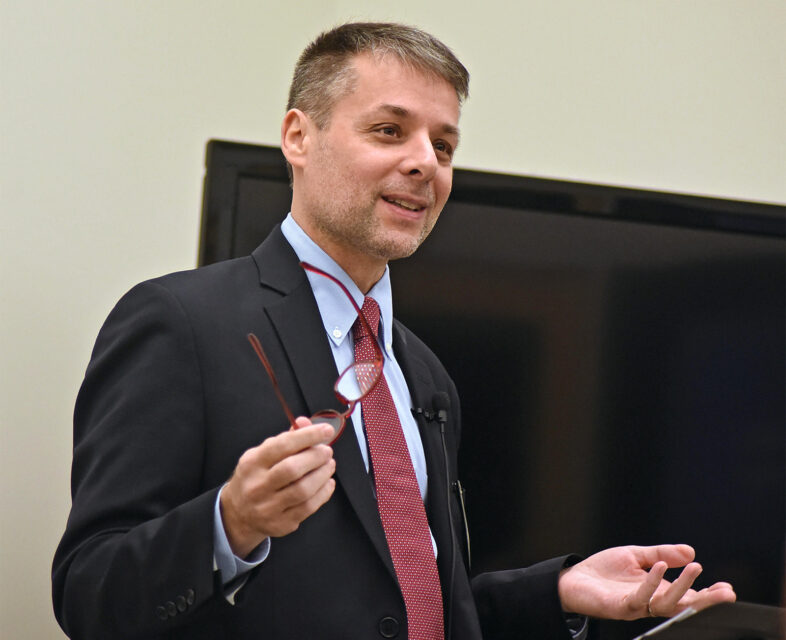
Massimo Faggioli addresses the 2019 Fall Education Speaker Series at the Community of St. Peter, Oct. 24, 2019, in Cleveland. (Photo by Peggy Turbett/ Community of St. Peter)
Critics acknowledge colleges’ financial and other pressures, including new ones added by the Trump administration. But such “technocratic” thinking is shortsighted and damages the entire church, especially when there is so much “bad religion” going on in American public life, said Massimo Faggioli, author of “Theology and Catholic Higher Education: Beyond Our Identity Crisis.”
“Eliminating majors is one way to cut costs. But at this particular moment, the consideration of keeping or cutting a major should not be made in terms of how many majors we had in the last year, but what should we as a Catholic university be thinking about,” said Faggioli. “It’s like cutting research on epidemics when there is no epidemic. Once you need it, it’s too late to start something.”
Faggioli’s book places blame not only on administrators who are not well formed in Catholic identity, but also on theologians in academia who have pursued niche areas of study when this generation of students has different interests.
Professional Catholic theology organizations, too, have spoken out about how cuts have affected their members and their field. In his presidential address at the College Theology Society in 2023, Brian Flanagan said “theology as many of us have known it is dying.”
“There has been a dramatic weakening of Catholic and other religious identities in our institutions as administrations and boards of trustees pursue an increasingly corporatized and increasingly desperate competition for customers — sorry, students,” he said.
That same year, Francis Clooney, then president of the Catholic Theological Society of America, said a new era is dawning, one that will replace what he called “the great and golden era of colleges and universities.”
The new era will be marked by stresses on colleges and universities and a waning support of theology, he said. “But this emerging era is marked also by new societal, political and cultural dynamics, including unprecedented religious pluralism, a spiritual but not religious attitude toward established churches and the freedom, imposed on us by economic change, to think outside the margins of both churches and universities and colleges.”
Clooney called for a “radical freedom” in his presidential address, while Flanagan urged an “empowered humility” on the part of theologians.
Donna Carroll, executive director of the Association of Catholic Colleges and Universities, declined to comment on specific institutions but noted that “program reduction is painful for presidents and faculty alike.”
“In this climate, it sometimes falls to new presidents to make hard choices without sufficient time to build trust,” she said. “Other presidents feel very real financial pressures to move quickly, which creates tensions with shared governance.”
But she also praised schools that are creatively adding new programs, including interfaith ones, as well as the possibility of multi-institution departments or cross-institution collaboration with shared online offerings and fractional faculty appointments, before reducing programs and positions.
“The losses in theology and philosophy are poignant,” she said, “(yet) the broad touch of the core and seminar programs is hopeful.”