


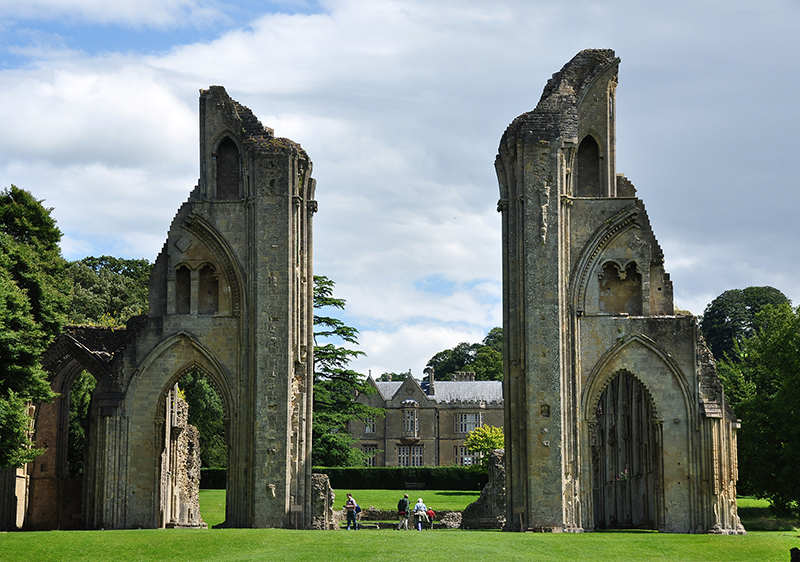


The ruins of Glastonbury Abbey church, Somerset, England. Photo courtesy of Nilfanion via Wikimedia Commons
CANTERBURY, England (RNS) Twelfth-century Roman Catholic monks with their eyes fixed on the equivalent of medieval cash registers were responsible for spreading the story that King Arthur and his golden-haired wife, Guinevere, were buried at Glastonbury Abbey in Somerset, one of England’s best known and most loved pilgrimage sites.
Archaeologists now say the story was invented to attract pilgrims.
Led by University of Reading archaeologist Roberta Gilchrist, 30 other scholars have dismissed the idea that Arthur and his queen were found in a wooden coffin deep down in the earth next to the Lady Chapel in 1181.
Arthur’s name is on the coffin in Latin, the lingua franca of that time.
But after carrying out a chemical and compositional analysis of glass, metal, and pottery artifacts, Gilchrist’s team found the grave is nothing but a pit filled with rubble.
The scholars concluded that the monks needed a lot of money to rebuild their famous abbey after a disastrous fire, so they invented the story that Arthur was buried there following his death in a battle against his son, Mordred.
According to Thomas Malory, an English writer, who wrote a book based on the king’s legends, Arthur was taken to a nearby island — and today’s Glastonbury Abbey — but doctors were unable to save his life. After his death, the famous Knights of the Round Table disbanded.
Tens of thousands of tourists from all over the world visit Glastonbury every year. Whether it will remain a top religious tours spot remains to be seen.
“We are not in the business of destroying people’s beliefs,” said Gilchrist whose study spanned four years. “A thousand years of beliefs and legends are part of the intangible history of this remarkable place.”
YS/AMB END GRUNDY