A Buddhist prayer festival fills a remote Tibetan village with color
(RNS) — Every year, between the sixth and seventh months of the lunar calendar, nomad tribes gather in the tiny Tibetan village of Ser Geyrgo for a prayer festival that is meant to invoke heaven.
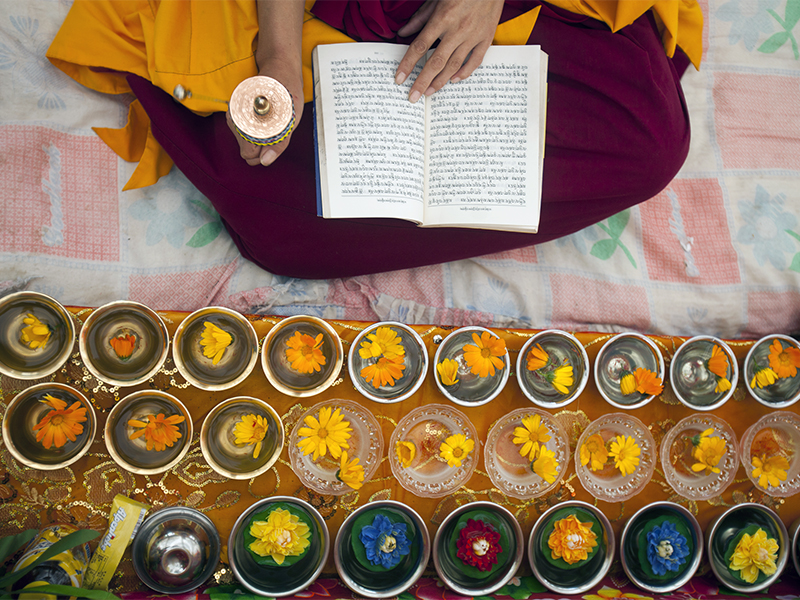
A nun recites mantras in front of a small altar with offerings. The offerings, in the form seven bowls of water with flowers represent the seven lakes surrounding Mount Meru, the center of the Buddhist universe. RNS photo by Alexandra Radu
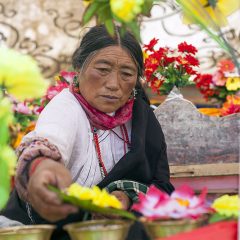
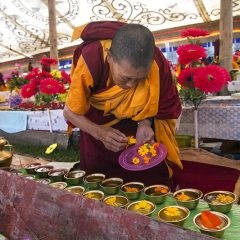
A nun recites mantras in front of a small altar with offerings. The offerings, in the form of seven bowls of water with flowers, represent the seven lakes surrounding Mount Meru, the center of the Buddhist universe. RNS photo by Alexandra Radu
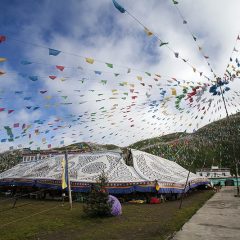
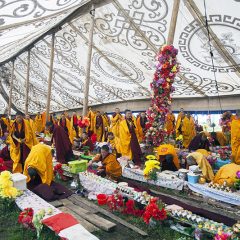
The Pure Land prayer festival takes place in and around a huge Tibetan nomad tent decorated with traditional patterns. RNS photo by Alexandra Radu
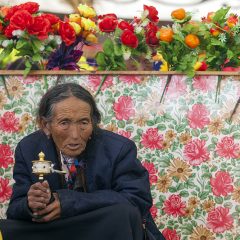
A Buddhist devotee recites the Amitabha Buddha mantra at the Ser Geyrgo Pure Land prayer festival. While spinning prayer wheels, reciting the mantra and meditating, the people imagine the Pure Land, home of Amitabha Buddha. RNS photo by Alexandra Radu
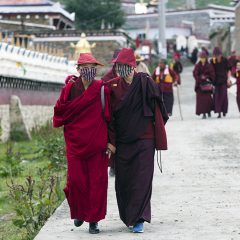
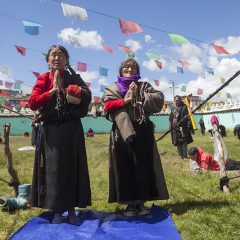
Buddhist nuns arrive at the Pure Land prayer festival in the Ser Geyrgo village. RNS photo by Alexandra Radu
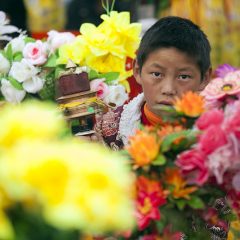
A boy recites mantras while spinning a prayer wheel at the Pure Land prayer festival. The area is decorated with flowers, creating an image of the Pure Land, the home of the Amitabha Buddha. RNS photo by Alexandra Radu
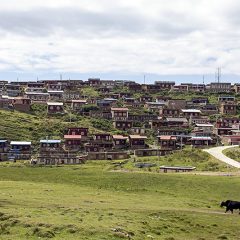
A yak grazes on the pastures near the village of Ser Geyrgo. During midsummer, nomad yak herders gather around the village nunnery for the six-week Pure Land prayer festival. RNS photo by Alexandra Radu
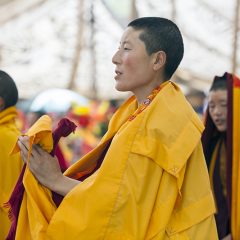
Nuns recite the Amitabha Buddha mantra while facing the center of the tent symbolizing the Pure Land. RNS photo by Alexandra Radu
Devotees recite mantras and many prostrate themselves at the Pure Land prayer festival. Prayer beads are used to count the mantras while reciting. RNS photo by Alexandra Radu
A devotee offers bowls of water and flowers while reciting mantras during the Pure Land prayer festival. RNS photo by Alexandra Radu
Nuns recite the Amitabha Buddha mantra while facing the center of the tent symbolizing the Pure Land during the annual prayer festival in Ser Geyrgo on the Tibetan Plateau in China’s Sichuan province. RNS photo by Alexandra Radu
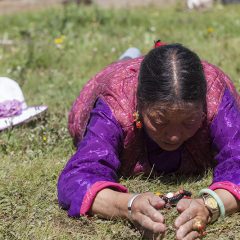
A woman prostrates herself while reciting the Amitabha Buddha mantra during the Pure Land festival. Prostrations are done to sweep away delusions, negative karma or obstructions, and request all good qualities. RNS photo by Alexandra Radu
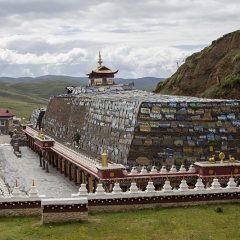
The remains of the lama in whose memory the nunnery was founded lie in a large chorten (Tibetan for stupa) that attracts many pilgrims. The chorten is covered with mani stones, each painted or carved with the mantra “Om mani padme hum.” RNS photo by Alexandra Radu
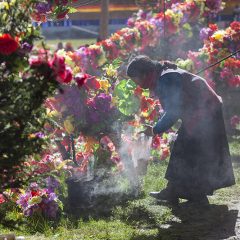
A Buddhist devotee burns incense in the center of the tent of the Pure Land festival. The burning of incense signifies the burning away of the negative qualities and revealing one’s pure self. RNS photo by Alexandra Radu
A nun offers seven bowls of water with flowers while reciting the Amitabha Buddha mantra. After the bowls are filled with water and decorated with flowers, the water is poured on the ground and the process is repeated. The prayers take place throughout the morning and afternoon. RNS photo by Alexandra Radu
The Pure Land prayer festival is one of the few yearly occasions when different nomadic families meet, giving it an important social component. RNS photo by Alexandra Radu
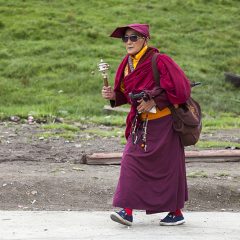
A Buddhist nun walks while spinning a prayer wheel at the Pure Land prayer festival. The prayer wheel, inscribed with the mantra “Om mani padme hum,” is believed to be equivalent to reciting the mantra. RNS photo by Alexandra Radu
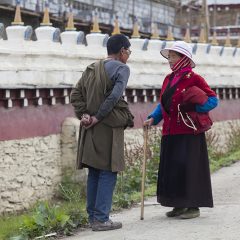
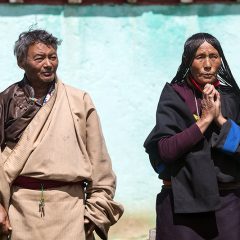
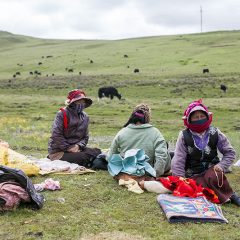
Buddhist pilgrims pray at the Pure Land festival. They are dressed in traditional Tibetan nomadic attire. RNS photo by Alexandra Radu
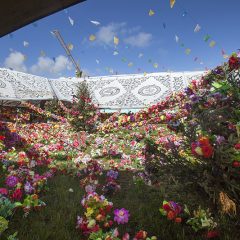
The center of the main tent of the Pure Land prayer festival is open and decorated with flowers, which attract birds, creating an image of the Pure Land. The devotees recite the mantra while they sit facing the center of the tent. RNS photo by Alexandra Radu
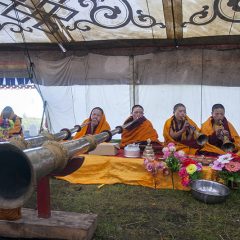
Nuns play traditional ceremonial Tibetan musical horns during the Pure Land festival. RNS photo by Alexandra Radu
Tibetan women tend a yak herd on the pastures near Ser Geyrgo village. RNS photo by Alexandra Radu
(RNS) — By a remote Buddhist nunnery that is home to 500 nuns and 100 monks sits the tiny Tibetan village of Ser Geyrgo. Every year, between the sixth and seventh months of the lunar calendar, nomad tribes gather in the village for a six-week prayer festival meant to invoke heaven.
Nestled in the alpine pastures of the Tibetan Plateau in China’s Sichuan province, the nunnery is part of the southeastern historical Kham region, where nomads cross great swaths of land, living in tents and following their herds of yak.
Devotees practicing Amidism — a branch of Mahayana Buddhism — participate in the festival, which is meant to invoke the Pure Land of Buddhism, or heaven. The festival takes place in a traditional Tibetan tent decorated with flowers that attract birds.
Devotees spend mornings and afternoons meditating by reciting a mantra, the name of Amitabha Buddha, “Na-Mo-A-Mi-Tuo-Fo,” and give offerings to the Buddhas. The offerings, water bowls with flowers and clay shaped in the form of stupas — dome-shaped structures erected as a Buddhist shrine — represent the seven freshwater lakes and the seven rings of golden mountains that surround Mount Meru. The mountain, held sacred, stands at the center of the physical and spiritual universes in the Buddhist cosmology.
The prayer festival is a meeting place for nomadic clans from the region, who otherwise rarely see each other, and give the festival an important social dimension.
Link copied!
No paywalls here. Thanks to you.
As an independent nonprofit, RNS believes everyone should have access to coverage of religion that is fair, thoughtful and inclusive. That's why you will never hit a paywall on our site; you can read all the stories and columns you want, free of charge (and we hope you read a lot of them!)
But, of course, producing this journalism carries a high cost, to support the reporters, editors, columnists, and the behind-the-scenes staff that keep this site up and running. That's why we ask that if you can, you consider becoming one of our donors. Any amount helps, and because we're a nonprofit, all of it goes to support our mission: To produce thoughtful, factual coverage of religion that helps you better understand the world. Thank you for reading and supporting RNS.