

How alliances between Black and Jewish voters are reshaping one New York district
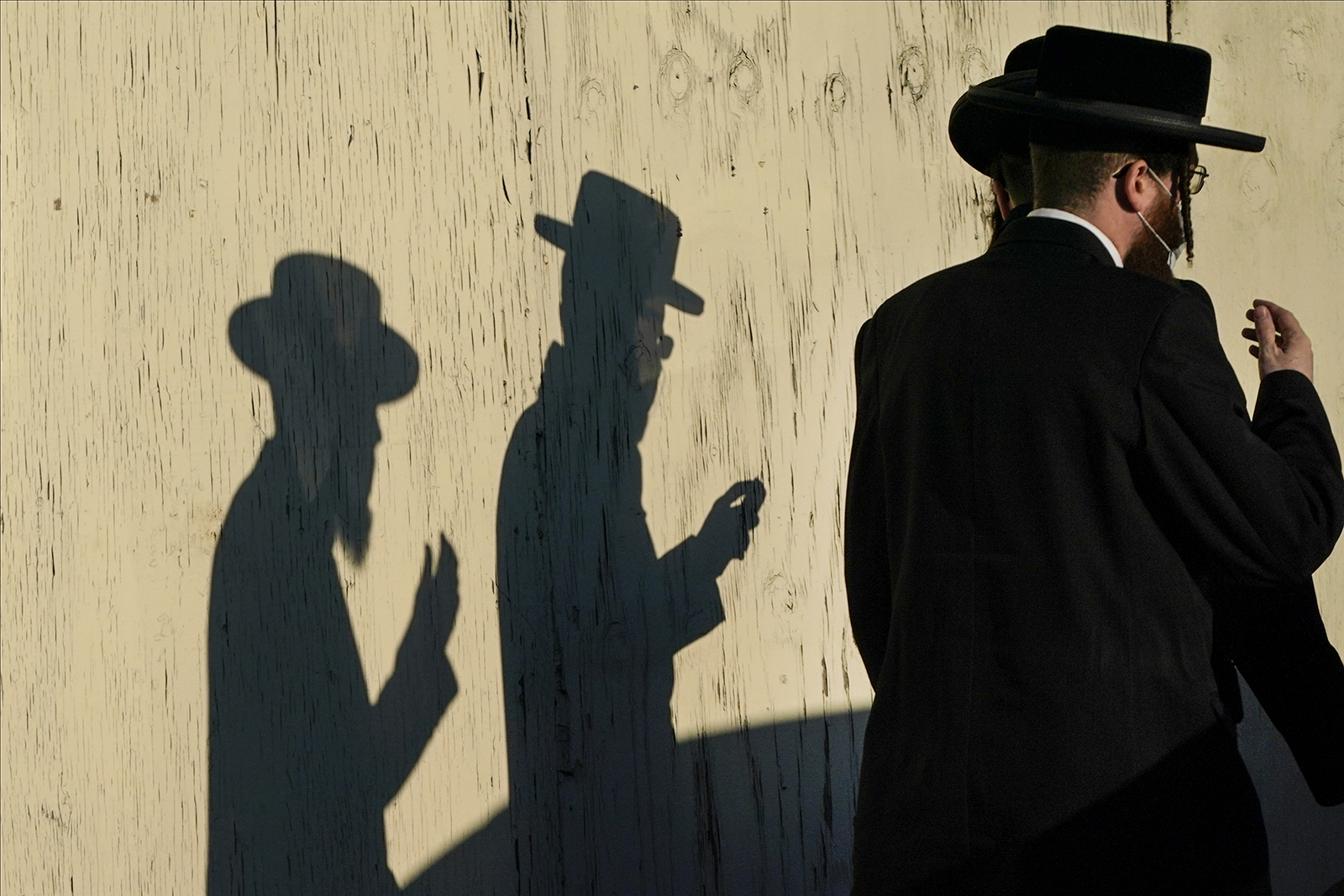


NEW YORK (RNS) — “There’s a perception out there — and for good reason — that the Orthodox community is monolithic,” said Sasha Kesler, who identifies herself as a Modern Orthodox Jew. “And becoming increasingly conservative. But it’s not.”
“I know what I know about my community,” continued Kesler, who lives in Riverdale, New York, and attends the Hebrew Institute, one of the major synagogues in the Bronx neighborhood. “My friends, the rabbis, the leaders: We are progressives. We look to the Torah and the texts we have to teach us the lessons of our obligation to care for others.”
Riverdale is in New York’s 16th Congressional District and is the neighborhood where Rep. Eliot Engel once called himself “the mayor.”
Engel’s defeat in June’s Democratic primary by progressive insurgent Jamaal Bowman signaled shifts within the electorate, which straddles wide income divides in the Bronx and southern Westchester and is 30% Black and 20% Jewish — double statewide averages. Historically, Engel’s wins depended on tepid voter turnout; only 4% of the district’s population voted in 2018’s primary. This year, three times that amount voted.
In the spring, commentators aptly cast the primary race for the congressional seat as a litmus test on whether the Jewish community would prioritize hawkish policies on Israel — Engel was chairman of the House Foreign Affairs Committee and a favorite of the American Israel Public Affairs Committee, known as AIPAC — or progressivism. That question was answered when Bowman, who is Black and a democratic socialist, won by wide margins, even at the polling place at the Hebrew Institute in Riverdale.
Micah Sifry lives a few miles away in Hastings-on-Hudson, a smaller and whiter town in the district. Looking forward, Sifry said: “There’s a broader multiracial, multiethnic democracy on the rise that Jews are going to be a part of. The Jewish vote needs to be an organizing vehicle that, in partnership with other folks, can midwife it into existence. It has a particular role to play in the places where, by the nature of geography, there is an opportunity to move a significant amount of votes.”
Indeed, even as sectors of the Orthodox community align themselves with Trump, drawn to a rhetoric that resonates with memories of the Crown Heights riot, his fight against coronavirus-driven masks and lockdowns, and his move of the American Embassy to Jerusalem, a significant number of Jews are defining progressive political action as central to their religion.
Although Sifry helped start a Reconstructionist synagogue, Mishkan Ha’am, he told Religion News Service that “after years of feeling like the organized Jewish community had moved to the right, I didn’t feel like I had a home.”
(Full disclosure: My family belongs to Mishkan Ha’am and I was bat mitzvahed there, but I did not know Sifry or make the connection until reporting this story.)
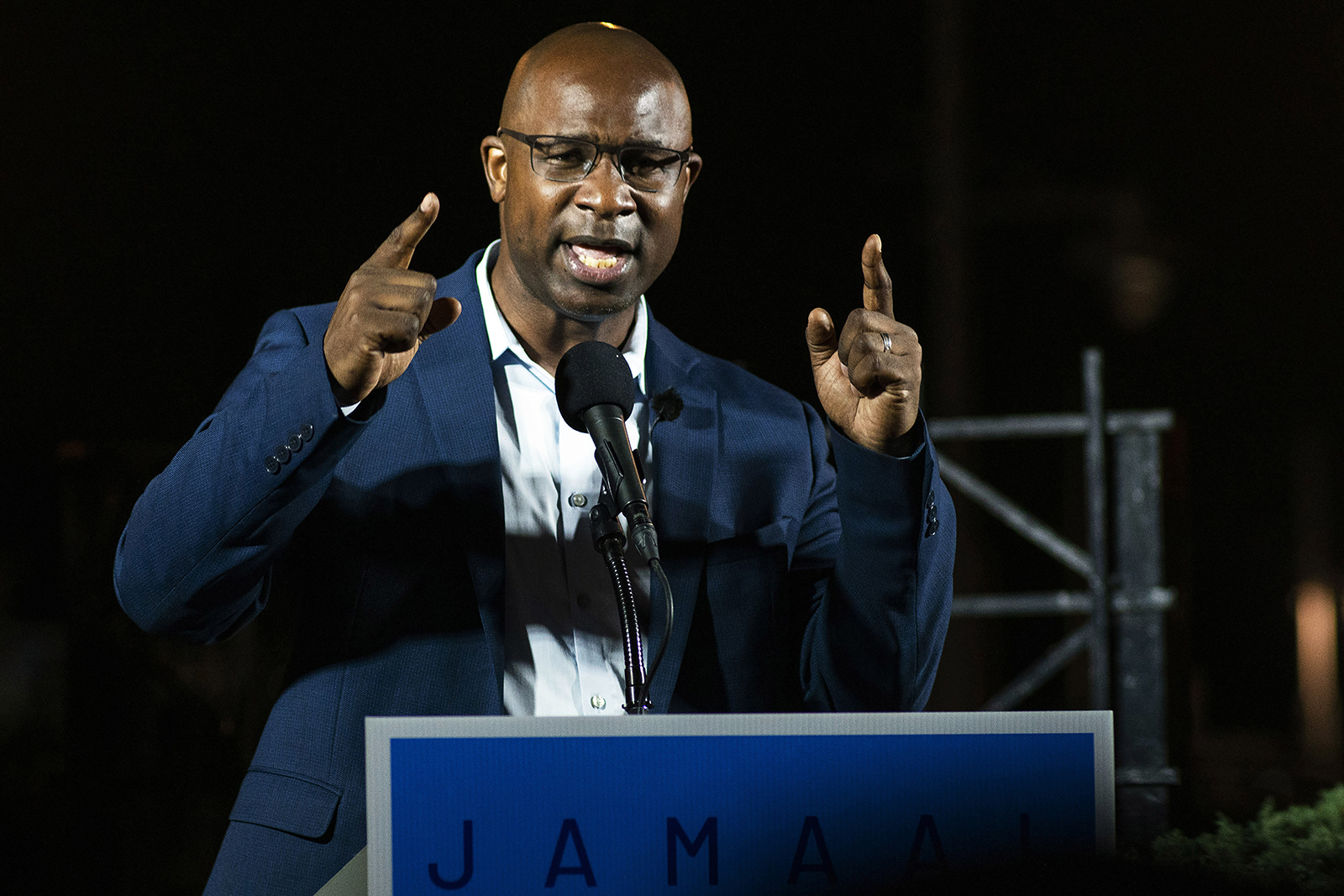
This June 23, 2020, file photo shows Jamaal Bowman speaking to attendees during his primary-night party. The former middle school principal toppled 16-term U.S. Rep. Eliot Engel in New York’s Democratic congressional primary. (AP Photo/Eduardo Munoz Alvarez, FIle)
He feels most connected to his Jewishness through his activism, Sifry explained. In that, he said, there is “a sense of this feels like home.”
To that end, both Sifry and Kesler volunteer with The Jewish Vote, an organization that endorses and campaigns for “radicals and reformers” in New York, whose support was crucial to Bowman’s win over Engel.
There’s little doubt the organization’s efforts made an impact in the race. Bowman successfully batted off massive ad spending from pro-Israel groups, including the Democratic Majority for Israel, that were eager to save Engel’s seat, and weathered attacks in the press over his politics. The Hebrew Institute’s founding rabbi, Avi Weiss (who retired in 2015), wrote “An open letter to Jamaal Bowman” in The Riverdale Press interrogating Bowman’s stance on Israel and asserting “amongst the issues most important” to “our community” is “the well-being of the state of Israel.”
Bowman responded with a letter titled “We have so much to learn from each other,” linking his oppression as a Black man to that of Jews. Bowman attended The Jewish Vote’s virtual “Freedom Seder,” and the organization started a social media hashtag #JewsForJamaal and relational organizing campaigns. “The Jewish Vote was one of the first grassroots groups in New York that had my back,” Bowman told RNS in an email. “I’m grateful they stepped up when our campaign was still small and needed their help, and it made a huge difference. I’m proud to call them friends, and look forward to keep working with them to build a more just future for all of us.”
“For us,” said Rachel McCullough, the organization’s political director, “the Bowman victory is a watershed moment for Jewish voters and proof that a new approach to the Jewish vote is on the rise. For years it was assumed that a hawkish approach on Israel is what won over voters. The truth is that Israel isn’t even a leading priority.”
“That’s the genius of the moment,” Sifry said. “People recognized that expanding access to a better life and justice is not a zero-sum game.
“Our political stance has long been a combination of self-interest and a broader sense of common interest,” he added. “We don’t do well in an America where people are pitted against each other. We do better when we have a more expansive vision.”
The care economy has been a specific focus of the partnership between The Jewish Vote and Bowman’s team, during the campaign and going forward. Both The Jewish Vote and Bowman link the care economy to the green jobs that would be created and better funded under the Green New Deal, another mutual focus. And both Kesler and Sifry mentioned historic Jewish fights for social justice, Medicare for All and the Black Lives Matter movement as priorities that drew them even closer to the campaign.
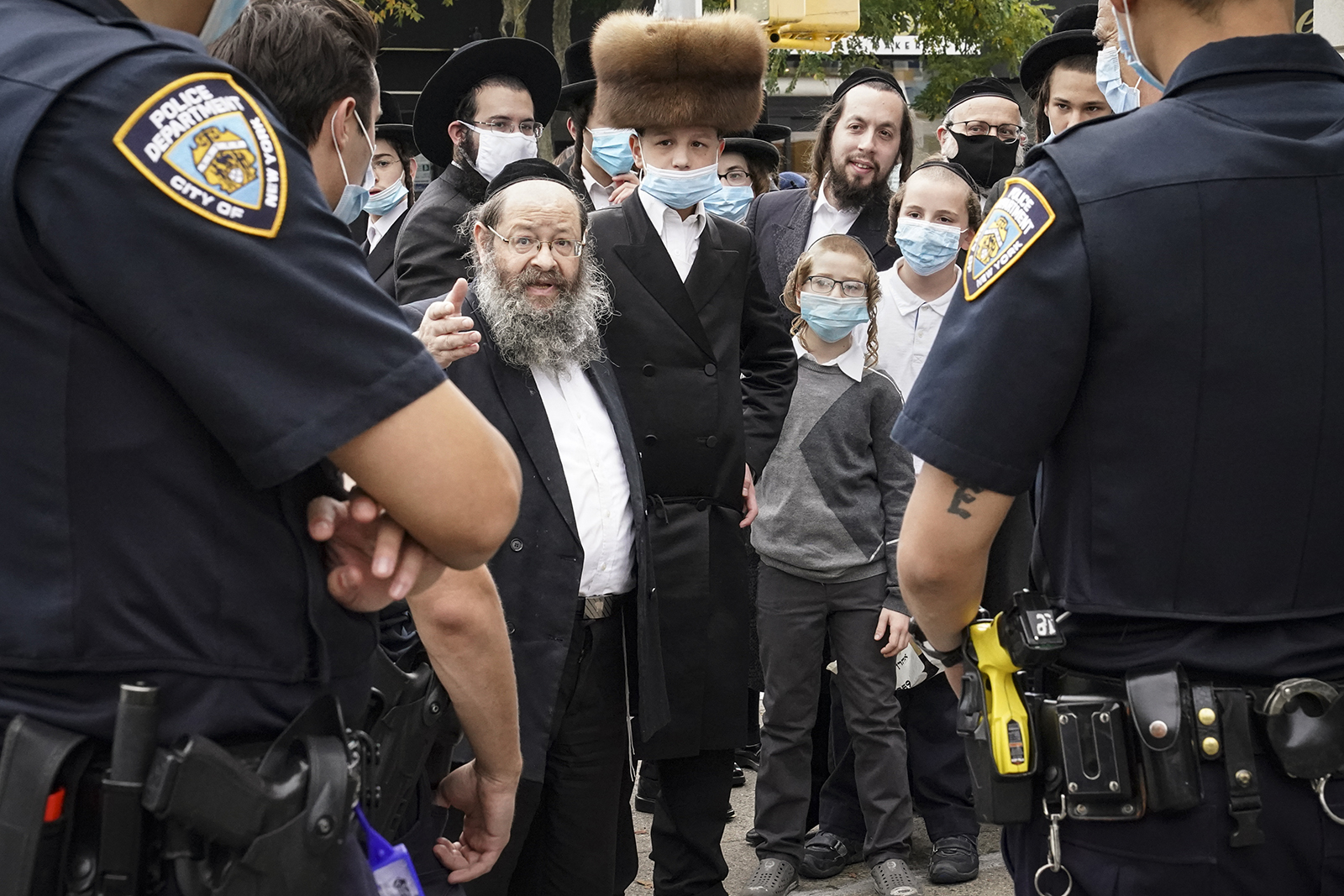
Members of the Orthodox Jewish community speak with New York police officers on Oct. 7, 2020, in the Borough Park neighborhood of New York’s Brooklyn borough. (AP Photo/John Minchillo)
“We’re all united in the need for an equitable caring economy,” said Kesler, who threw herself into the Bowman campaign, taking her newborn son out to canvass with her and (once the pandemic hit) to virtual phone banks.
“Jewish people have struggled immensely. To do anything other than improve our society and our lives and the lives of those we live with would be a negation of our values as Jews,” she said.
With Bowman’s once-unlikely victory behind them, The Jewish Vote is gearing up for its next fights.
After Bronx City Council Member Andrew Cohen was nominated for a state Supreme Court judgeship, The Jewish Vote saw an opportunity. On Monday (Dec. 21), the organization endorsed activist, artist and educator Mino Lora for his vacated seat. Like Bowman, Lora emphasizes redistributive tax policies that would fund progressive policies.
The hashtags are already beginning; on Twitter, The Jewish Vote co-founder Katie Unger wrote “We’re so excited to get to work! #menschformino.”
On the state level, The Jewish Vote is joining with other groups pushing for Gov. Andrew Cuomo to tax the rich to fund a score of social benefits. On the city level, they plan to push for reducing the size and scope of the New York Police Department.
“A big part of the concern there, as Jews,” McCullough said, “is hate violence. We believe that the only effective solution to hate violence is education, restorative justice and intercommunity solidarity, not more policing.
“Hate and anti-Semitism aren’t things we can police ourselves out of.”
And, according to McCullough, they’re also planning to grow. Their formula for success? A base of members, a potential showdown between a “corrupt out-of-touch incumbent” and a “progressive insurgent,” and allyships with other grassroots organizations.
“We’re looking at other places in the city with pockets of underrepresented progressive Jews who can be brought together: Central and Eastern Queens, South Brooklyn and the northwest Bronx, as well as our current strongholds in Park Slope and Central Brooklyn.”
If Sen. Chuck Schumer faces a progressive primary challenger in 2022 — as some have speculated he will, and as his recent push for popular policies such as canceling student debt seems to indicate he fears — it seems likely The Jewish Vote will take its winning formula statewide.