

In time for Lent: new ecumenical study guide for new Kairos Palestine II


Brings bold Palestinian Christian document to congregations
Three Christian organizations will soon jointly release a new congregational study guide for the confessional document A Moment of Truth: Faith in a Time of Genocide, the recently issued Kairos Palestine II statement from Palestinian Christian leaders. (Issued Nov. 2025).
This new resource invites congregations into a sacred dialogue with the Kairos Palestine II document—a living confession born from the heart of Palestinian Christian suffering. To study it during Lent, that ancient season of preparation and renewal, is to walk the path of baptism once more: to rediscover what it means to pledge our faith in Christ and to boldly renounce the sin and evil alive in our world today.
The study sessions ground the confession in current realities in Gaza, the West Bank, and within the wider Palestinian diaspora, where church leaders describe an ongoing time of genocide, ethnic cleansing, and forced displacement. The guide situates the new Kairos Palestine text within the long arc of ecumenical concern for Palestine/Israel and invites congregations to receive it as a cry to the global church for help and hope.
Developed by The Palestine Justice Network (PJN) of the Presbyterian Church (U.S.A.), with United Methodists for Kairos Response(UMKR), and Friends of Sabeel North America (FOSNA), the study guide will be a free digital download. It will be available at their websites in February, for use as a 2026 Lenten Study and throughout the year.
A Palestinian Christian Lens
The Kairos Palestine II document describes itself as a renewed “word of faith, hope, and love” and a “moment of truth” for the whole church; this study guide is offered as a tool for congregations to listen carefully to that word and to discern how God is calling the church in the United States (and beyond) to respond.
Throughout the guide, questions are framed to engage the wide spectrum of opinions present in church pews and leadership, from deep concern for Jewish–Christian relations to long-standing commitments to Palestinian human rights. Each session invites participants to ask, “How might this issue look when viewed through the eyes of Palestinian Christians who confess Christ in a time of genocide?” Further, how might we as Christians let that perspective challenge and deepen our own discipleship?
Contents:
- Leader’s Guide
- Lesson Plans
- Worship Liturgy
- Children’s Sermon
- Text of Kairos Palestine II
- Readers’ Theater
- Palestine 101
- Glossary
- Current Denominational Policies
The study guide is intended to equip Christians to speak the truth about Palestinian realities while rooting that truth-telling in a theology of social justice and the traditions and positions of their church.
For more information and to download the guide in February 2026, please visit the Palestine Justice Network at thepjn.org, UMKR at kairosresponse.org, or FOSNA at fosna.org.
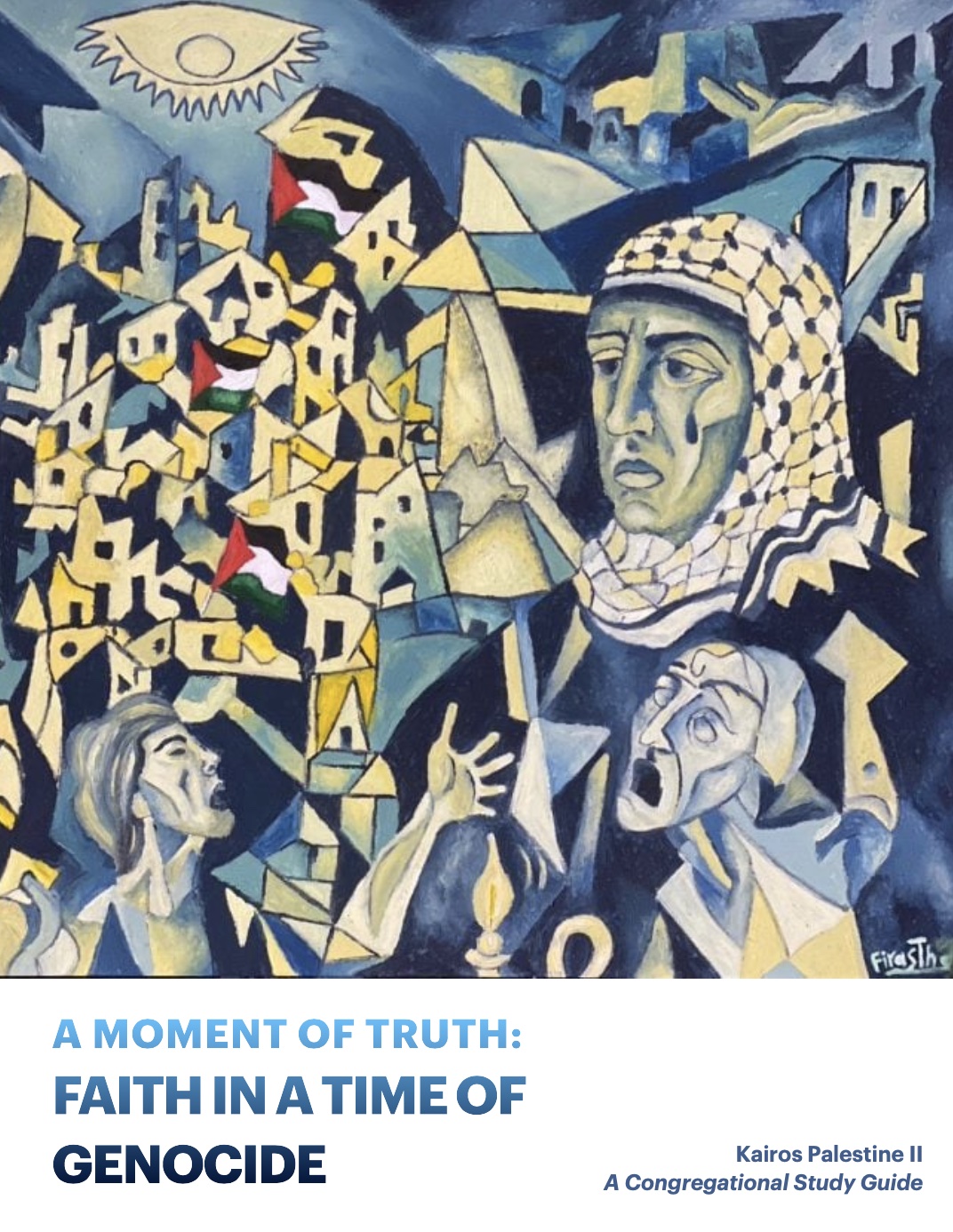
Description of Front cover:
Firas Thabet, Gaznica, 2025, acrylic on canvas, 127 x 152 cm. Courtesy of the artist.
“Every brushstroke in my paintings carries the pain of a nation.” Firas Thabet’s work appeared in the “Gaza Biennale” in an exhibition entitled From Gaza to the World, which opened on September 11, 2025 in Brooklyn, NY. Most of the 25 artists remain in Gaza, and do their work amid the rubble of the ruins which Israel has reduced Gaza to. Thabet’s Gaznica, like Picasso’s Guernica, shows devastation and despair and illustrates that in a time of war and genocide, art is not a luxury but an essential record of life as well as death.
###
Contact:
Rev. Ron Shive
The Palestine Justice Network of the Presbyterian Church (U.S.A.), United Methodists for Kairos Response, and FOSNA
[email protected]
Disclaimer: The views and opinions expressed in this article are those of the authors and do not necessarily reflect the official policy or position of RNS or Religion News Foundation.