


Catholic rally celebrating nation's founding offers a vision of America's future


(RNS) — There’s Christian nationalism, and then there’s Catholic Christian nationalism. Perhaps no event has fully captured the latter until this past weekend, when more than 700 people gathered in La Crosse, Wisconsin, to celebrate the American founding — reinterpreted through a distinctly Catholic lens. The Virgin Mary, the Constitution, saints, patriots and right-wing political activists all occupied the same crowded platform, one where sexual and reproductive issues took center stage.
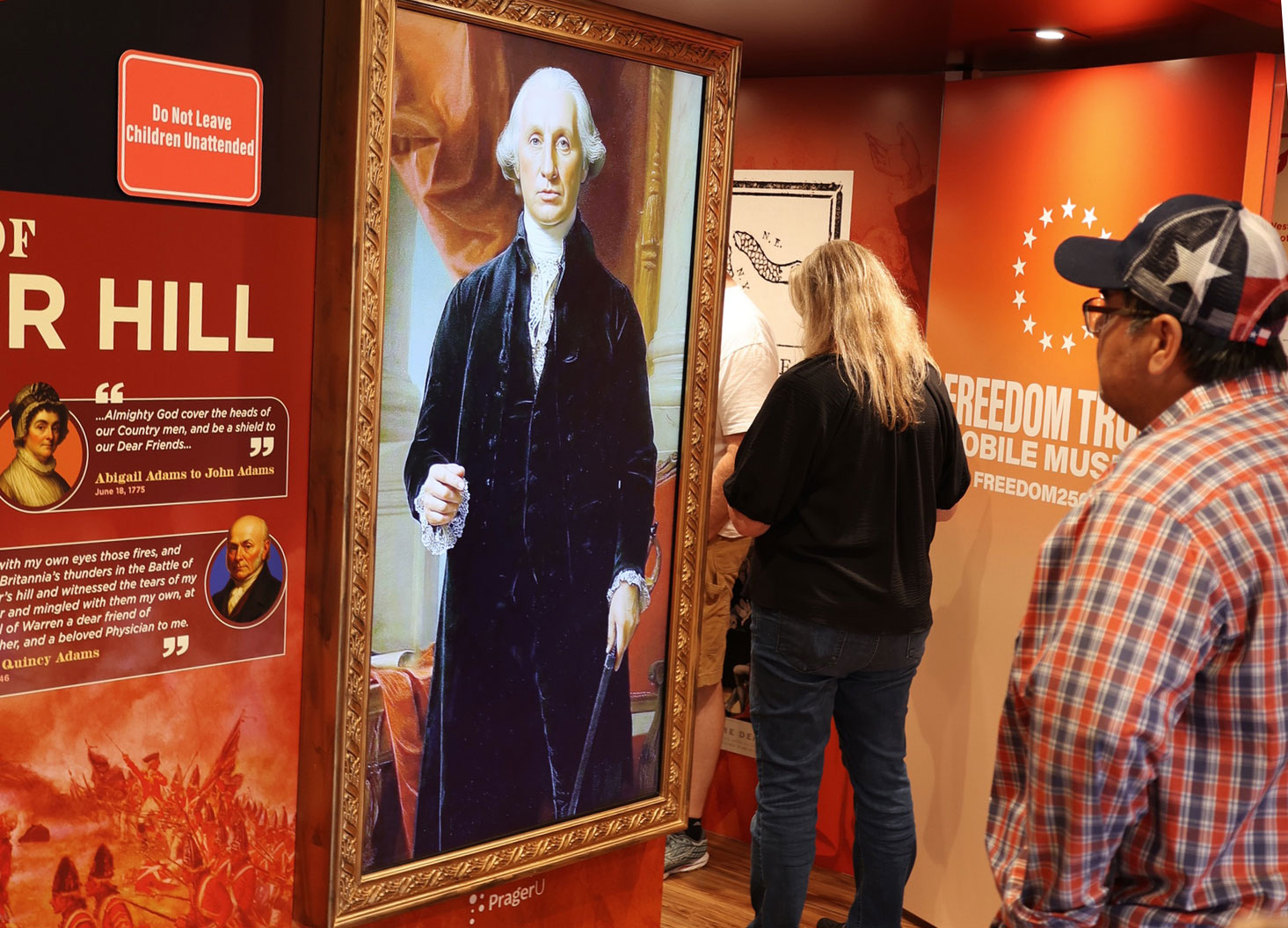
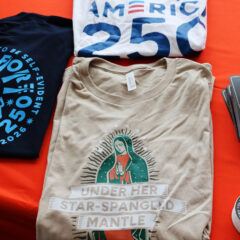
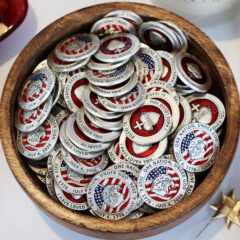
Outside the arena, one of PragerU’s six traveling Freedom Trucks invited visitors, some wearing camouflage MAGA hats, to step inside and hear AI-generated Founding Fathers narrate a providential account of American history. Inside, attendees circulated around a large exhibit on the Shroud of Turin (venerated as the burial cloth of Jesus), tables selling Catholic books and devotional items and an organization sharing the story of the former “abortion king” Dr. Bernard Nathanson, who later converted to Catholicism and spoke out against abortion.
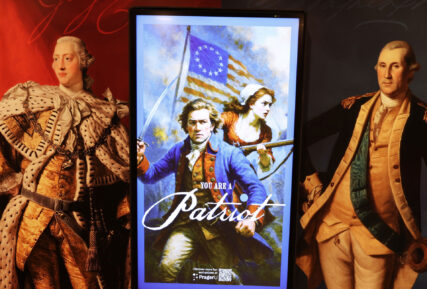
A traveling museum housed in the “Freedom Truck” included an exhibit on early American leaders like George Washington in a presentation on American Freedom through the Catholic lens. Photo courtesy of Martyn Smith
The event sought to place contemporary conservative politics inside a sacred Catholic narrative stretching from the Virgin Mary and the saints to the Founding Fathers and the present day. In that story, modern political conflicts emerge not merely as policy disputes but as chapters in a sweeping narrative struggle over the nation’s moral and spiritual future.
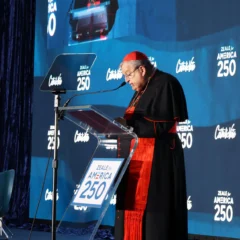
Meanwhile, issues often emphasized in Catholic social teaching that are emerging as major concerns of Pope Leo XIV — including immigration, poverty and war — received no attention from speakers, vendors or clergy such as Cardinal Raymond Leo Burke. Burke, who oversees the La Crosse Shrine of Our Lady of Guadalupe, a major Catholic pilgrimage site, organized the Zeale for America 250 event in partnership with CatholicVote.
What emerged over the course of the day was something more ambitious than a political rally and more overtly partisan than a religious gathering. Master of ceremonies Steve Cortes, a senior political adviser at CatholicVote, described himself as a Trump operative and called for the support of Republican Wisconsin gubernatorial candidate Tom Tiffany. A video greeting from Brian Burch, founder of CatholicVote and now President Donald Trump’s ambassador to the Holy See, drew enthusiastic applause.
As a historian of American Catholicism and frequent writer on church issues and American politics, I was struck most about Zeale for America not by its political conservatism, but its effort to place contemporary political concerns within a distinctly Catholic sacred political narrative. Throughout the day, speakers returned to a clear theme: America’s story is inseparable from Christianity and, more specifically, from Catholicism.
CatholicVote President Kelsey Reinhardt argued that Catholic influence is woven into the nation’s very geography, pointing to place names such as St. Louis and Sacramento and describing the United States as fundamentally shaped by Catholic history.
“This is a Catholic country,” she told the audience.
Reinhardt framed the nation’s story through a series of Catholic historical touchstones and urged attendees to see themselves as participants in a continuing story of national renewal, repeatedly invoking the idea of “American saints” and blending the “sacredness” of the Founding Fathers with canonized American saints like St. Elizabeth Ann Seton and St. Kateri Tekakwitha.
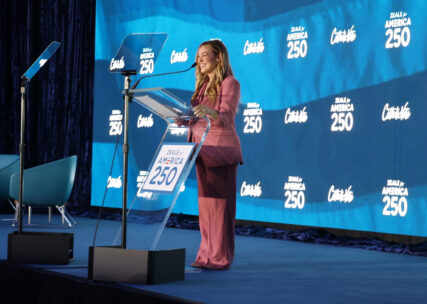
Catholic influencer Isabel Brown speaks during the event rally. Photo courtesy of Martyn Smith
Conservative influencer Isabel Brown offered a similar narrative, connecting the founding of the United States to Christian salvation history itself. Brown began not with the Declaration of Independence but with the Virgin Mary. Mary’s acceptance of God’s call, she argued, set into motion the events that ultimately led to the development of Christian civilization and eventually to Philadelphia in 1776.
“The American story and the story of the church are deeply intertwined,” Brown said.
She described the Declaration of Independence as rooted in a Christian understanding of the human person and argued that the nation’s future depended on strong families, religious faith and moral virtue. At one point she mocked people of her generation who had “37 pronouns” and “rainbow hair,” drawing laughter from the crowd. She then said she hoped that her talk reassured the audience about the future of her generation. Brown also spoke extensively about motherhood and family life, describing the family as the institution that precedes the state and forms citizens capable of sustaining a free society.
Conservative Catholic podcaster and Daily Wire show host Michael Knowles, the keynote speaker, admitted, unlike Reinhardt, that some of the Founding Fathers had been quite anti-Catholic. But Knowles argued that the American Revolution was unique because it sought to preserve inherited traditions rather than destroy them. He contrasted the American founding with anti-clerical revolutions in Europe and suggested that America’s political principles naturally point toward Catholicism.
“The more conservative one becomes,” Knowles said, “the more one feels the pull of Rome.”
Knowles celebrated what he described as the decline of the sexual revolution, drawing some of the loudest applause of the day when he declared that support for abortion rights, same-sex marriage and transgender ideology was collapsing or “dead.”
While the ballroom speeches highlighted the movement’s intellectual framework, the vendor hall revealed its culture.
Sophia Institute Press promoted Catholic and patriotic children’s books, devotional literature and its Sanctify audio app. Guadalupe Coffee sold Catholic-themed coffee products. A clothing line called XX XY offered sports apparel dedicated to “keeping men out of women’s sports.” Another booth promoted SMOL, short for “Six Months or Less,” an app inspired by a hospice physician’s work with dying patients and the concept of Memento Mori, meant to spur reflection on one’s mortality.
The marketplace suggested that Catholic conservatism increasingly functions not only as a political identity but as a broader cultural ecosystem encompassing media, publishing, education, consumer products and family life.
Kris Quillin, who has managed the Flores Maria gift shop at Burke’s Guadalupe shrine for 16 years, said customer interests have shifted in recent years toward Marian gardens, homeschooling materials and modest clothing for women. Since the pandemic, she said, many visitors have become interested in integrating Catholic devotion into everyday life through their homes, clothing and family practices.
Attendees often echoed the themes they heard from the stage.
Gabriel and Jayci Polcyn, who traveled two and a half hours from the small town of Poy Sippi, Wisconsin, to attend the rally, said America had been founded on God’s laws and needed to return to them. They spoke about government overreach, cultural decline and the importance of faith. They were not Catholic, they said, though they “had no problem with it” but had come because they were fans of Michael Knowles.
One Catholic attendee, who traveled from Tulsa, Oklahoma, after hearing about the event through CatholicVote’s popular “Loopcast” podcast, praised Trump for “bringing virtue back to the country.” Asked about criticism of Trump’s personal behavior, he responded that Trump was “very virtuous” and “a great family man” and that critics simply disliked his blunt style.
In Zeale 250’s telling, these themes are all part of a singular drama about American political and religious identity, one in which might makes right and the marginalized ought to stay in the shadows.
That vision represents one possible future for American Catholicism, but it is not the only one. The Catholic tradition also contains deep commitments to the poor, migrants, workers, peacemaking and social justice. Those themes, which have been brought to the forefront by both Pope Francis and Pope Leo XIV, were absent at the rally. This was by design.
Quillin, the gift shop manager, confirmed to me that Burke’s shrine sells no posters, medals, books or other items related to Pope Francis. When asked why, she said, “We’re just not interested.”
What emerged at the Zeale for America 250 rally was a version of Catholic public life focused on perceived cultural decline and the recovery of a lost Christian America. What was missing was any sense of humility about the nation or the pursuit of political power. As the U.S. approaches its 250th anniversary, one of the most important questions facing American believers, both Catholic and non-Catholic, may be which of these competing visions will prove most compelling.
(Karen E. Park is a writer and historian of American Christianity whose work focuses on religion, politics and public life. Her writing has appeared in Religion News Service, National Catholic Reporter, Religion Dispatches and other outlets. She publishes the newsletter Ex Voto and is co-editor of “American Patroness: Marian Shrines and the Making of US Catholicism.” The views expressed in this commentary do not necessarily reflect those of Religion News Service.)