

Cardinals, cake and corndogs: Inside a complicated Vatican July 4
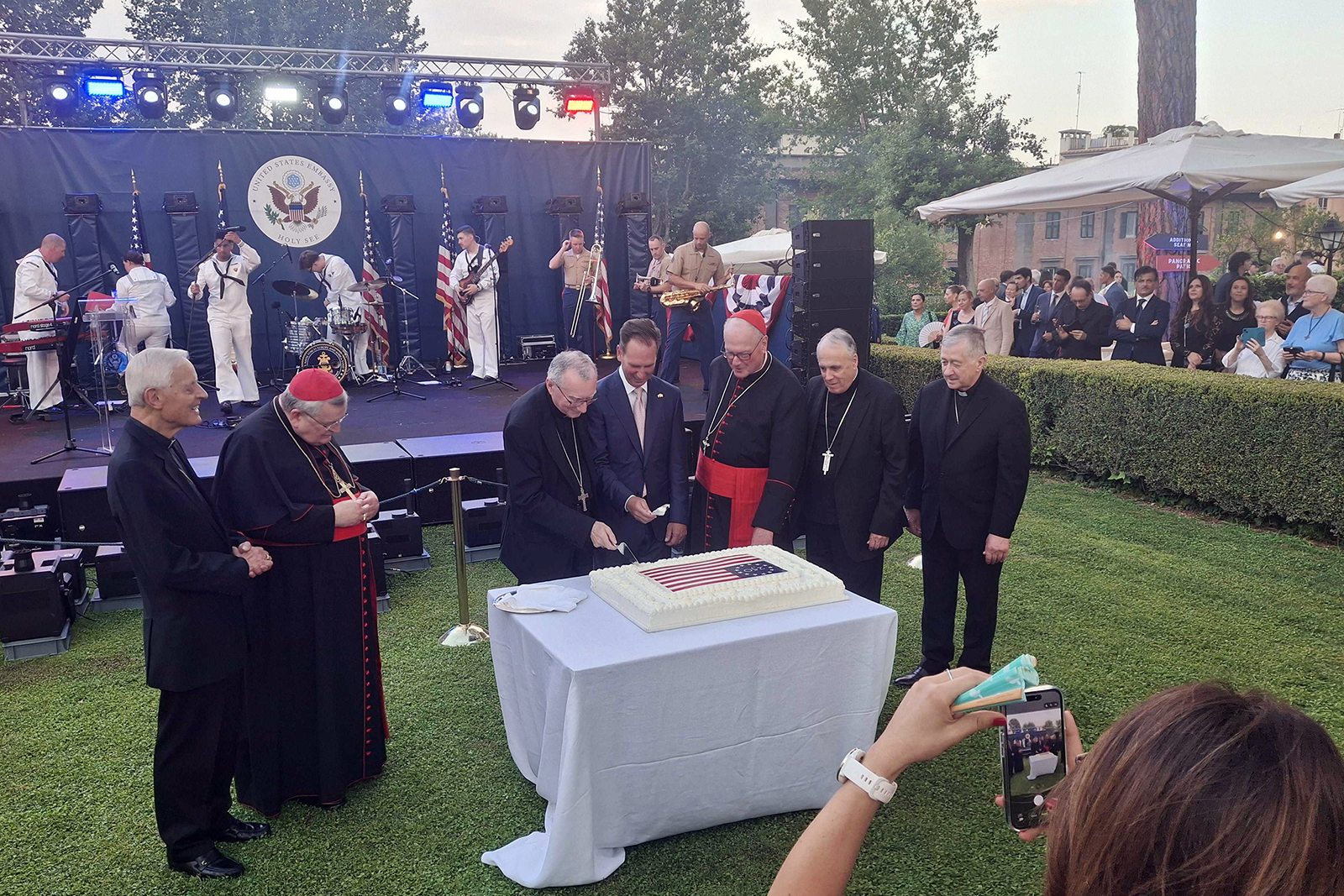


VATICAN CITY (RNS) — This year’s Independence Day party at the private residence of the United States’ ambassador to the Holy See, Brian Burch, was a brightly colored spectacle mixing the patriotic with the sacred, as cardinals lined up to cut a star-spangled cake commemorating the 250th anniversary of the U.S.
The event, which took place on June 26, happened to coincide with Pope Leo XIV’s summit of cardinals at the Vatican, allowing some of the U.S.-born prelates to enjoy a taste of home while in Rome. Cardinals who less than a year ago had helped to elect the first American pope — Cardinal Daniel DiNardo, Cardinal Donald Wuerl, Cardinal Blase Cupich and Cardinal Timothy Dolan — joined to celebrate their country’s anniversary, as American hits played in the background and the smell of corndogs filled Rome’s hot summer evening air.
Among manicured gardens complete with a photo booth, an ice cream line and a 1947 Cadillac Series 70 used by Pope Pius XII, the crowd of U.S. expats and Vatican officials offered a heartwarming snapshot of the relationship between the Holy See and the global superpower. But beneath the bunting and patriotic nostalgia, the celebration belied a more complicated truth: The first American pope may have brought Washington and Rome closer symbolically, but not necessarily politically.
U.S. President Donald Trump appointed Brian Burch as ambassador to the Holy See in 2025. The co-founder and former president of CatholicVote had been instrumental in gathering the Catholic votes that helped President Trump win his second term. Burch, the father of nine children, is a recurring fixture of U.S. and Vatican events in Rome.
“For generations, the United States and the Holy See have maintained an abiding friendship founded not on power or economic advantage, but on our shared commitment to the deepest longings of humanity: faith and human dignity, the plight of the poor and vulnerable, family and children, education, justice, and yes, peace,” Burch said in his speech.
The term “peace” has become a point of tension between the U.S. and the Holy See, as President Trump in a Truth Social post in April criticized the pope’s appeals for peace as a sign that he is “weak on crime and terrible for foreign policy.” Leo, meanwhile, on multiple occasions urged the U.S. to seek peace and dialogue instead of war in Iran, calling it an unjust war.
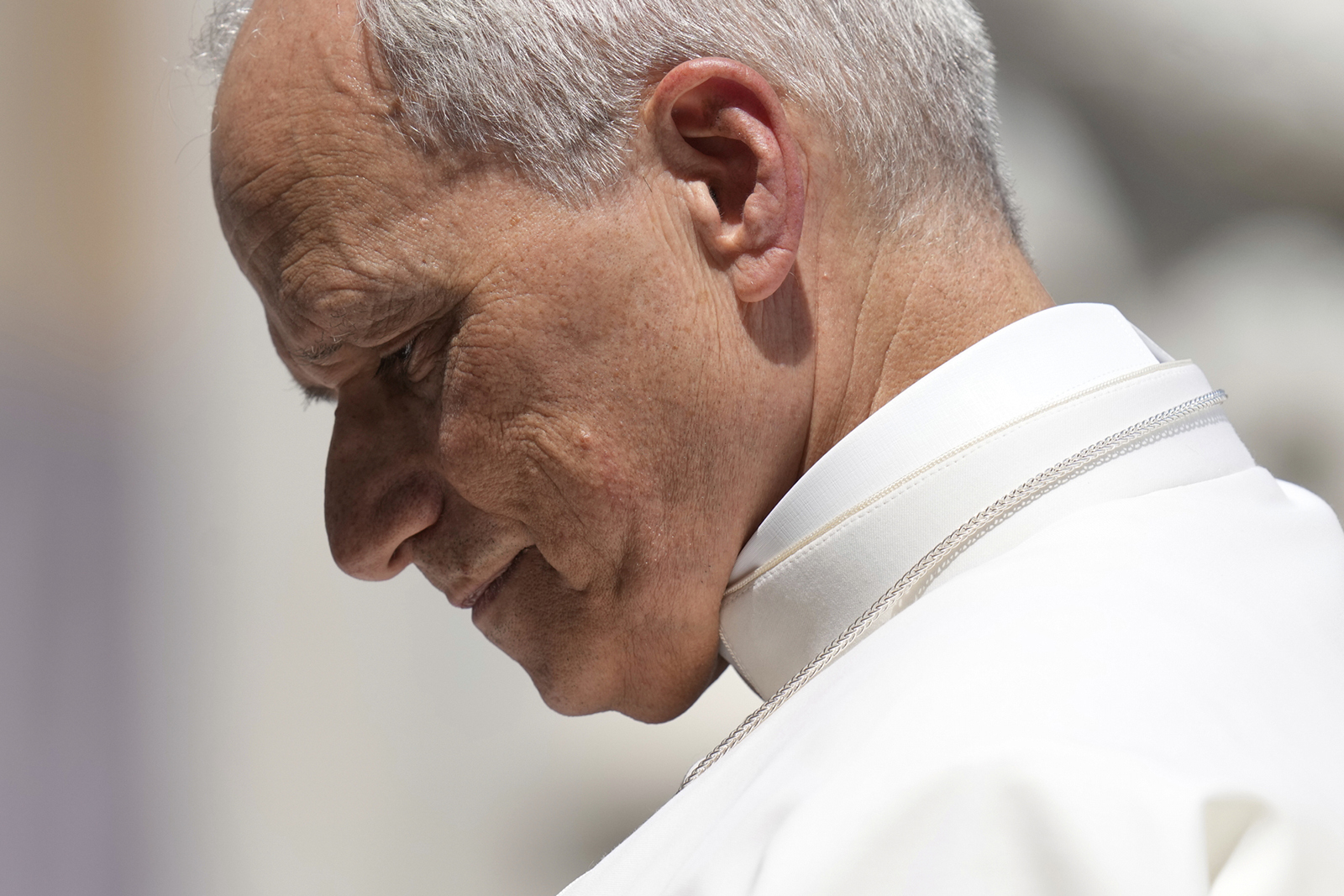
Pope Leo XIV leaves after his weekly general audience in St. Peter’s Square at the Vatican, June 4, 2025. (AP Photo/Gregorio Borgia)
Marking the 250th anniversary of the United States, Leo doubled down with a series of pointed messages about the country’s founding ideals. Speaking “as a son of this great country,” the first U.S.-born pope urged Americans to recommit to the protection of human life, the welcoming of immigrants and the pursuit of peace through interfaith cooperation.
In a letter to the United States on July 4, Leo said defending human life includes welcoming, protecting and assisting immigrants, whose hopes and sacrifices have helped shape the country from its beginning.
Despite tensions, Burch’s speech grasped at the potential for unity between the U.S. and the Catholic Church. The relationship between the U.S. and the Holy See “reminds us that diplomacy can and must be more than the mere management of interests; it can be an expression of moral purpose,” he said.
But speaking after him, Cardinal Pietro Parolin, the second-highest ranking official at the Vatican as secretary of state, noted that despite many points of convergence, the Vatican has a few pointed messages for the U.S.
He reminded those present that Leo’s first remarks as pope were an appeal for peace. “He has had cause to repeat that call many times because of the numerous troubled parts of our world afflicted by conflict and war,” Parolin said, underscoring that commitment to peace is a “pledge” for the Holy See.
When he stepped down from the stage, RNS approached Parolin to ask if he believed the U.S. and the Vatican still share a commitment to peace. “For our part, as the church, peace is both a task and a hope,” he said. “May that hope become a task.”
This ambivalent dynamic is nothing new in the history of U.S.-Vatican relations. For much of its history, Protestant America looked at papal Rome with suspicion, while the Vatican viewed the rising Protestant power across the Atlantic with caution. It was only after World War I, as Europe emerged devastated and financially weakened, that Rome began to grasp the potential of American Catholic power.
In 1922, short of cash after the death of Benedict XV, the Vatican turned to the American church for emergency funds to help cover the conclave that elected Pius XI. More than $210,000 was sent from Washington, a moment Italian journalist Massimo Franco described as a turning point in Rome’s recognition of U.S. Catholicism’s financial weight, in his book “Popes, Dollars and Wars.”
Over the decades, figures such as Cardinal Francis Spellman and wealthy American donors helped draw the Vatican closer to the booming Atlantic superpower, linking U.S. Catholic money, diplomacy and influence to the Holy See’s global ambitions.
Those ties reached a high point during the Cold War, when President Ronald Reagan and St. John Paul II, both survivors of assassinations and feeling called to a common purpose, forged a close relationship and were widely credited with helping bring down Communism and ending the Cold War. It was during this time that the U.S. and the Holy See established formal diplomatic relations.
Even at its height, U.S.-Vatican relations have never been linear. John Paul II strongly condemned the Iraq war under President George W. Bush, while the Vatican backed U.S. bishops in their clashes with President Barack Obama’s administration over religious liberty, abortion and conscience protections.
Pope Francis did not hide his frustration with conservative fringes in the United States, stating in 2019 that it was “an honor” to be attacked by Americans after receiving a book about conservative opposition to his papacy. Relations chilled under the Argentine pope, and U.S. donations to the Vatican fell sharply, battered by scandal, pandemic disruptions and donor mistrust, even as the United States remained the fund’s single largest national source of support.
What an American pope means for the relations between the U.S. and the Holy See is a still unfolding question. Leo has made it clear that he won’t back down on issues he believes are central to the Gospel. President Trump, despite surrounding himself with prominent Catholics, has shown little interest in treating the Holy See as a moral partner on the global stage.
Meanwhile, Leo refused an invitation, personally delivered by Vice President JD Vance, to visit the U.S. on its anniversary this year.
The Vatican may be playing a longer game, waiting for what happens after President Trump. As Parolin said in his speech, among the “ancient ruins and venerable buildings” of the millennial history of Rome, “250 years can seem like the blinking of an eye.”
But after issuing pointed reminders about the principles Leo said should guide the United States — the protection of human dignity, religious freedom and welcome for immigrants — the first American pope became the first pontiff to spend the Fourth of July with the U.S. ambassador to the Holy See and his family.
They “discussed President Trump’s bold leadership and American efforts to pursue peace, religious freedom, and the need for moral clarity and courage around the world,” according to a post by the U.S. Embassy to the Holy See on X.
Leo, known for his sweet tooth, was gifted with an apple pie.