


The conservative Christian women turning moral urgency into political power
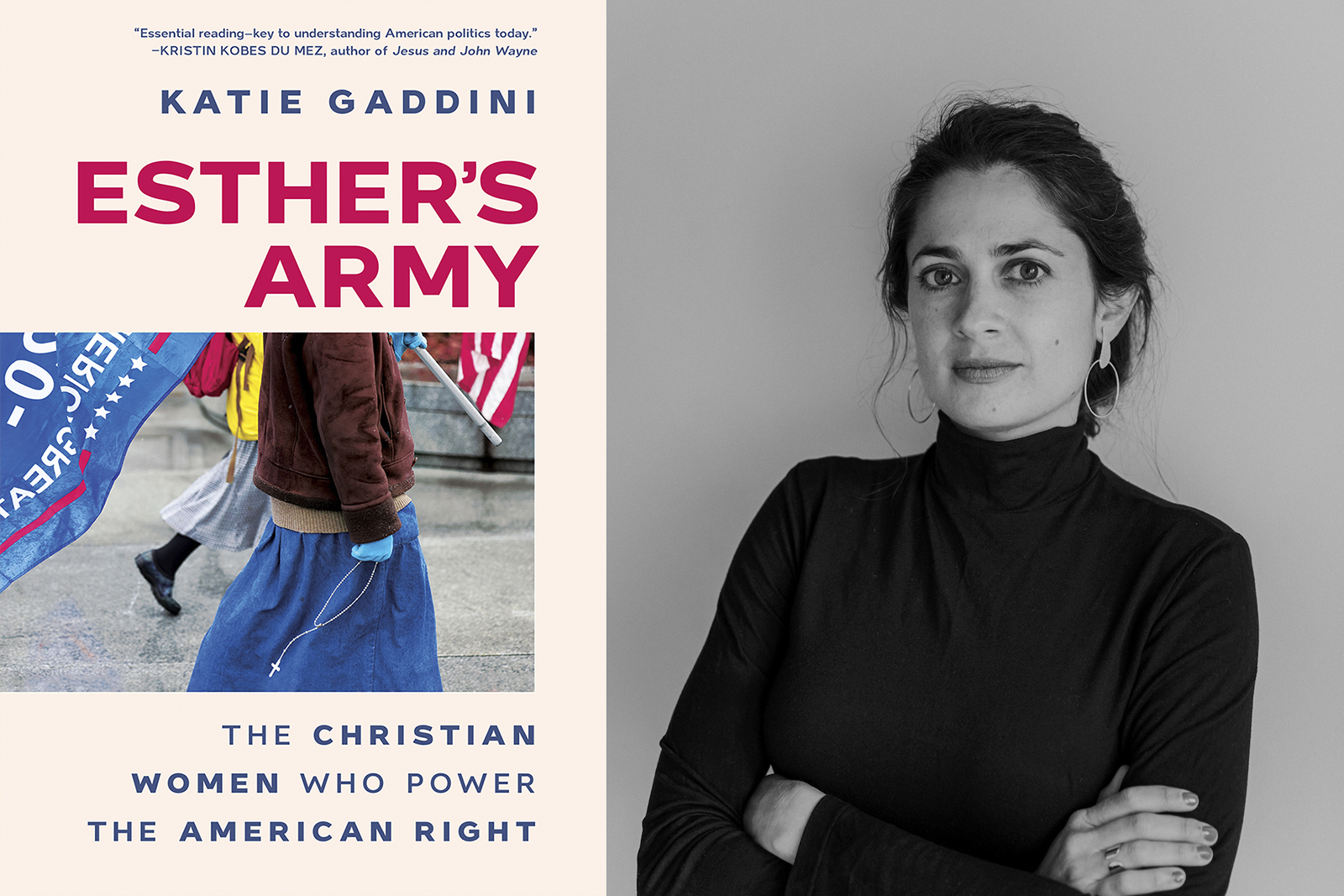


(RNS) — “If I perish, I perish.”
That’s the chant sociologist Katie Gaddini heard echoing from the National Mall in October 2024, weeks before President Donald Trump was elected a second time.
Raised an evangelical, Gaddini knew the reference — Esther 4:16, a Bible passage in which the Jewish Queen Esther prepares to risk her life to save her people. But to the thousands of conservative Christian women gathered for a prayer rally that fall day, the declaration had taken on a different meaning.
“In the retelling, they were Esther, they were the warrior queens,” Gaddini explained to RNS. “God had called them to save the nation from destruction — that being the left, or what they call woke indoctrination.”
Gaddini said the chant was indicative of how conservative women viewed the stakes of the 2024 election. To them, the nation’s morality was on the line.
In her latest book, “Esther’s Army: The Christian Women Who Power the American Right,” Gaddini distills 10 years of ethnographic research on conservative Christian women into six chapters, each exploring an archetype: college students, “Mama Bears,” political powerhouses, social media influencers, Black conservatives and white suburbanites. She spoke to RNS about how these women are re-defining feminism and reshaping America’s political and religious landscape. This interview has been edited for length and clarity.
How did 2020 fuel a political awakening among conservative Christian women?
At the time, I thought it was a temporary awakening. Women were telling me that they previously hadn’t cared about politics. During the pandemic, they felt they lost trust in institutions, including the mainstream media and health authorities. They felt under attack when there were closures in schools and churches, mask mandates and vaccine mandates. All of that coalesced to activate them politically. I was curious to see what would happen in 2022 during the midterms, and especially the 2024 election. That engagement stuck four years after the onset of the COVID-19 pandemic.
What role did faith play in this awakening?
There’s a long-standing narrative in American evangelicalism of white evangelicals being under attack. That persecution narrative has really bolstered the evangelical right, and it was energized within the pandemic. ‘We’re under attack again. They’re closing our church. We need to fight back.’ Bringing it into religious language of martyrdom and persecution. And when there was so much instability with regulations and safety precautions and protocols, because it was a novel virus that really shook the ground underneath people’s feet, evangelicals turned to what was certain for them. That included ideas about their faith that they wanted to bring into the public sphere. That seemed like the only sure thing in this really unstable moment.
How do conservative Christian women think about feminism? What elements of feminism do they reject, and which do they borrow?
The relationship with feminism is complex and nuanced. They reject some planks of feminism, and they absorb and articulate other forms. The U.S. Supreme Court decision today on upholding bans on transgender athletes is a perfect example. Young right-wing Christian women were especially involved in activism against trans athletes’ participation in sports on the grounds of liberal feminist mantras about women’s empowerment, breaking glass ceilings and girls belonging in sports. That was eye-opening, that they are borrowing and articulating feminist rhetoric that their foremothers absolutely despised to meet their political aims.
At the same time, they are against reproductive rights, including, in some cases, birth control. They are usually against any sort of sexual diversity and sexual activity outside of marriage. At the same time, some of the women I met have incorrect notions of feminism. They think it’s about hating or opposing men. They would be against that, though I would argue that hating men is not a form of feminism.
What are some of the core beliefs uniting conservative Christian women?
Some women even called 2024 the ‘election of kids,’ and by that they mean opposing trans rights, as well as gender and sexual diversity. Immigration was a major concern, and so was the economy. Different groups understood those issues in different ways, but those were consistent issues.
Where are the fault lines? What are these women disagreeing about?
They disagree on the war in Iran and on foreign policy, including support for Israel and how far that support for Israel extends. There were already some fault lines with support for Israel before (the U.S.) partnered with them to bomb Iran, and that has really deepened disagreements over the successor to Donald Trump and where the movement goes from here. The MAHA (Make America Healthy Again) movement is experiencing some fault lines. Several MAHA leaders are very displeased with the way that Trump has handled regulations when it comes to pesticides. And they disagree about Epstein.
Have these women shifted on how they view Trump?
On the one hand, I think that the modern MAGA movement has outgrown Trump in a lot of ways. It is a big umbrella that seeks to outlive him, or at least to have political threads carried into the future once he’s no longer president. I don’t know how much his gaffs, such as depicting himself online as Jesus, threaten the movement. On the other hand, I’m really curious to see how deep these other fault lines are going to run. Historically, the movement tends to coalesce, regroup and continue stronger. So, I’m not holding my breath. I think we must get past the midterms to see how these fault lines are going to continue.
How do these conservative Christian women see the left?
They feel that the left is condescending toward them and is hateful. They say that the tolerance that the left preaches when it comes to racial and gender and sexual minorities excludes evangelicals, especially those who support Trump. Depending on where the person lives, they feel that the left has become an elitist party.
What do you hope folks on the left will take away from reading your book about these women?
I hope they let go of some of these very sexist and damaging stereotypes about right-wing women being brainwashed and being unintelligent or uneducated. Whether you’re on the left or the right, these are very sexist perspectives to hold about any woman. I also hope people examine the way they speak about Trump supporters, especially if they call themselves Christian. If the language you’re using is hateful and mean, that is fueling that movement. I don’t think our country needs more polarization right now.
Now that Trump is in power, where are you seeing conservative Christian women putting their energy?
After the overturning of Roe v. Wade, I saw energy moving much more into limiting trans rights. I think the recent Supreme Court ruling on trans women is going to bolster that pursuit even more. There are still some goals when it comes to reproductive rights that the right wants to focus on, such as ending mifepristone’s Food and Drug Administration approval.
Immigration is a big one. Trump hasn’t gone as far as he promised to go, and as far as many right-wing Christians hoped he would go, so that’s another aim. I think it’s also about preserving the movement, making sure that it is strong and stable enough to make it through the next presidential election.