


Pro-Palestinian interfaith coalition protests Christian Zionist summit
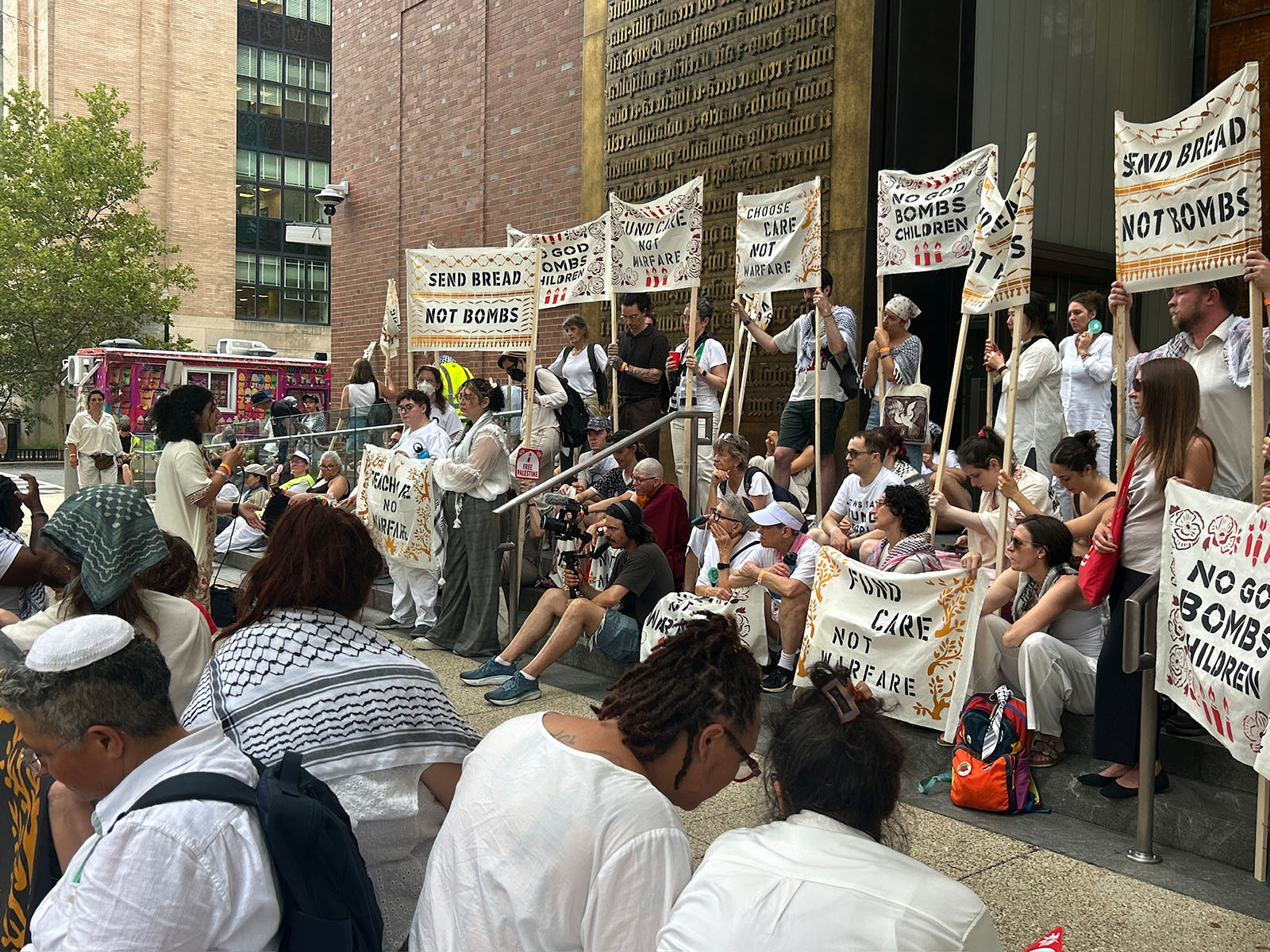


WASHINGTON (RNS) — Just two days after hundreds of members of the white nationalist group Patriot Front descended on Washington, D.C., on the Fourth of July, a diverse group of about 200 protesters sporting keffiyehs and kippahs, pushing strollers and walkers, crossed those same streets with a very different message.
Marchers from a variety of religious backgrounds walked across Capitol Hill on Monday (July 6) as part of a demonstration organized by Interfaith Action for Palestine in protest of the Christians United for Israel national summit taking place at the same time. CUFI describes itself as “the largest pro-Israel organization in the United States” and boasts a membership of 10 million people, according to its website. Interfaith Action for Palestine is a coalition of 11 Christian, Jewish, Muslim and Buddhist organizations opposed to CUFI.
Denouncing what they called American support for “genocide in Gaza,” the marchers sought to offer an alternative vision of freedom and interfaith collaboration while demanding an end to U.S. support for the Israeli military. Protesters carried painted banners with slogans like “Fund Care Not Warfare,” “Send Bread Not Bombs” and “No God Bombs Children.”
“It’s largely about helping the public to awaken to what our role is,” said Steven Sellers Lapham of Gaithersburg, Maryland, and a board member of Unitarian Universalists for Justice in the Middle East. At 70, he marched for hours to demand an end to U.S. “diplomatic cover and funds” for Israel, which he said are used to “slaughter (Palestinian) children.”

Protesters hold an unfinished banner, produced by the Buddhist Peace Fellowship, listing the names of children who have been killed in Gaza, July 6, 2026, in Washington, D.C. (RNS photo/David Katibah)
The coalition’s three-day gathering also included an interfaith worship service and in-person visits to 90% of congressional offices, according to organizers. The annual CUFI summit brings thousands of Christians and others to D.C. to lobby Congress for pro-Israel measures, such as support for the Iron Dome and counter-boycott, divestment and sanctions legislation. Previous summit speakers include former United Nations Ambassador Nikki Haley, Florida Gov. Ron DeSantis and former Vice President Mike Pence.
CUFI did not immediately respond to a request for comment on the action.
For three years now, Interfaith Action for Palestine has disrupted and protested CUFI summits.
After the Oct. 7, 2023, Hamas attacks on Israel that killed about 1,200 people, Israel’s retaliation in Gaza has killed an estimated 73,000 Palestinians, according to the Gaza Health Ministry, which doesn’t distinguish between civilian and combatant deaths. Nearly a third of the reported casualties have been children, according to a United Nations Human Rights Council investigative body.
“We are building an alternative to CUFI’s Christian supremacist, Christian-Jewish exclusive, exploitative form of interfaith work with an interfaith gathering that is built on equality, care and solidarity for all people,” said Jonathan Brenneman, who is part of the national leadership team of Christians for a Free Palestine, one of the action’s convening organizations.
This year, the group did not actively disrupt the summit — as it has in the past — as much as it aimed to provide an alternative to Christian Zionism, which the marchers described as “a theological distortion and a moral corruption,” citing Palestinian Christian theologians.
“Not all people of faith are OK with our faith and our theology being weaponized to harm God’s people,” said the Rev. Hannah Sachs, a United Church of Christ minister based in Falls Church, Virginia, who was raised supporting Christian Zionism.
Many of the Christians RNS spoke with at the march said they decided to attend to clarify what they believed was true Christian practice. “What CUFI represents, it’s not what we represent, and I believe it’s antithetical, actually, to what Christ represents,” said Bethany George of Maryland, who described herself as Catholic.
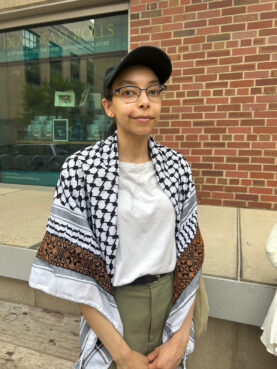
Marcher Bethany George, July 6, 2026, in Washington, D.C. (RNS photo/David Katibah)
Others were drawn by a desire to “build community” and “build witness,” they said. The Rev. Beth Johnson, an ordained Unitarian Universalist minister and board member of the Unitarian Universalist Advocacy Network of Illinois, said this was her third year making the trip from outside Chicago. “My voice is just one voice. But joined with other voices, we make a difference,” she said.
Many opponents to Christian Zionism argue the ideology is fixated on the return of Jews to the land of ancient Israel in order to spark the second coming of Christ. Eliana Fishman of Jewish Voice for Peace DC Metro, a Palestinian solidarity group, said this worldview is “horrifying,” as it justifies violence against Palestinians and anticipates the eventual death or conversion of the global Jewish population.
“I don’t want Palestinians to die. I don’t want Jews to die. I don’t want anyone to die,” Fishman said.
While CUFI says its support for Israel is not conditional on “theological expectation,” the Christian Zionism they promote is rooted in the Bible. Its founder, televangelist and pastor John Hagee, often cites Genesis 12:1-3 when describing why Christians should support Israel, referencing the Abrahamic covenant in which Yahweh promises to “bless those who bless” Abraham and “curse those who curse” him and his descendants. For Hagee and other Christian Zionists, this promise still rings true for America’s policy relationship to the modern nation-state of Israel.
Brenneman described Christian Zionism as being embedded in the highest levels of the U.S. government today. U.S. Ambassador to Israel Mike Huckabee, for example, has suggested Israel has a biblical right to the entire land between the Nile and the Euphrates Rivers. The prophetic imagination of Christian Zionism came under particular scrutiny in March, after reports surfaced that military leaders had informed service members the war in Iran would hasten Armageddon, though those claims have yet to be verified.
While the march and lobbying efforts centered on solidarity with Palestinians and against the devastation of Gaza, it made connections to U.S. policy. “Christian Zionism is the foreign policy of white Christian nationalism,” Brenneman said.
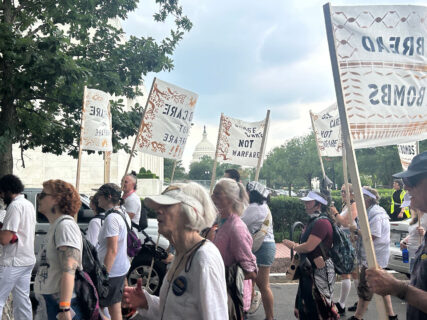
Protesters of CUFI march past the U.S. Capitol on July 6, 2026, in Washington, D.C. (RNS photo/David Katibah)
Another goal of the march, according to organizers, was to draw clearer connections across intersectional struggles. Between verses predicting “Palestine will be free,” marchers also demanded that “ICE get off our streets.”
The march stopped at three locations across Capitol Hill, which organizers said represent the intertwined matrix of Christian Zionism and Christian nationalism: the Heritage Foundation, a right-wing think tank; Christ Church Washington, D.C., the church of Secretary of Defense Pete Hegseth; and the Museum of the Bible.
Claire Abilmona, a Frederick County, Maryland, resident who described herself as an abolitionist and practitioner of African American spirituality, attended the march to clarify her opposition to the American carceral system as well as the “genocides happening around the world.” She brought her 6-year-old son and 5-year-old niece to the march to help them “understand the world they are growing up in.”
For a few Palestinian Christians present, the show of interfaith solidarity was especially important. Lydia El-Sayegh, a D.C. resident whose family is from Gaza and who grew up in the Baptist tradition in the U.S., said she experienced grief at her church’s silence on the suffering of her family and other Palestinians in Gaza. This event was different, she said.
“The people here today definitely show me how close Christ is and how he experiences our pain in solidarity with us,” she said. “In many ways, it’s very beautiful.”
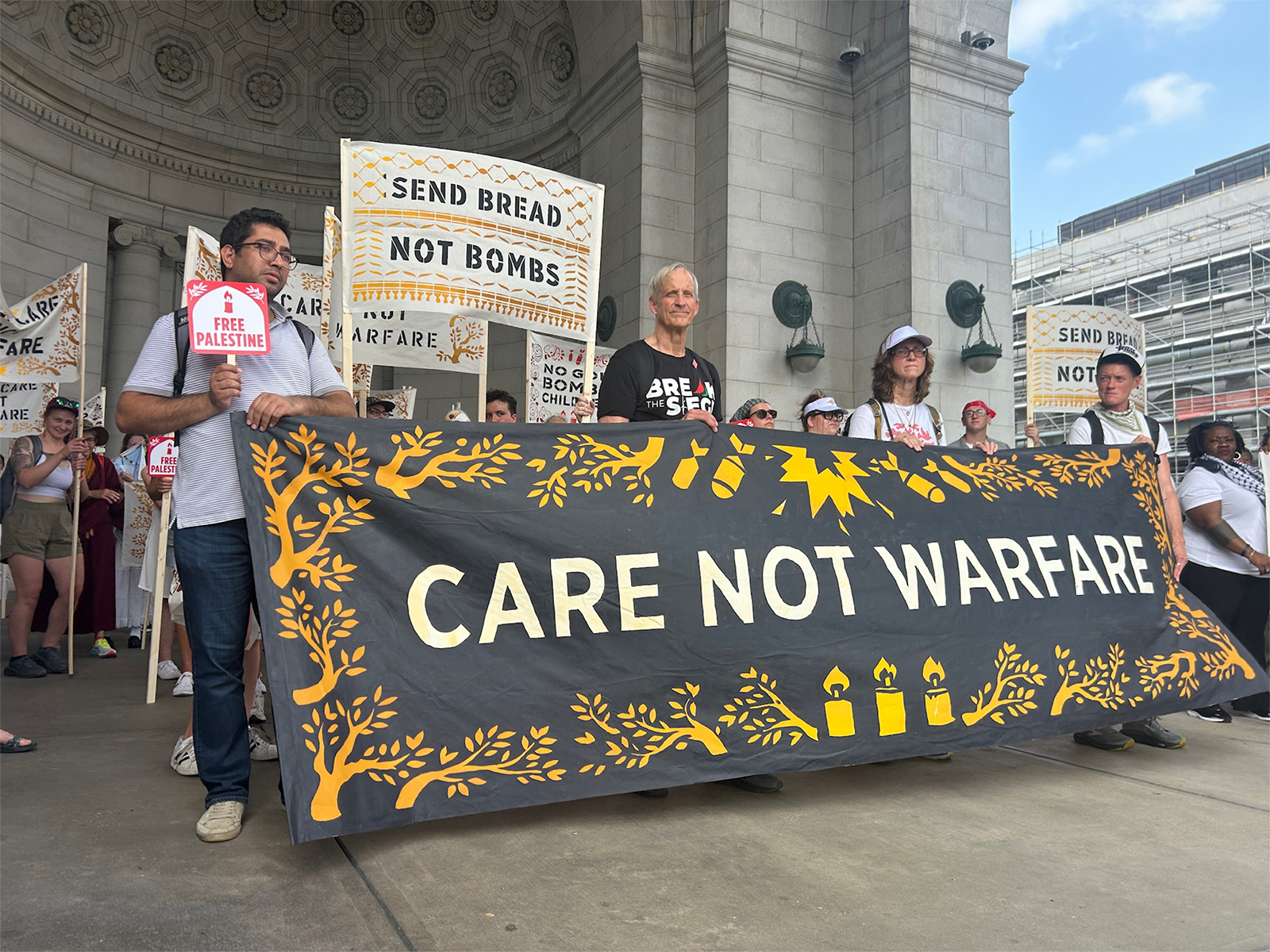
Activists demonstrate at Union Station, Monday, July 6, 2026, in Washington, D.C. (RNS photo/David Katibah)