

'It really did take me back to after 9/11': How Islamophobia roiled a Texas election


FRISCO, Texas (RNS) — When Aneela Charania approached Frisco’s city council office on May 20, she said she immediately felt fear creep in. Charania, who is Muslim, had come to a public comment meeting about construction projects for a mosque and two Hindu temples.
In the parking lot, Charania, who wears a hijab, texted a neighbor to ask if she could be escorted from her car to the room, as she feared being targeted.
At the meeting, she says she sat through anti-Muslim, anti-Hindu and anti-immigrant comments as speakers debated whether her community belonged in the city at all.
“It really did take me back to after 9/11, to be honest,” said Charania, who moved to the Dallas suburb in February. “I’ve never experienced that level of hatred towards our community.”
The city council meeting was one of many that turned into a public referendum on Frisco’s diverse communities amid a mayoral runoff election pitting Mark Hill, a Republican business attorney, against fellow Republican Rod Vilhauer, a retired construction business owner. Vilhauer campaigned on anti-Muslim, anti-South Asian immigrant rhetoric, while Hill promised to “unite our city and build a future rooted in connection, opportunity, and pride.”
Last week (July 7), Hill was sworn in as Frisco’s new mayor after winning 58% of the vote in the June 13 election.
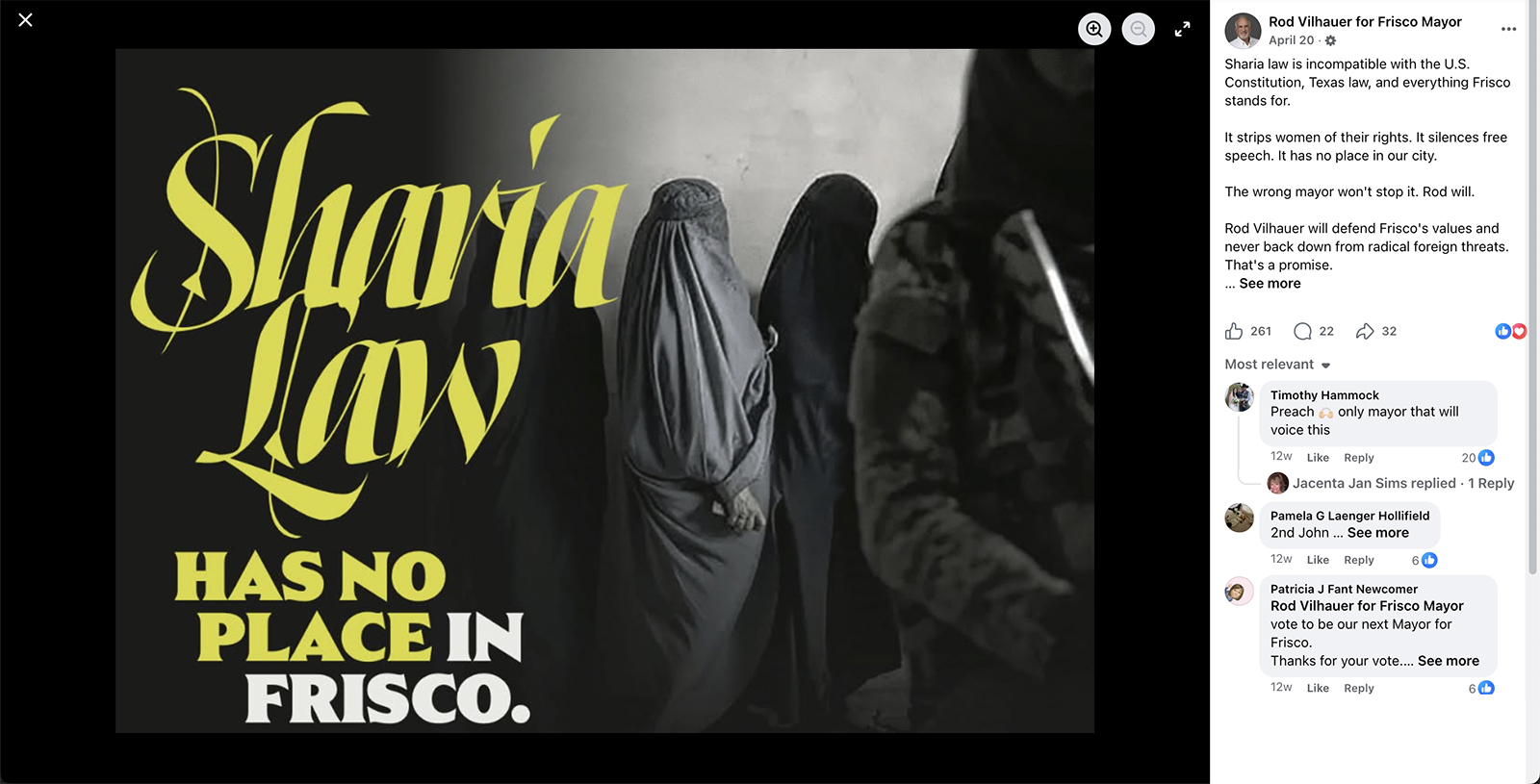
A post by Frisco mayoral candidate Rod Vilhauer on social media. (Screen grab)
But the race, marked by vitriolic city council meetings, clashes on Facebook groups and rallies drawing conservative activists from across the country, divided the city of 245,000. And as state Republican leaders have ramped up their Islamophobic, anti-Shariah law rhetoric ahead of the 2026 midterm elections, the race has been seen as a bellwether of what happens when campaigns stoke anti-immigrant, anti-Muslim sentiment.
For decades, Republicans have dominated political life in Frisco, located 25 miles north of Dallas, and the city has been diverse, at 34% Asian, 46% white, 10% Black and 10% Hispanic, according to the city’s website. In recent years, Frisco has registered anti-Muslim incidents during local elections. In 2020, mailers targeted Sadaf Haq, a Muslim running for city council, claiming she supported radical Islam and drawing suspicion over her support of Rep. Ilhan Omar, D-Minn., one of four Muslims serving in Congress. Haq lost the election.
Still, residents said, the rhetoric that spilled out online and in public in this year’s mayoral election dwarfed anything they had seen before.
In late March, Vilhauer appeared on “Nick’s Right,” a conservative podcast about Texas politics. In an episode entitled “Can Frisco, Texas Be Saved?” Vilhauer detailed his views on Frisco’s Muslim and Hindu populations.
“No matter how kind or how sweet they are, they don’t want to assimilate,” Vilhauer said of the city’s Muslim population. “Anyone who governs himself by Shariah law and the Quran — I’m 100% against.”
Asked about the city’s Hindu population, Vilhauer reiterated unsubstantiated claims that the city owed the growth of its Indian-American population to a fraud scheme involving H-1B visas, an employer-sponsored visa that allows foreign nationals to work and live in the U.S.
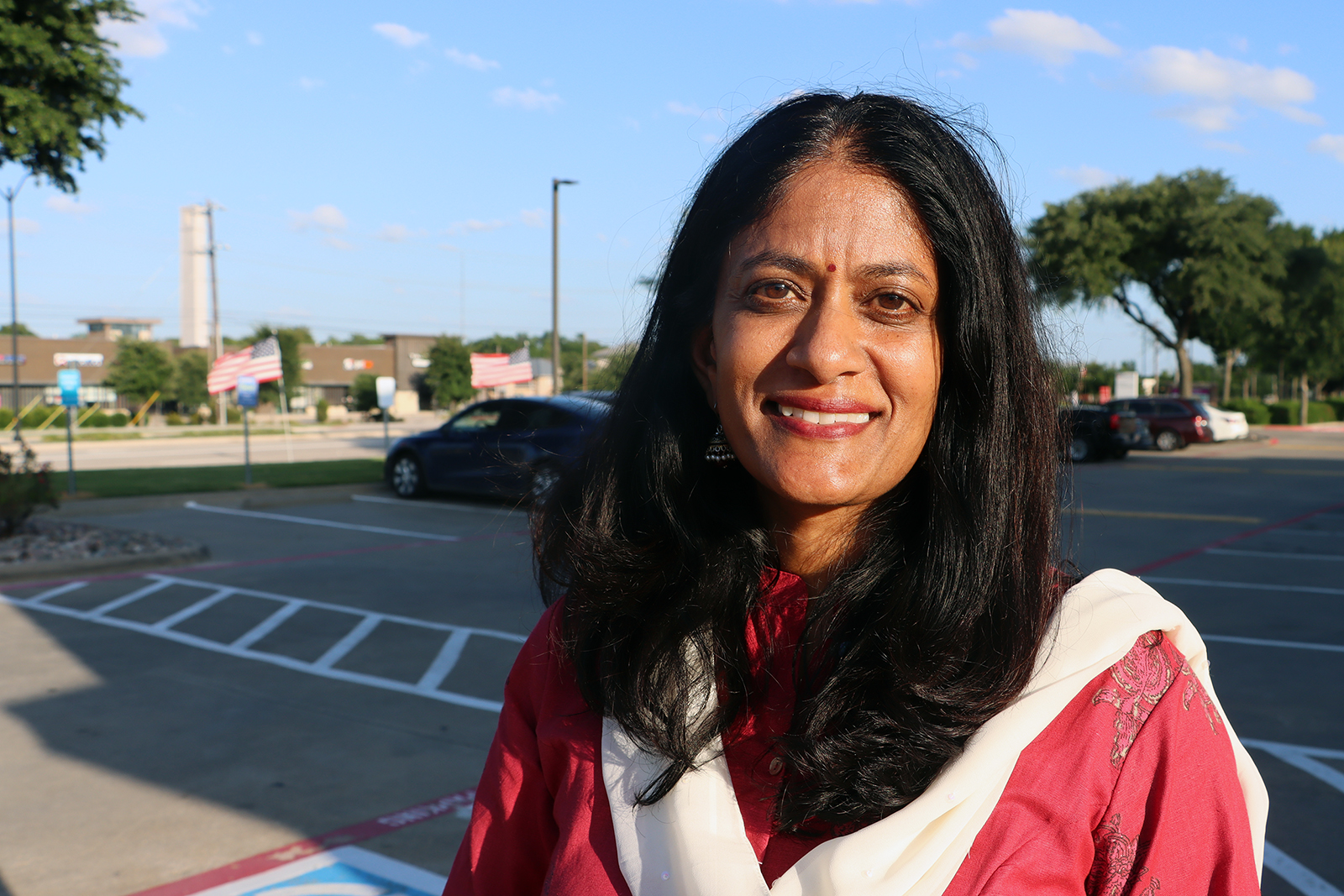
Laxmi Tummala. (RNS photo/Fiona André)
For Laxmi Tummala, a Mississippi native who moved to Frisco in 2009, Vilhauer’s remarks on the podcast cut deep.
“It’s hurtful for anybody, but for me, this is my country, like, so what does that exactly mean when you say go back to your country?” said Tummala, who is Hindu and whose parents are from India.
It's hurtful for anybody, but for me, is my country, like, so what does that exactly mean when you say go back to your country?Laxmi Tummala, who is Hindu and has lived in Frisco since 2009.
She and her family moved to Frisco soon after the opening of the Hanuman Cultural Center, a Hindu temple, in 2009. Now called the Karya Siddhi Hanuman Temple, it is one of the country’s largest Hindu temples. The temple’s opening and its inauguration in 2019 marked a milestone for Frisco’s growing Hindu community.
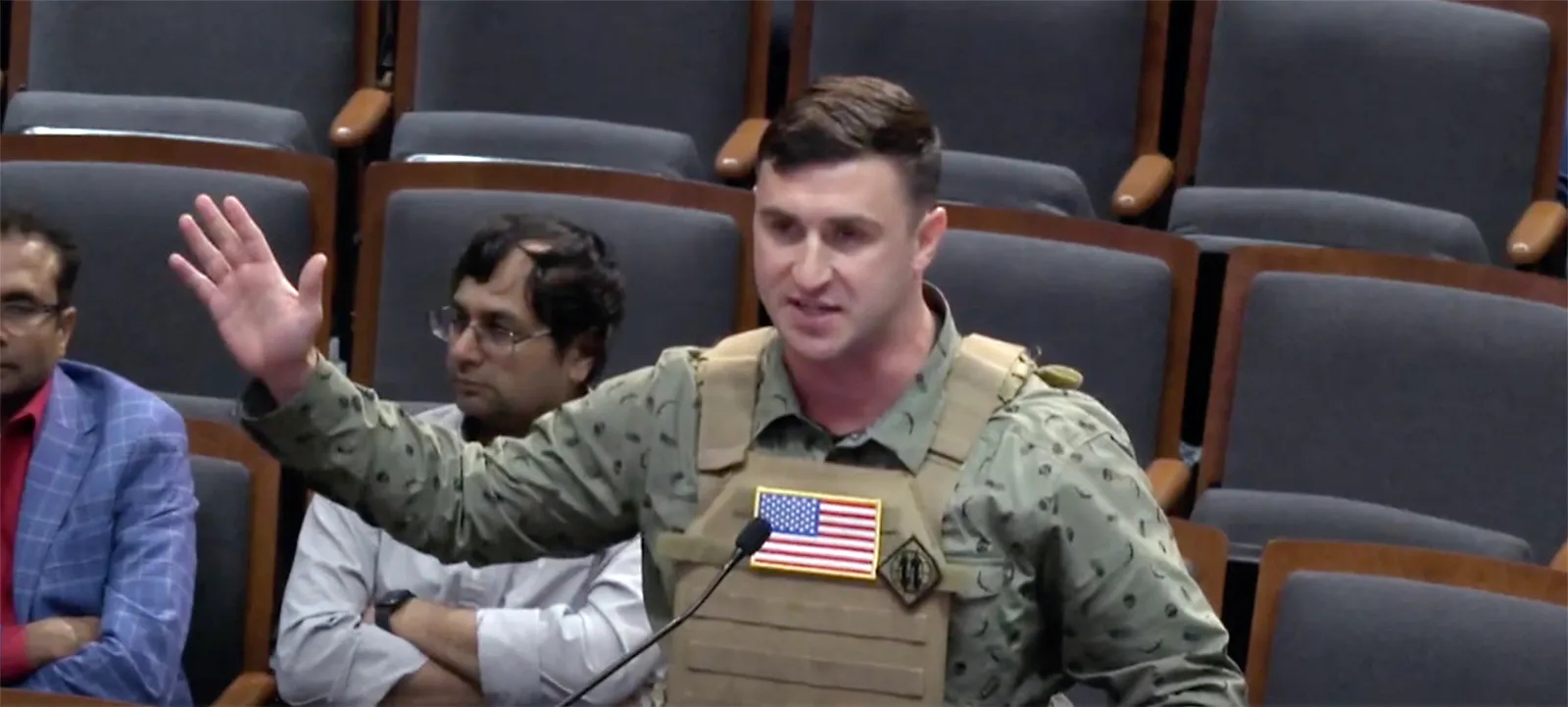
In May, the rhetoric escalated when far-right Jake Lang, a pardoned Jan. 6 rioter from Florida, appeared at a city council meeting in a bulletproof jacket to speak out against the mosque and temple construction. Lang, who flew from Florida for the occasion, used his three-minute slot to condemn the construction projects and support Vilhauer’s views. (He was arrested in June in Dallas for allegedly making terrorist threats.)
“Your replacement is here, Americans, and it is coming faster and faster,” said Lang at the May 20 city council meeting. “The Hindus and the Muslims are teaming up to take over Texas. This is not Muslims versus Hindus here. They are here to eradicate the Christians.”
In recent years, Frisco has been one of the fastest-growing and diversifying cities in Texas. From 2010 to 2020, the city’s population grew by 71%. In 2016, the Dallas Cowboys relocated their headquarters to Frisco, cementing the city’s status as a sports and corporate hub in the Dallas area. Over the same period, Frisco’s Asian population jumped from 10% to 26%, and the city’s white population dropped from 67% to 48%. (The city’s Black and Hispanic population remained relatively unchanged.)
During the 2026 campaign, some of the harshest attacks were aimed at Muslim residents of Frisco. In the final hours of Frisco’s mayoral campaign on June 13, Azfar Saeed, a local Muslim community leader who campaigned for Hill, said he was outside a polling station welcoming voters when he said Vilhauer campaign volunteers approached, shouting Islamophobic slurs. “They were saying that our Prophet Muhammad was a pedophile, saying, ‘Hey, vote for Rod, make sure your girls are protected,’” he said.

Azfar Saeed. (RNS photo/Fiona André)
Saeed and his family have lived in Frisco since 2005, and he has seen how the Muslim community flourished. He recalled how, early on, the community gathered in a rented room in a strip mall on Main Street. In 2016, Frisco’s Muslim community inaugurated the new campus of the Islamic Center of Frisco, an 18,000-square-foot facility that has since tripled in size to accommodate worshippers.
“On our Friday’s biggest congregations, people were praying outside the mosque. In Ramadan, we had to set up a tent outside to do the overflow,” said Saeed, a former board member of the Islamic Center of Frisco.
During the election, he said he and his family had begun to fear for their safety if Vilhauer were elected. They had agreed if he won, they would “pack their bags and find another place to live.”
Even with Hill’s election, Saeed says the work isn’t over, and the community needs to focus on mending divides.
“Mark Hill won, but there’s also the reality that 41.8% of the people believe the hatemongers, which means that we just, we have to fight that battle every single day,” he said.
For Tummala, the election’s results reaffirmed her attachment to the city. “This is my home. I have nothing to be afraid of. I believe in people … and I still believe in this community,” she said.
After the election, Vilhauer, in a Facebook post, wrote, “I pray for God’s wisdom for Mark so that he will be able to lead Frisco the way he campaigned he would and in a way that is best for the city and its citizens.”
Meanwhile, the mosque and Hindu temple projects are still underway; the city council said it had no legal grounds to stop their construction.
At Hill’s swearing-in ceremony last week, held at Frisco’s city council building, Hill called for unity.
“This place will always be a welcoming place for everyone in this room,” said the new mayor. “We are a community that has a lot ahead of us.”