A Malaysian animist group gives thanks to spirits of the sea
CAREY ISLAND, Malaysia (RNS) — The ceremony takes place over four days, in which shamans and villagers visit different points on the rivers and seashores where boats have sunk in the past.
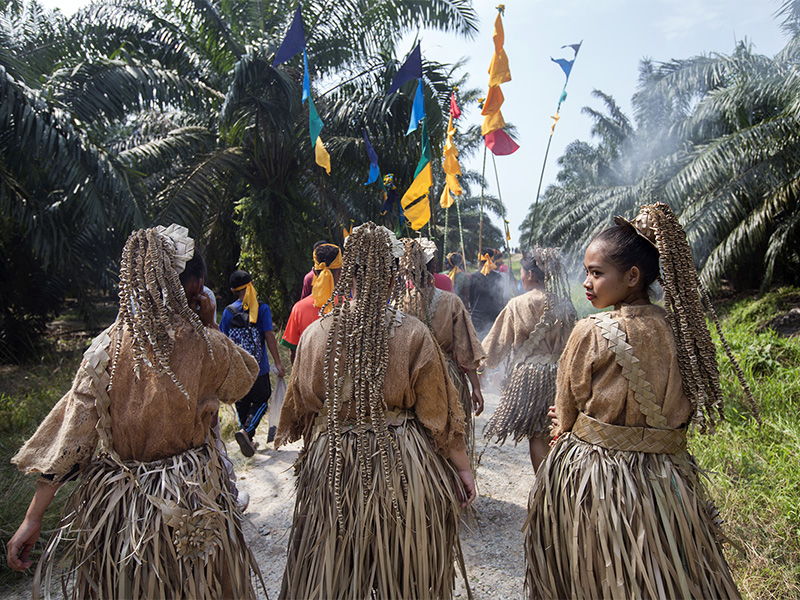
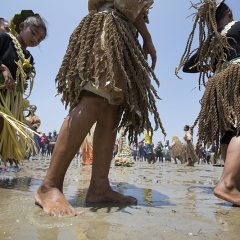
A piece of burning sandalwood fills the air with incense as the Mah Meri procession walks towards the beach on Feb. 20, 2018. Women wear traditional outfits made from palm fronds and tree bark. RNS photo by Alexandra Radu
A piece of burning sandalwood fills the air with incense as the Mah Meri procession moves toward the beach on Feb. 20, 2018. Women wear traditional outfits made from palm fronds and tree bark. RNS photo by Alexandra Radu
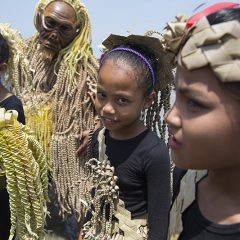
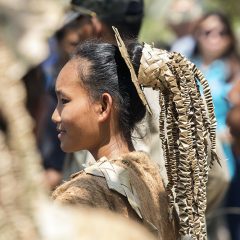
Villagers start in the morning with preparations and prayers in the village. Girls dressed in the traditional Mah Meri attire, intricately woven palm fronds, await the beginning of the ceremony on Feb. 20, 2018. RNS photo by Alexandra Radu
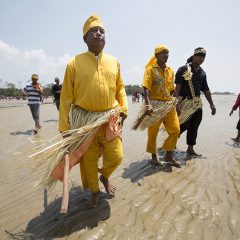
A few hours before the beginning of the main ceremony, the villagers walk in a procession to the beach near the spot where the Puja Pantai will take place, roughly 50 meters away off the shore of Carey Island. RNS photo by Alexandra Radu
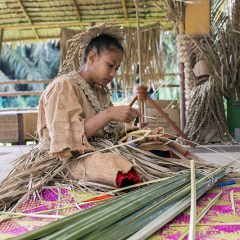
A young Mah Meri woman, dressed in traditional clothes made from tree bark and leaves, weaves decorations in preparation for Puja Pantai on Feb. 20, 2018. RNS photo by Alexandra Radu
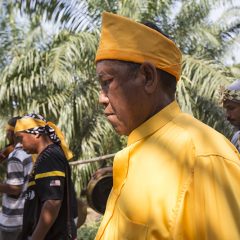
Kamet Anak Kade (Kamet the son of Kade), the main shaman and leader of the Puja Pantai ceremony, walks along with the procession to the rhythm of violin and gong music on Feb. 20, 2018. This is his sixth year conducting the ceremony. RNS photo by Alexandra Radu
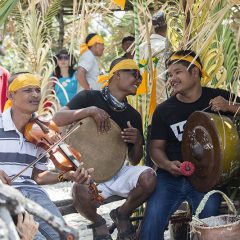
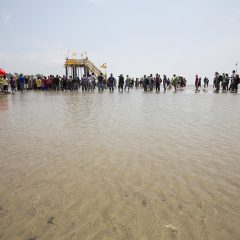
The main ceremony spot lies 50 meters off the shore of Carey Island, Malaysia, and is only accessible during low tide, around noon on Feb. 20, 2018. While waiting for the waters to retreat, Mah Meri play traditional music and chat. RNS photo by Alexandra Radu
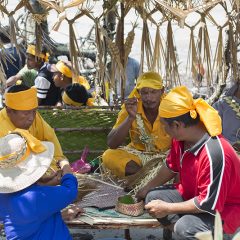
Mah Meri villagers wait for the ceremony to begin on Feb. 20, 2018. The annual Puja Pantai ceremony is an opportunity to socialize and see friends. RNS photo by Alexandra Radu
A shaman, right, has his feet ritually washed before the beginning of the Puja Pantai ceremony on Feb. 20, 2018. RNS photo by Alexandra Radu
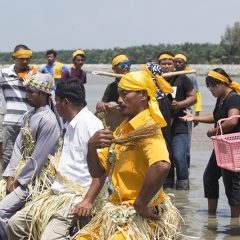
Shamans eat betel nuts and smoke traditional cigarettes, entering a light trance before the Puja Pantai ceremony. Shamans are selected by their predecesors based on the strength of their spirit and their dedication in following the Mah Meri religious traditions. RNS photo by Alexandra Radu
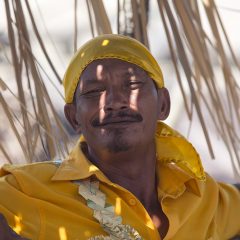
A shaman relaxes in a light trance before the beginning of the Puja Pantai ceremony on Feb. 20, 2018. The shamans enter a trance in order to receive different spirits of the seas in their bodies, blessing the people throughout the ceremony. Only shamans are allowed to receive spirits for fear of the spirit not wanting to leave the body that received it after the end of the ritual. RNS photo by Alexandra Radu
As the waters retreat, shamans lead the procession to the location of the Puja Pantai ceremony, in the middle of the sea off Carey Island, Malaysia. RNS photo by Alexandra Radu
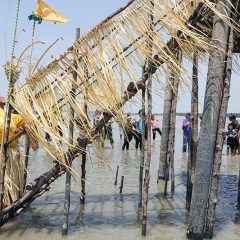
The villagers gather around a tower with a platform on top, named Mahligai, the place where they put offerings of food for the sea spirits during the Puja Pantai ceremony on Feb. 20, 2018. RNS photo by Alexandra Radu
Shamans sit on a wooden bench and enter a deeper trance while waiting to receive sea spirits into their bodies on Feb. 20, 2018. RNS photo by Alexandra Radu
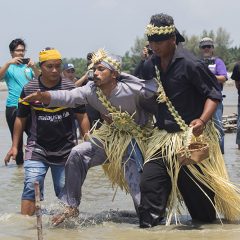
Believing a sea spirit to have entered his body, a shaman walks erratically, supported by a villager. RNS photo by Alexandra Radu
The leader of the ceremony, believed to be posessed by Moyang Getah, the main spirit honored during the ritual, climbs the stairs to the offering platform to receive the food offered by the Mah Meri villagers on Feb. 20, 2018. RNS photo by Alexandra Radu
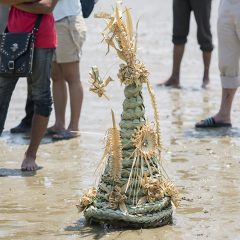
The “busu” is a conical offering weaved of screwpine (Pandanus) leaves decorated with
“bunga moyang” (spirit flowers). Together with the tower for offerings, constructed in the middle of
the sea at the spot where legend says a ship was miraculously saved, it represents the center of the ceremony. RNS photo by Alexandra Radu
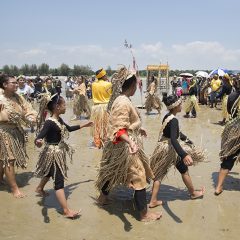
Mah Meri women, dresed in traditional clothes, perform the traditional dance “Jo’oh” in a circle
around the spirit flower, accompanying the shaman in the ritual. RNS photo by Alexandra Radu
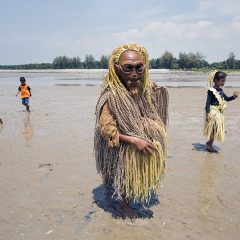
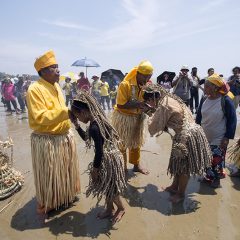
A man wearing traditional clothes and a wooden mask, symbolizing the spirits of the ancestors,
dances in movements that mimic regular activities in village life, like farming or fishing. The Mah Meri are skilled artisans and wooden sculpture is a craft ever
present in the life of the tribe. RNS photo by Alexandra Radu
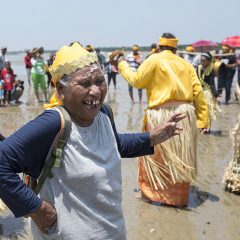
An old Mah Meri woman enjoys the ceremonial dance on Feb. 20, 2018. One by one, most of the villagers join the circle around the spirit flower. RNS photo by Alexandra Radu
As the Puja Pantai ceremony reaches its peak, the entire Mah Meri village dances together to honor the spirits of the sea on Feb. 20, 2018. RNS photo by Alexandra Radu
At the end of the Puja Pantai ceremony, Mah Meri villagers line up to pay their respects to the shamans. RNS photo by Alexandra Radu
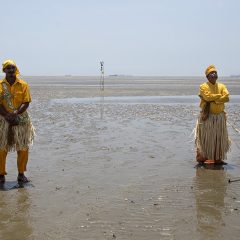
After all the rituals are fulfilled, the shamans, still in a trance, take a moment to reconnect with themselves on Carey Island. In the background, many cargo ships cross the Malacca Strait on Feb. 20, 2018. RNS photo by Alexandra Radu
CAREY ISLAND, Malaysia (RNS) — The Mah Meri, an indigenous people who hold animist beliefs, are one of the few groups left in Malaysia that celebrate a day of thanksgiving for the spirits of the sea.
Traditionally seafarers who are believed to have come from southern Thailand, the Mah Meri arrived in Malaysia thousands of years before the Malay people.
[ad number=“1”]
They number around 4,200 and live on the shores of the Malacca Strait, one of the busiest naval routes in the world.
Every year, on the fifth day of the Chinese Lunar New Year — this year the fifth day fell on Feb. 20 — the Mah Meri observe Puja Pantai. Similar versions of the ritual were observed by other fishing communities around the same time, after the crop harvest and before the beginning of the fishing season. But many disappeared over time, and in the 1960s the ritual was banned as un-Islamic. The Mah Meri — somewhat removed from areas undergoing Islamization — were able to continue their observance.
[ad number=“2”]
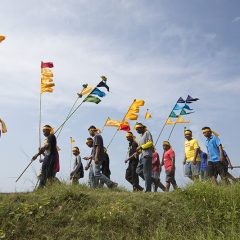
The ceremony takes place over four days, in which shamans and villagers visit different points on the rivers and seashores where boats have sunk in the past. These spots are marked with colorful flags that also serve as navigation aids for boats to avoid treacherous sandbanks. In each place, prayers are said to honor and appease the spirits of the sea. Puja Pantai culminates with a ceremony near the spot off Carey Island where the Mah Meri legend has it that a ship was miraculously pulled to safety by the spirit Moyang Getah (the Rubber Spirit).
“The significance of this ritual is far-reaching for the Mah Meri, as it serves both worlds,” says Rashid Esa, director of the Mah Meri cultural village. “It not only recognizes the powers of the spirits but it is also a reminder to the villagers of the dangers they face at sea.”
[ad number=“3”]
Link copied!
No paywalls here. Thanks to you.
As an independent nonprofit, RNS believes everyone should have access to coverage of religion that is fair, thoughtful and inclusive. That's why you will never hit a paywall on our site; you can read all the stories and columns you want, free of charge (and we hope you read a lot of them!)
But, of course, producing this journalism carries a high cost, to support the reporters, editors, columnists, and the behind-the-scenes staff that keep this site up and running. That's why we ask that if you can, you consider becoming one of our donors. Any amount helps, and because we're a nonprofit, all of it goes to support our mission: To produce thoughtful, factual coverage of religion that helps you better understand the world. Thank you for reading and supporting RNS.