


A cemetery is desecrated, shaking Michigan’s Jewish community on Election Day
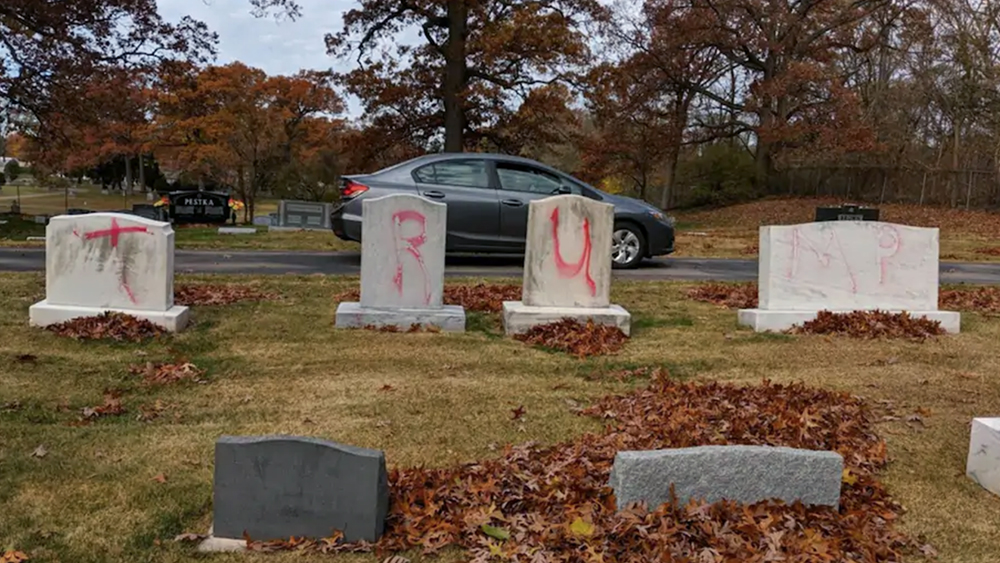


(RNS) — Gayle Kirshenbaum planned to spend Election Day calling potential voters in Michigan and Pennsylvania and urging them to vote.
Instead she woke up to a disturbing text from her brother telling her the Ahavas Israel Cemetery where her grandparents and great-grandparents are buried had been desecrated by vandals who spray-painted T-R-U-M-P and MAGA (President Donald Trump’s campaign slogan, “Make America Great Again”) in red paint on headstones.
The apparent anti-Semitic attack was discovered hours before Trump arrived in Grand Rapids on Monday (Nov. 2) to stage a final rally of his campaign. It shook the Jewish community, which just last year saw the city’s Reform synagogue also vandalized. An extremist group had hoisted neo-Nazi posters, including one that read “A crusade against Semite led subhumans.”
We are appalled by the reported desecration of gravestones at the Ahavas Israel Cemetery in Grand Rapids, MI. We are in close touch with the Jewish community and Law Enforcement to investigate this vandalism. pic.twitter.com/mVeGrlsWxE
— ADL Michigan (@ADLMichigan) November 2, 2020
Michigan is a swing state in the presidential election and the Michigan Jewish Democratic Caucus quickly issued a statement: “Make no mistake, this heinous act was committed on the eve of the 2020 election to send an intimidating message to the president’s opponents, and particularly, Jewish voters.”
The Anti-Defamation League said it was appalled by the desecration and will press for an investigation.
Last month, six men from Michigan were charged in federal court with conspiring to kidnap Michigan Gov. Gretchen Whitmer. Earlier this year, the president tweeted “LIBERATE MICHIGAN!” after Whitmer imposed some statewide coronavirus pandemic restrictions.
Kirshenbaum, who now lives in Brooklyn, where she works as a freelance writer and editor, grew up in the town of Benton Harbor, about 80 miles south of Grand Rapids. She visited her grandparents frequently. The couple, whose names the family wanted to keep private, belonged to Ahavas Israel, a Conservative synagogue. Her grandfather ran a service station in town and was active in his congregation’s burial society, or Chevra Kadisha. He helped care for the cemetery grounds before he died in 1980.
The couple’s headstones, along with those of other relatives, may not have been the ones desecrated because most of them lie flat on the ground. Photos show the vandals picked the upright headstones for maximum visibility.
Anti-Semitism has surged in the U.S. in the last four years, much of it animated by white nationalism. A poll earlier this year found nearly two-thirds of U.S. Jews (63%) believe they are less safe than they were a decade ago. Half are worried that a person wearing a yarmulke, religious skullcap or other public display of Judaism will be physically assaulted (47%) or verbally harassed (50%) “on the street or in a public place,” according to the survey sponsored by the Anti-Defamation League.
READ: Survey: Half of American Jews have experienced or witnessed anti-Semitism
Kirshenbaum, who has already voted for Joe Biden, said the desecration was another example of the hate Trump and many of his supporters direct toward “anyone who isn’t white and Christian.”
“This is a moment where Trump’s hate touched my family and this Grand Rapids Jewish community,” she said.
Kirshenbaum’s great-grandparents immigrated to the U.S. from the Pale of Settlement, the region that encompasses western Russia, Belarus, Lithuania, Moldova, much of Ukraine and parts of eastern Poland, where Jews lived.
Just last year on a trip to Michigan to visit her parents, Kirshenbaum visited the Grand Rapids cemetery alongside her 18-year-old child, Aaron.
“It was a beautiful winter day and we walked from gravestone to gravestone of our family members. We cleared the snow out of the way and showed Aaron where his great-grandparents and great-great-grandparents lay.”
Kirshenbaum said she went ahead with the phone-banking Tuesday afternoon, hoping her work to get people to the polls might honor the legacy of her grandparents and great-grandparents.
“I refuse to feel that sacred space has been violated,” she said. “It just can’t be altered. It’s a space that’s full of love.”