


Bipartisan Bill Would Place Thomas Paine Memorial Among America's Most Honored Founders in Washington, D.C.


More than two centuries after Thomas Paine helped ignite the movement for American independence, Congress has taken an important step toward giving him the national recognition many historians believe he has long deserved.
The Thomas Paine Memorial Association (TPMA) welcomes the introduction of the Common Sense 250 Act of 2026 (H.R. 9600), bipartisan legislation sponsored by Congressman Jamie Raskin (D-MD-08) and Congresswoman Victoria Spartz (R-IN-05). Once enacted, the bill would authorize a memorial honoring Thomas Paine in Area I of Washington, D.C.’s monumental core—an honor reserved for individuals whose contributions to the United States are of “preeminent and lasting historical significance.”
The legislation arrives at a particularly meaningful moment as the nation commemorates the 250th anniversary of its founding. It also marks the 250th anniversary of the publication of Common Sense, the extraordinary pamphlet that transformed colonial debate into a movement for independence.
Although Thomas Paine’s words helped inspire the birth of the United States, he remains one of the few major Founding figures without a memorial in the nation’s capital.
Born in England, Paine arrived in America in 1774 with little more than a letter of introduction from Benjamin Franklin. Within months, he had become one of the Revolution’s most influential voices.
Published in January 1776, Common Sense became the bestselling political work of the eighteenth century. Written in language ordinary citizens could understand, it persuaded thousands of colonists that complete independence—not reconciliation with Great Britain—was both necessary and achievable. He sold half a million copies of Common Sense when the nation was still only an idea. Paine never sought to profit from his revolutionary writing. He declined royalties from Common Sense, surrendered his copyright so it could be freely reprinted, and donated his earnings to support the Continental Army.
Thomas Paine gave this country its argument for independence, then took up a musket in the Continental Army to help win it. His service extended beyond the printed page. During the Revolutionary War, Paine served alongside General George Washington’s army and wrote the thirteen essays collectively known as The American Crisis. His words inspired soldiers during some of the war’s darkest days.
Paine’s legacy extends well beyond American independence. He condemned slavery decades before abolition became a national movement. He advocated universal education for boys and girls, defended religious liberty, promoted democratic government, argued for social welfare programs, and envisioned international cooperation among free nations. He also popularized the phrase “United States of America,” helping define the identity of the new nation.
His writings later influenced leaders including Abraham Lincoln and Frederick Douglass, demonstrating that his ideas continued to shape American democracy long after the Revolution.
For many supporters, the absence of a memorial to Paine on the National Mall has become one of the nation’s most significant historical omissions.
Congressman Jamie Raskin emphasized the historic significance of the legislation, saying, “On the 250th anniversary of the publication of Common Sense, our legislation finally brings the great Tom Paine from the attics and libraries of history to a place of shining prominence on our National Mall, establishing the dazzling national memorial he deserves.”
Congresswoman Victoria Spartz connected the proposal to the nation’s anniversary celebration, stating, “As we celebrate America’s 250th anniversary, we remember Thomas Paine’s timeless words, ‘These are the times that try men’s souls,’ important words that helped rally General Washington’s army. Their sacrifices should remind us of the price so many Americans paid to secure our freedom—a precious gift we have a solemn duty to preserve for future generations.”
Leaders of the Thomas Paine Memorial Association described the bill as the culmination of decades of effort by supporters throughout the United States and abroad.
TPMA Vice President Robyn Blumner noted that Paine’s influence continues to resonate around the world. “Thomas Paine’s writings transformed scattered resistance into a movement for independence,” she said. “His ideas helped create the United States, and his influence continues to shape democratic societies around the world. A memorial worthy of his legacy belongs in our nation’s most distinguished commemorative landscape.”
Secretary of TPMA Annie Laurie Gaylor underscored the memorial’s symbolic importance during the nation’s semiquincentennial. “Without Thomas Paine, the United States would not be celebrating its 250th anniversary,” she said. “No tribute to this milestone would be more fitting than ensuring that Paine’s long-overdue memorial standsprominently near the Capitol and National Mall, where his life, words, and vision can inspire millions of visitors.”
TPMA Treasurer Diane Straka reflected on the many years of dedication that have brought the project to this point. “For decades, supporters across the United States and around the world have shared a vision of honoring Thomas Paine in the place where his ideas helped shape the nation he inspired,” Straka said. “This legislation brings that vision significantly closer to reality. We remain steadfast in our commitment to honoring Thomas Paine and to ensuring that every contribution entrusted to us advances our mission with transparency, accountability, and responsible stewardship.”
If Congress approves the legislation, supporters will have up to seven years to complete fundraising, finalize the memorial’s design, secure approvals from federal commissions, and construct the monument on an approved Area I site.
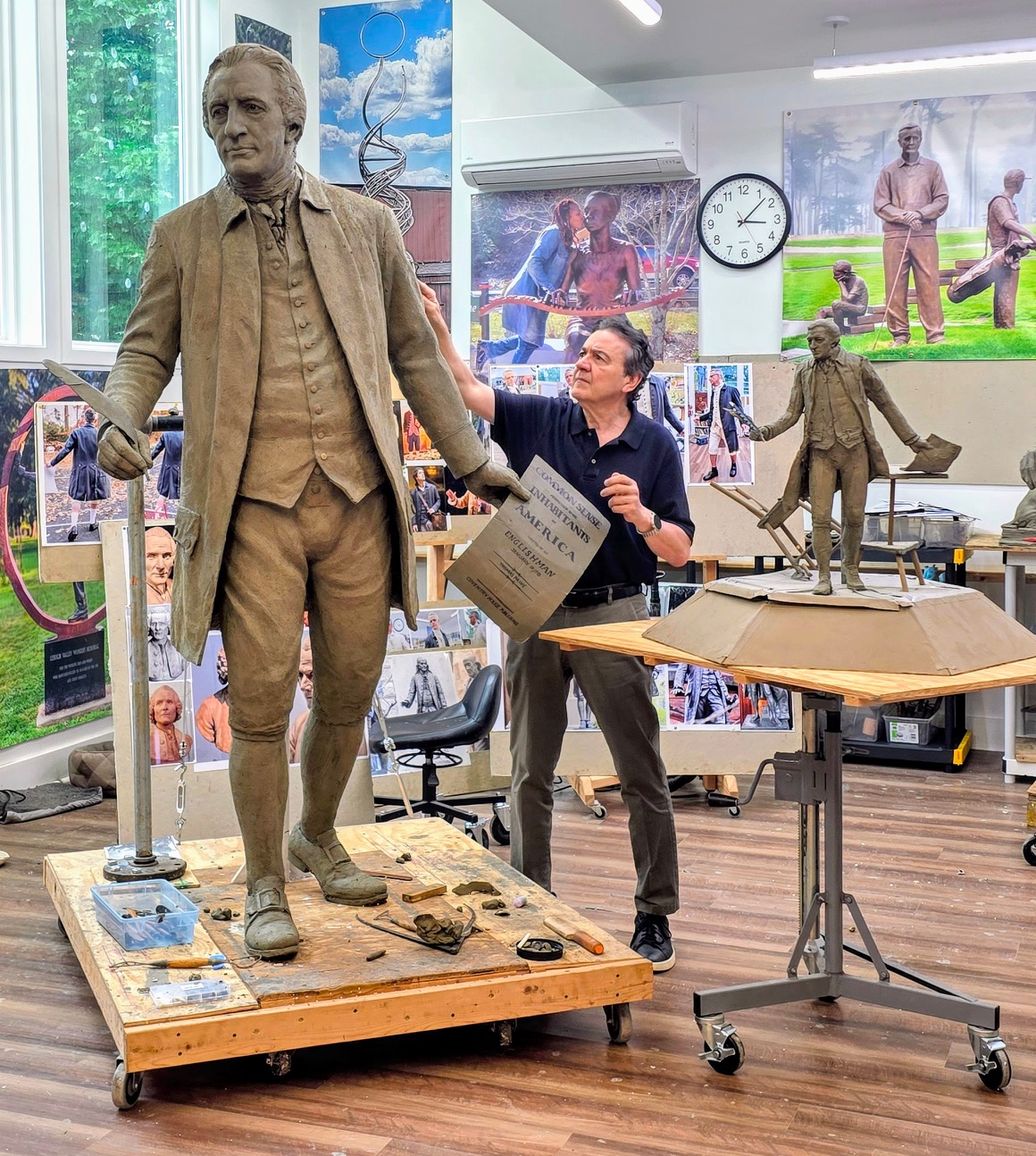
The Thomas Paine Memorial Association has already enlisted internationally acclaimed sculptor Zenos Frudakis, whose bronze statue of Thomas Paine has been completed and awaits installation at his studio in Glenside, Pennsylvania.
Upon learning that the legislation had been introduced, Frudakis reflected on the significance of the project. “As a sculptor, there are few honors greater than being entrusted with preserving the memory of someone who helped change the course of history. My goal is to create a Thomas Paine who speaks not only to his own time, but to every generation that believes in freedom, reason, and the power of ideas.”
For supporters of the memorial, the legislation represents more than authorization for another monument. It is an opportunity to restore one of America’s most influential founders to his rightful place among the nation’s honored architects of liberty. For 250 years, the capital he helped bring into being has had no memorial to him. TPMA seeks to correct that, and Area I is the prestigious location where he belongs.
As the United States reflects on its first 250 years, many believe there could be no more appropriate time to recognize the writer whose words helped make American independence possible.
Thomas Paine Memorial Association
Email: [email protected]
Website: https://ThomasPaineMemorial.org
Facebook: https://www.facebook.com/ThomasPaineMA/
Meetup: https://www.meetup.com/thomas-paine-memorial-association-meetup-group/
Phone: 610-357-9432
###
Disclaimer: The views and opinions expressed in this article are those of the authors and do not necessarily reflect the official policy or position of RNS or Religion News Foundation.