


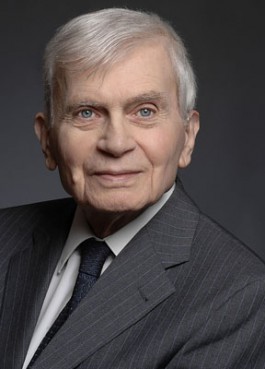
(RNS2-MAR16) French physicist Bernard d’Espagnat is the 2009 winner of the Templeton Prize for advances in science and religion. For use with RNS-TEMPLETON-PRIZE, transmitted March 16, 2009. Religion News Service photo courtesy Laurence Godart.
(RNS) A former Dominican priest and outspoken critic of creationism has won this year’s Templeton Prize — an honor awarded to scholars who study how science and religion intersect.
Francisco J. Ayala is a professor of both biology and philosophy at the University of California, Irvine, where he has been a leading critic of creationism as an erroneous attempt to blend faith and science.
But neither do the two realms contradict each other, said Ayala on Thursday (March 25) at the National Academy of Sciences in Washington, where he was announced the award’s winner. At $1.5 million, the Templeton prize is the world’s largest annual award given to an individual.
“If they are properly understood, they cannot be in contradiction because science and religion concern different matters,” Ayala said.
Whereas science concerns the natural world, religion concerns the meaning and purpose of the world and of human life, added the 76-year-old molecular biologist.
Ayala’s scientific research centers on molecular biology and includes finding cures for diseases such as malaria; he earned a 2001 National Medal of Science from former President George W. Bush.
Ayala has also been a passionate defender of the theory of evolution, writing several books on the topic, and appearing as a witness in an Arkansas court case on teaching creationism in public schools in 1981. The court eventually ruled that creationism lacks scientific merit and was an unconstitutional entanglement of church and state.
In announcing the award, John M. Templeton, Jr., the president and chairman of the John Templeton Foundation, said Ayala’s “clear voice in matters of science and faith” echoes “the foundation’s belief that evolution of the mind and truly open-minded inquiry can lead to real spiritual progress in the world.”
In an interview, Ayala said he was “surprised and astonished” at winning the award. “It’s such an unexpected gift,” he said.
Ayala, a native of Spain, was ordained a Dominican priest in 1960 and like others of his generation was influenced by the Jesuit paleontologist and philosopher Pierre Teilhard de Chardin, who argued humanity and the planet were undergoing an ongoing evolution. Ayala left the priesthood soon after his ordination to study genetics.
Ayala said he does not consider himself a “Catholic scientist,” but rather a scientist who is interested in spiritual questions. Still, he said his relations with the Catholic church remain cordial, noting the church’s supportive intellectual tradition of scientific inquiry.
In his remarks Thursday, Ayala, now a naturalized American citizen, drew upon a well-known painting of Spanish artist Pablo Picasso to make a point about how to relate science and religion.
“Scientific knowledge, like the description of the size, materials, and geometry of (Picasso’s) `Guernica,’ is satisfying and useful,” he said, “but once science has its say, there remains much about reality that is of interest: questions of value, meaning, and purpose that are beyond science’s scope.”
The Templeton Prize was created by the late John Templeton, an investor and philanthropist who died in 2008. Ayala will be presented the award on May 5 by Prince Philip at a ceremony at Buckingham Palace in London.