


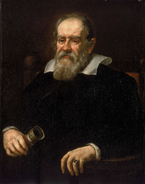


Galileo Galilei (seen here in a 1636 painting by Justus Sustermans) was condemned by the Roman Catholic Church in 1633 for supporting the theory that the sun was the center of the universe; the church formally apologized in 1992.
VATICAN CITY (RNS) Nearly four centuries after the Roman Catholic Church branded Galileo Galilei a heretic for positing that the sun was the center of the universe, the Vatican is co-hosting a major science exhibition in his hometown.
The Vatican is teaming with Italy's main physics research center to host “Stories from Another World. The Universe Inside and Outside of Us,” in Pisa.
The exhibit will illustrate the progress of knowledge of the physical universe, from prehistoric times to recent discoveries. The exhibit is organized by the Specola Vaticana — the Vatican-supported observatory — and Italy's National Institute for Nuclear Physics, together with Pisa University's physics department.
The exhibition aims to tell “the history of the universe, from the particles which make up the atoms in our bodies to distant galaxies,” the Rev. Jose Funes, director of the observatory, told reporters on Thursday (Feb. 2).
It is aimed particularly at young people and great care has been taken “to make complex and difficult knowledge accessible, while at the same time avoiding the risk of superficiality.”
Cosimo Bracci Torsi, president of the exhibit's venue, the Palazzo Blu Foundation, stressed that the placement of the exhibit in Galileo's hometown reflects the progress made between secular science and religion since Galileo was “first condemned then cleared up.”
Galileo was condemned by the Vatican in 1633 for his astronomical theories and spent the last eight years of his life under house arrest. The late Pope John Paul II apologized in 1992, saying the church was wrong to convict Galileo.
Objects on display include rock fragments from the moon and Mars, and original copies of the books of Isaac Newton. The exhibition runs from March 10 to July 1.