


Beyond tolerance: We need neighbors, not just permission


(RNS) — As Jews and Muslims have just concluded the holidays of Shavuot and Eid al-Adha, I have found myself thinking less about theology and more about neighbors.
The two holidays commemorate very different moments. Eid al-Adha recalls Abraham — Ibrahim in the Islamic tradition — and his willingness to sacrifice his son in obedience to God. Shavuot marks the revelation at Sinai and the receiving of the Torah. One centers on submission and sacrifice, the other on law and teaching.
Yet both begin with the same foundational recognition: that the individual human being is not the center of the world. Humanity stands before its Creator.
That idea has become harder to sustain in our time.
People speak with certainty about histories they have never studied, religions they have never encountered and conflicts they know only through fragments and slogans. In recent weeks, attacks targeting visibly religious people have served as reminders of how quickly fear and hatred can enter everyday life. Across Europe and beyond, houses of worship increasingly require levels of security once associated only with embassies. Fear hardens communities inward and slowly erodes familiarity between neighbors.
Shavuot is not only about revelation. It is about study. Judaism became a civilization built around text, memory, argument and learning. Not only belief, but obligation. Islamic tradition understands this deeply as well. The Quran speaks of Ahl al-Kitab, the People of the Book, recognizing communities shaped by revelation and learning, even where they differ.
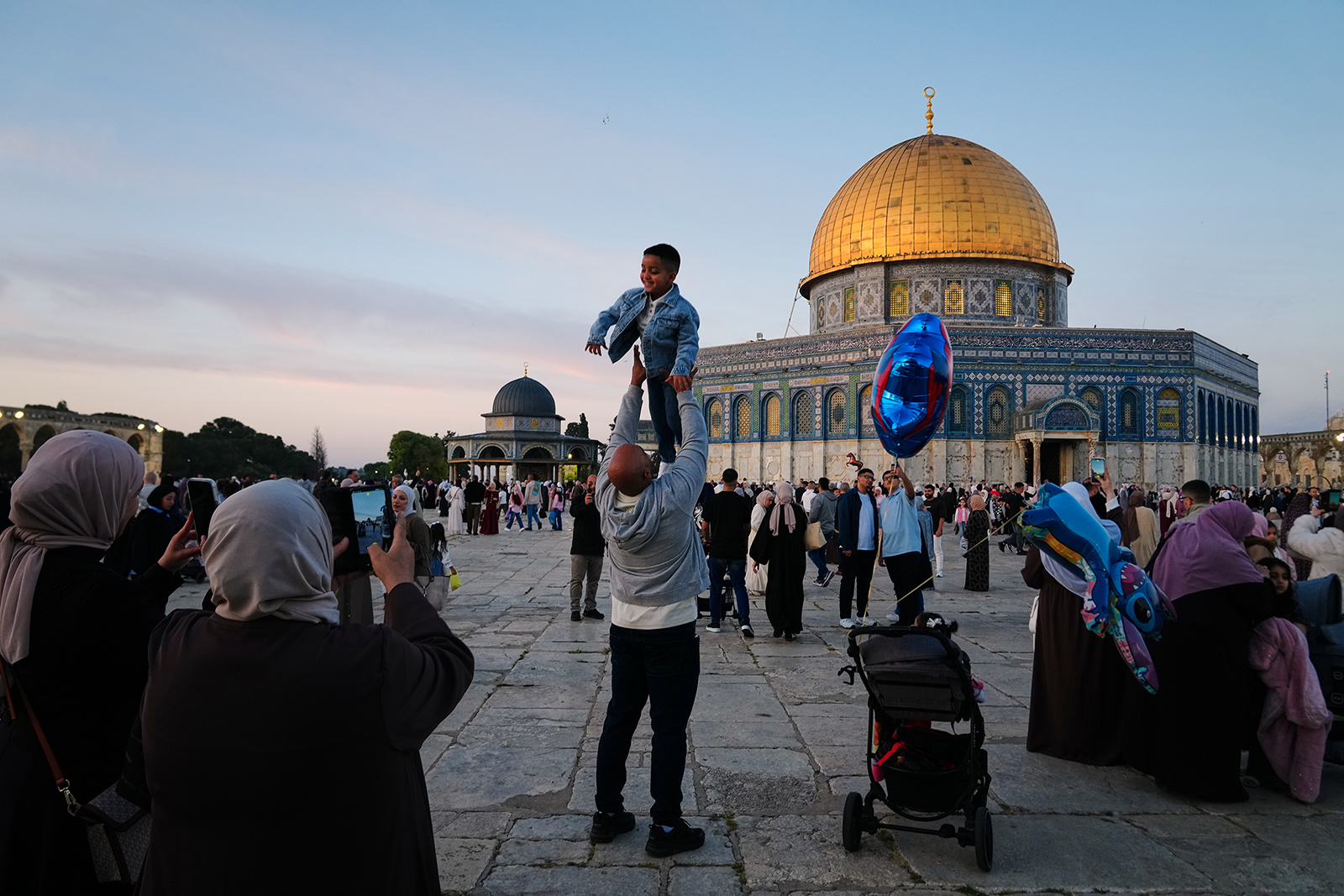
Muslim worshippers gather for Eid al-Adha prayers next to the Dome of the Rock shrine at the Al-Aqsa Mosque compound in Jerusalem’s Old City, May 27, 2026. (AP Photo/Mahmoud Illean)
That recognition was never merely theoretical. Maimonides wrote his great works of Jewish law in Cairo while serving as court physician to Saladin’s family. Jewish life inside Islamic civilization was a daily reality for centuries.
A society cannot survive on identity alone. The rabbis warned against becoming a ḥamor noseh sefarim — a donkey carrying books. The Quran, in Surat al-Jumu’ah, uses the same image. Carrying sacred texts is not enough. The question is whether they shape the person carrying them.
One of the misunderstandings of modern society is the idea that people of different faiths must eventually dilute their differences in order to live together peacefully. They must not. Judaism and Islam are different faiths. The differences are real, and they matter. Serious believers should not pretend otherwise.
Coexistence does not require theological agreement. It requires restraint. It requires the ability to share space without demanding sameness — recognizing that another person can stand before God differently than you do and still remain your neighbor.
What matters is not creating a vague universal religion, nor reducing faith into carefully managed public relations exercises, but remaining deeply rooted in one’s own tradition while meeting another person without fear or contempt. The Quranic concept of ta’aruf — that humanity was created into peoples and tribes so that they may know one another — was never about erasing distinctions. It was about learning how to live with them.

(Photo by Nina Strehl/Unsplash/Creative Commons)
I recently visited Azerbaijan as part of my work with the Alliance of Rabbis in Islamic States. Azerbaijan is home to the largest Jewish community in the Muslim world. More than 20,000 Jews live there openly and securely. The Mountain Jews of the Caucasus have lived in the region for more than a century. The country honors Albert Agarunov, a Jewish soldier killed while defending Azerbaijan, as a national hero.
A senior Azerbaijani official told me something that stayed with me: “We do not like the word ‘tolerance.’ Tolerance means you are putting up with someone. We are not tolerating one another. We are citizens of the same country.”
Morocco operates on a similar premise. Its constitution names the Hebraic alongside the Arab, Amazigh and Andalusian as part of Moroccan identity. In these societies, Jewish life is not tolerated. It belongs.
In healthy societies, religious identity must be able to exist openly and without fear. In Istanbul, where I have lived for more than two decades, coexistence is rarely abstract. It exists in apartment buildings, shared courtyards and holiday greetings exchanged between neighbors. During Ramadan and Eid, Muslim neighbors send sweets and aşure. On Passover, the municipalities of Beşiktaş, Şişli and Beyoğlu put up street signs congratulating their Jewish neighbors. These gestures do not erase disagreement or history. They create familiarity.
Since the war in Gaza, some of that familiarity has thinned. The suffering has been profound and has deepened mistrust across communities far beyond the region itself. Many people on all sides are disturbed by this erosion of trust. None of this is abstract.
The question is not only which side to declare for. It is sharper than that. What have I done today to make my neighbor feel safer, more able to live openly according to his convictions? That is the question coexistence actually asks of us — not in conferences but in apartment buildings, workplaces, schools and around dinner tables.
At Sinai, the Israelites answered “naaseh venishma” — we will do, and we will hear. Action before full understanding. Commitment before certainty.
During the days between Passover and Shavuot, Jews count the Omer day by day. The counting is the discipline. You cannot skip ahead. Coexistence works the same way: slowly, imperfectly and through repeated encounters.
The Lubavitcher Rebbe often taught that the ultimate purpose of religious life is not withdrawal from the world, but helping transform it into a better and more godly place — what Jewish tradition calls tikkun olam, repairing the world. But such repair does not begin with governments or declarations. It begins with a single human act: one person making space for another, one gesture of dignity, one conversation, one act of kindness. It begins today, and it begins with each of us. Now.
(Rabbi Mendy Chitrik is chairman of the Alliance of Rabbis in Islamic States and the Ashkenazi Rabbi of Turkiye. The views expressed in this commentary do not necessarily reflect those of RNS.)