


Questions remain after Christian painter Thomas Kinkade dies
(RNS) Thomas Kinkade, a commercially successful painter of pastoral settings and a special favorite of his fellow evangelicals, died Friday (April 6) at the age of 54. Questions remain, however, about his behavior in recent years, including financial scandals as well as suspicions of alcohol abuse and reports of bizarre public incidents. By David Gibson.
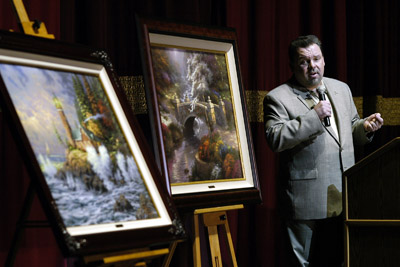


(RNS) The unexpected death of Thomas Kinkade on Friday (April 6) prompted an outpouring of grief for the hugely successful painter of pastoral landscapes, but also raised questions about the troubled final years of an artist whose use of Christian imagery made him a special favorite of his fellow evangelicals.
An autopsy was scheduled for Monday on the man known as the “Painter of Light” for his signature, soft-focus landscapes and seascapes that critics dismissed as kitsch but nonetheless fetched upwards of $10,000 a piece from millions of American buyers.
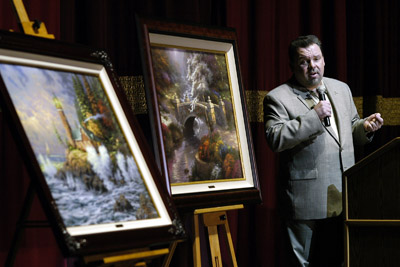
Painter Thomas Kinkade talks with a group of fans at the Whitaker Center for the
Science and the Arts in Harrisburg, Pa., on Feb. 7, 2004.
“My paintings are messengers of God's love. Nature is simply the language which I speak,” Kinkade once said.
Kinkade's family said the artist, 54, died alone at his home in Los Gatos near San Francisco, and that his death appeared to be from natural causes.
An art school dropout from a broken home, Kinkade became a born-again Christian in 1980, and shortly afterwards started peddling his inspirational landscapes out of the trunk of his car.
“Well, it was almost as if God became my art agent. He basically gave me ideas,” he told USA Today in 2002. One of those ideas was mass-marketing his canvases to the point that he was recognized as the most-collected living artist – and one of the richest.
Kinkade infused his work with faith as deliberately as he did with light. His paintings often featured a church as well as a Bible reference and the Christian symbol of a fish with his signature; he also sometimes included traces of his own DNA from blood and hair mixed with the paint he used.
At one point, Kinkade’s factories churned out as many as 500 reproductions a day of his most beloved works, which then sold for thousands of dollars in Kinkade’s galleries. He became a best-selling author and inspirational speaker, and he designed a housing complex of $400,000 homes inspired by his paintings. At the height of his popularity a decade ago, Kinkade was profiled in magazines as diverse as Christianity Today and the New Yorker.
But in recent years financial troubles and bizarre behavior began overwhelming the idyllic images.
Kinkade was accused of behaving inappropriately with women and even urinating on a Winnie the Pooh figure at the Disneyland Hotel in Anaheim – an especially odd occurrence for a man who compared himself to Walt Disney, as well as Norman Rockwell, the illustrator of iconic Americana.
In a 2006 letter to his gallery owners, he denied some charges but chalked up the rest to drinking and overeating caused by stress, adding that “With God's help and the support of my family and friends, I have returned balance to my life.”
Then in 2009, the Los Angeles Times reported that the FBI was investigating Kinkade for defrauding investors; in 2010, his company’s manufacturing arm filed for bankruptcy protection. Also that year Kinkade was reportedly arrested on suspicion of drunk driving.
Despite the problems, Kinkade managed to amass legions of fans whom he jokingly referred to as a “cult,” and professional critics could never dent his popularity.
“Art is forever,” Kinkade told “60 Minutes” in 2007. “It goes front and center on your wall, where everyday the rest of your life you see that image. And it is shaping your children, it's shaping your life.”
KRE/DSB END GIBSON