


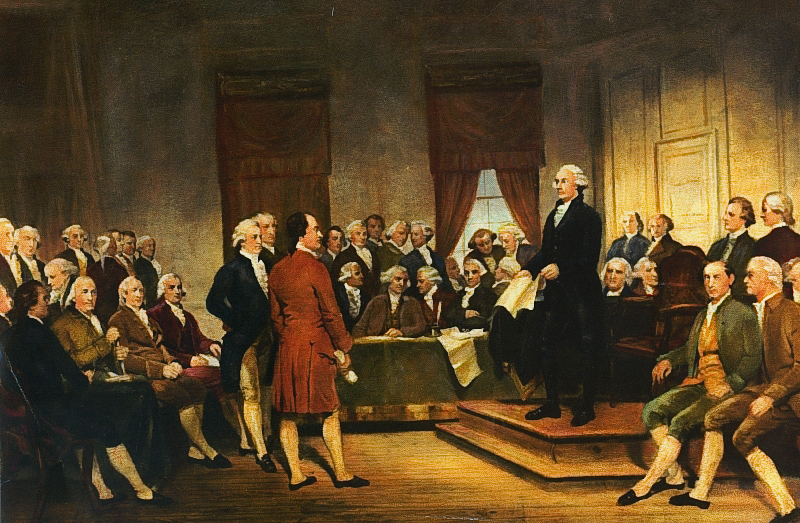
Author: http://commons.wikimedia.org/wiki/File:Washington_Constitutional_Convention_1787.jpg
When athletes join hands in prayer before a contest, they don't ask God to help them win but to play their best and avoid injuries. Republican members of Congress? Evidently, not so much. In an exit interview with Francis X. Clines in yesterday's New York Times, retiring congressman Gary Ackerman (Liberal Democrat-NY) talked about how the willingness to compromise on the other side of the aisle has disappeared over the course of his 30 years in the House.
The low point, he said, was when a Republican friend told him that private caucus meetings featured prayer gatherings where lawmakers hold hands and invoke God for or against specific measures on the House agenda. “In the past, a fight was over how to make a good bill better. Now it’s become Good versus Evil.”
While I'd like to see a little more reporting on this, it has the ring of truth. It also calls to mind the moment 225 years ago (on June 28, 1787, to be exact) when, with the Constitutional Convention stuck on deciding whether small states should have the same voting power as large ones, an aged Benjamin Franklin proposed seeking God's aid by way of an opening daily prayer given by a member of the Philadelphia clergy. Franklin's motion was seconded by Roger Sherman, the pious Connecticut Congregationalist, but the session adjourned without a vote, and the issue never arose again. Somehow the framers managed to achieve their miracle without benefit of clergy.
The episode has elicted some strenuous effort by the likes of David Barton's Wallbuilders to show that the framers were not acting out of deistic disregard for divine assistance. But as Michael I. Meyerson suggests in a fine new book on the birth of religious freedom in America, Franklin himself provided the simplest explanation in a postscript to the paper on which he had written his remarks: “The convention, except three or four persons, thought prayers unnecessary.”
So here's the trajectory: from a Constitutional Convention that forebore to ask for divine assistance to get its work done to a House of Representatives in which one of the two parties meets to ask God to take its side on specific pieces of legislation. If religion wasn't part of the solution in 1787, I'd say it's part of the problem in 2012. Given the relative achievements of the framers and the current Congress, that is.