



(RNS) Nothing can rile churchgoers more than tweaking the liturgy, so it was no surprise that sharp protests accompanied the introduction of a new translation of the Catholic Mass last year. But a survey shows that worshippers have by and large accepted – and even welcomed – the changes.
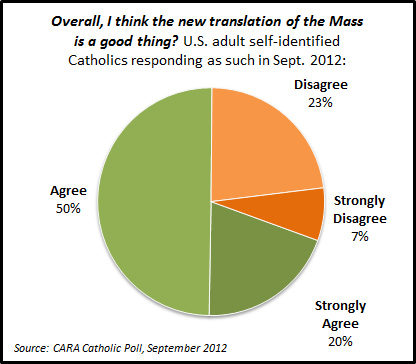
The survey, conducted in September by the Center for Applied Research in the Apostolate at Georgetown University, showed that seven in 10 Catholics agree that the new translation is “a good thing,” with 20 percent agreeing “strongly.”
Catholics who attend Mass weekly were more likely to agree that the new translation is a good thing, with 84 percent welcoming the new translation. Nearly half of those said they “strongly” approved of the new prayers.
Almost a third of the respondents (30 percent) disagreed, however, with 7 percent of the dissatisfied Massgoers expressing “strong” objections to the new prayers.
Overall, just 6 percent of the respondents said they thought the prayers had changed “to a great extent,” while 40 percent said they had changed only a bit and 31 percent said they had noticed no changes.
The translation was adopted after years of fierce debate and only after a strong push from the Vatican to have the U.S. bishops implement language that Rome said was closer to the Latin versions of past centuries. Advocates of an updated translation said it would be more accurate and poetic than the version that has been in use since the 1970s when the Mass was first translated from Latin to English for general use.
Critics replied that the latest translation was so literal that it wound up stilted rather than uplifting, and at times incomprehensible.
In one of the more memorable zingers, television comedian Stephen Colbert, a devout Catholic, told a crowd at Fordham University in September that he hated how translators replaced the Nicene Creed’s familiar phrase “one in being with the Father” to describe Jesus’ relationship to God, and instead used the term “consubstantial.”
“It’s the creed! It’s not the SAT prep,” Colbert quipped at a panel on faith and humor that also featured New York Cardinal Timothy Dolan.
The poll results should be good news for church leaders who are hoping to put the liturgy controversies behind them.
But this being liturgy, that may not happen. An online survey by U.S. Catholic magazine found a much higher level of dissatisfaction with the new prayers, and other Catholic media outlets have reported strong reactions against the translation, as well as vocal support for the more literal version.
The CARA survey of 1,047 self-identified adult Catholics was taken from Sept. 10-18 and has a margin of error of plus or minus 3 percentage points. It was commissioned by the Institute for Policy Research and Catholic Studies at the Catholic University of America.
DSB/AMB END GIBSON