


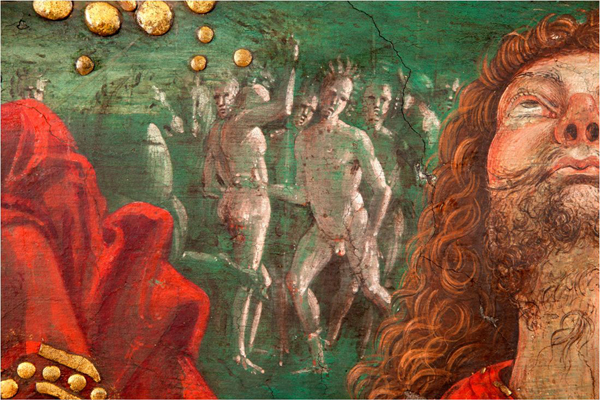


VATICAN CITY (RNS) Preservationists working on a Renaissance fresco in the Vatican have uncovered what experts believe is the first European representation of Native Americans, from 1494.
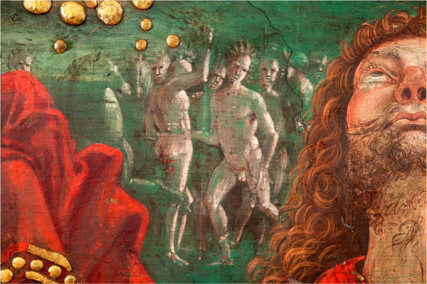
A Resurrection scene painted by the Renaissance master Pinturicchio was restored to reveal a small depiction of naked men with feathered headdresses who appear to be dancing. A man on horseback is also visible. Photo courtesy Vatican Museums
Writing on April 27 in the Vatican’s semi-official newspaper, L’Osservatore Romano, the director of the Vatican Museum, Antonio Paolucci, said the previously unnoticed detail was discovered in a Resurrection scene painted by the Renaissance master Pinturicchio.
Covered by centuries of soot, the restoration of the painting revealed a small depiction of naked men with feathered headdresses who appear to be dancing. A man on horseback is also visible.
According to Paolucci, Pinturicchio’s fresco dates back to 1494, just two years after Christopher Columbus “discovery” of the Americas.
The fresco is located in the so-called Borgia Apartment within the Vatican’s Apostolic Palace, three rooms used by Pope Alexander VI, the infamous Rodrigo Borgia, as his personal living space.
The depiction is consistent with Columbus’ account of being greeted by naked men who painted themselves black or red and danced for the European explorers on the coast of what he believed to be Eastern Asia.
Paolucci points out that Alexander VI, a Spaniard, was in close contact with the Spanish monarchy that had financed Columbus’ voyage.
Elected in 1492, Alexander VI showed a keen interest in the newly discovered continent. In 1493, he published the document dividing the uncharted New World between Spain and Portugal, the world’s major naval powers in that time.
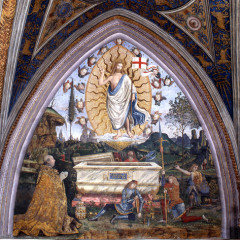
A Resurrection scene painted by the Renaissance master Pinturicchio was restored to reveal a small depiction of naked men with feathered headdresses who appear to be dancing. A man on horseback is also visible. Photo courtesy Vatican Museums
In his L’Osservatore Romano article, Paolucci writes that he can’t say for sure that the men in Pinturicchio’s fresco are Native Americans. But he says that it is hard to believe the Borgia papal court would be unaware of Columbus’ discovery and account, even if very recent.
“What if the early impression of those naked men, good and even happy, who gave parrots as gifts and painted their bodies black and red, came to life in the small dancing figurines in the background of Pinturicchio’s Resurrection?” Paolucci wrote.
KRE/LEM END SPECIALE