

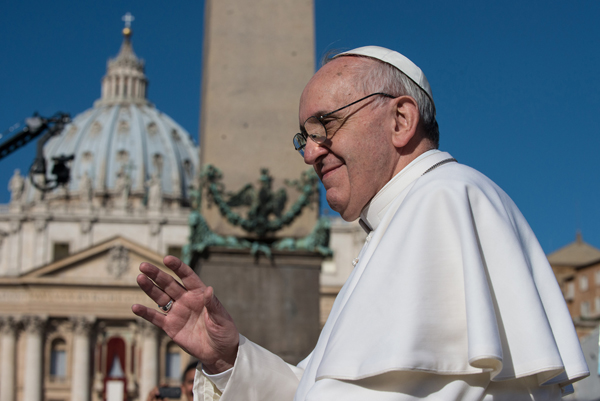


Pope Francis waves from the pope-mobile during his inauguration Mass at St. Peter’s Square on Tuesday (March 19) at the Vatican. RNS photo by Andrea Sabbadini
Pope Francis, as Cardinal Bergoglio, once tried to deliver the final blows to liberation theology but he has come around to embrace the poor. At least that’s what readers of the New York Times might believe.
On Saturday, an article entitled “Francis’ Humility and Emphasis on the Poor Strike a New Tone at the Vatican” began with this (emphases mine):
He has criticized the “cult of money” and greed he sees driving the world financial system, reflecting his affinity for liberation theology.
But if you think back to March, when the Pope was just elected, publications were scrambling to publish anything even remotely insightful about this unknown Cardinal Bergoglio of Buenos Aires. The Times settled on the “another conservative” theme, and paid particular attention to liberation theology given the new Pope’s Latin American roots.
From “Cardinals Pick Bergoglio, Who Will Be Pope Francis” on March 13:
A doctrinal conservative, Francis has opposed liberation theology, abortion, gay marriage and the ordination of women, standing with his predecessor in holding largely traditional views.
From “A Conservative With a Common Touch” that same day:
Though he is averse to liberation theology, which he views as hopelessly tainted with Marxist ideology, Cardinal Bergoglio has emphasized outreach to the impoverished, and as cardinal of Buenos Aires he has overseen increased social services and evangelization in the slums.
And “New Pope Puts Spotlight on Jesuits, an Influential Yet Self-Effacing Order” on March 16:
However, Francis, when he was head of the Jesuits in Argentina in the 1970s, was opposed to liberation theology, seeing it as too influenced by Marxist politics.
There are several possibilities here. Pope Francis might be a strong advocate for the poor and yet eschew liberation theology given its fairly controversial past. Maybe he see his role as pope as somewhat different from his role as archbishop and thus chooses his words more carefully. Or the Times, like many publications, might have, in this instance, rushed the characterization without fully considering Bergoglio’s nuanced position on complex social issues, including the economy and poverty.