

The Vatican sets rules for new Internet domain: sorry, Catholic bloggers


ROME (RNS) The Vatican has secured the use of the new Internet domain name “.catholic,” but bloggers hoping that platform could ramp up their own digital pulpit will be disappointed — the Holy See says it’ll be reserved for church-related organizations, not individuals.
The new rules on how to assign rights to the “.catholic” domain name are part of the larger issue of how to adapt a tradition-bound, 2,000-year-old institution to the fast-paced digital present.

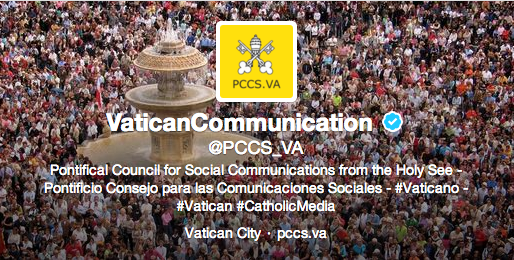
Screenshot of the Vatican Twitter profile
Case in point: As the parameters of the new domain name were being set, Ivano Dionigi, president of the Vatican’s Latin Academy, said Friday he was still debating how to say “Twitter” in Latin.
Pope Francis tweets in eight languages, and his Latin feed is surprisingly popular — it has more followers than the native languages of the last previous two popes, German and Polish. But there is still no consensus on how to refer to the medium in the church’s official language, Dionigi said.
National top-level Internet domains, such as “.it” for Italy or “.ca” for Canada or “.mx” for Mexico, are usually limited to sites based in those countries, and so the Vatican’s “.va” domain is necessarily restricted because it can be used only for sites that originate from within the 110 acres of the tiny city-state.
But other domains don’t carry geographical restrictions, though newer top-level Internet domains created by ICANN (the Internet Corporation for Assigned Names and Numbers) like “.movie” or “.guru” or “.museum” are more restrictive than the Web’s original monikers “.com,” “.org” and “.net.”
In the case of “.catholic,” individuals — whether religious bloggers or a cleric — will not have access, according to Monsignor Paul Tighe, secretary of the Vatican’s social communications council.
That extension will be reserved for church institutions such as dioceses, parishes, religious orders, schools, universities or hospitals. Use of the domain, Tighe said, will be a guarantee that a site is “authentically Catholic.”
“The domain will create a cohesive and organized [Web] presence … so the recognized structure of the church will be mirrored online,” he said, according to Italian media reports.
DBG/MG END LYMAN