




As a pastor’s kid, I’ve often encountered people who are surprised that I still identify as Christian.
“Aren’t pastor’s kids usually the most rebellious of them all?” seems to be the typical — or stereotypical — commonsense understanding of the character and inclination of the children of clergy.
Now there’s evidence that this assessment is exactly wrong.
Professor Vern L. Bengtson, who grew up in a highly religious family and attended an undergraduate institution sponsored by his denomination — the Evangelical Covenant Church — began wondering why “some young people adopt their families’ views, while others, especially in the ‘60s, strike out on their own?”
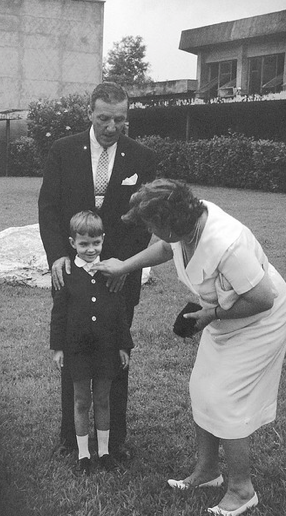
“Mi primera comunión.” [My first communion.] Caracas, Venezuela, 1963. Photo courtesy A. Davey via Flickr Creative Commons.
Bengtson, who is himself the son of a minister, left faith entirely during graduate school, but “by golly, I had this religious experience when I was about 67 years old,” he told Mark Oppenheimer of the New York Times. At 72, he is once again attending church.
“Don’t give up on the Prodigals,” says Bengston. “Many do return.”
The “major conclusion” of Bengston’s research? Staying close to your kids matters. You can be as pious as you want, impart all the “correct” doctrines, and keep the codes of best religious practice with absolute scrupulousness, but without “warmth and affirmation,” Bengston says, kids are less likely to follow their parents in their faith.
It’s not a list of beliefs or practices that parents pass on. It’s an orientation; a relationship, and something, Bengston suspects, that can’t be accurately measured by what he now calls the “trivial” questions he asked in his research.
Recently blogger and author Rachel Held Evans wrote about some of the pain that she has endured after having been essentially cast out of Christian communities with which she once identified strongly. This ‘exile’ is one that resonates deeply with me — a subject for a future post — but in light of Bengtson’s research, it seems to raise an important question:
Are we willing to trust our children to God as we understand God? Are we willing to impart our values and o faith to them without force-feeding them? Are we willing to accept that even if we raise our kids in the faith, “when [they are] old [they] will not depart from it” is not the ironclad guarantee we would like it to be?
Because if Bengtson’s research — nearly four decades of it! — has anything to say to parents of faith, I think it is this: we should not try to pass on a “checklist of beliefs.” We should try to model authenticity (in other words, to “practice what we preach.”) And above all, the research suggest, we should try to hold our kids close.
The greatest of these, it turns out, is not perfect doctrine, but love.