




(RNS) Bible films may be raking it in at the box office, but fewer people are reading the original and taking it seriously.
The American Bible Society’s latest State of the Bible survey documents steep skepticism that the Good Book is a God book.
“We are seeing an incredible change in just a few years time,” said Roy Peterson, president of the society.
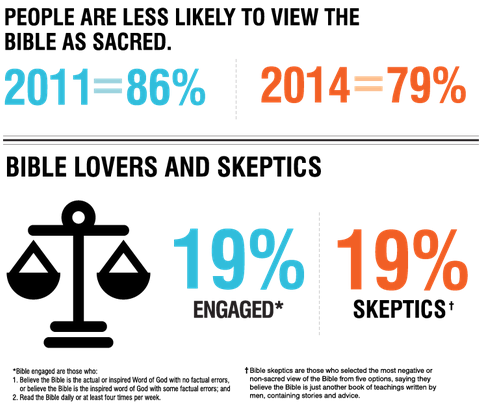
A new study by Barna Research for the American Bible Society finds skepticism is on the rise. Graphic courtesy of American Bible Society
The study, conducted annually by Barna Research, finds:
- The most “engaged” readers — who read the Bible almost daily and see it as sacred — are now matched by “skeptics” who say it’s just a book of stories and advice. Both groups measured 19 percent.
- While the engaged stayed steady since 2011, skeptics grew by 10 percentage points — since the same survey was conducted in 2011.
- Skeptics cut into the number of folks Barna calls “Bible friendly,” those who read the Bible occasionally and see it as inspired by God. The “friendly” demographic fell to 37 percent, down from 45 percent in 2011.
- The percentage of people who view the Bible as sacred has dropped to 79 percent, down from 86 percent in 2011.
The study is based on 2,036 interviews with U.S. adults in January and February.
Peterson told RNS on Wednesday (April 9) that the statistics are “sobering but not discouraging.”
The key, he said, is “adjusting our outreach” to reel in the next generation. Millennials, ages 18 to 29, lead the skeptics tally:
- 64 percent say the Bible is sacred literature, compared with 79 percent of all adults.
- 35 percent say the Bible offers “everything a person needs to know to lead a meaningful life,” compared with half of all adults.
- 39 percent of millennials admit they never read the Bible, compared with 26 percent of adults as a whole.
“We have to find where they are hurting, what questions millennials are asking,” he said.
The society has already started down that road by creating Bible-reading “journeys” to meet people’s needs, he said. On its website, people can key in a word such as “hope,” “parenting,” “job loss” or “loneliness” and be steered to a seven- or 10- or 40-day journey of Scripture selections designed to address that concern.
There are already more than 90 topics listed, he said, and “we are adding more strategic journeys every day. We’re being invited to youth conferences as a Scripture partner. So we take it as a very urgent mission.”
The data confirms, Peterson said, that “we just can’t hand them a Bible and expect them to find the answers. We have to get out the word to give God’s word a chance. It’s urgent.”
YS/MG END GROSSMAN