





As I previously posted, the 2012 American National Election Study, atheist is not a popular identity among the “nones.” Atheists made up less than one-in-five of those who did not belong to any religious group, never attended church, and said religion wasn’t important in their lives. So, who identifies as an “atheist”?
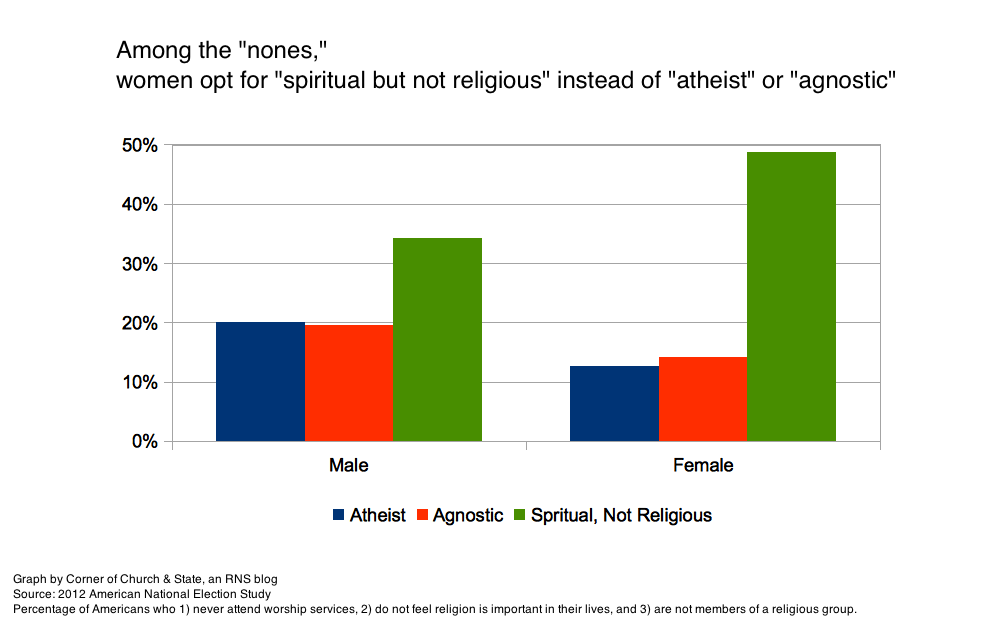
Women opt for “spiritual but not religious” instead of “atheist” or “agnostic”
The first answer is simple: women rarely consider themselves to be atheists. Gender problems well-known among those active in atheist or secular groups. The survey found nearly half of secular woman eschew both “atheist” and “agnostic” in favor of “spiritual but not religious.” Men are nearly twice as likely to identify as “atheist” or “agnostic”.
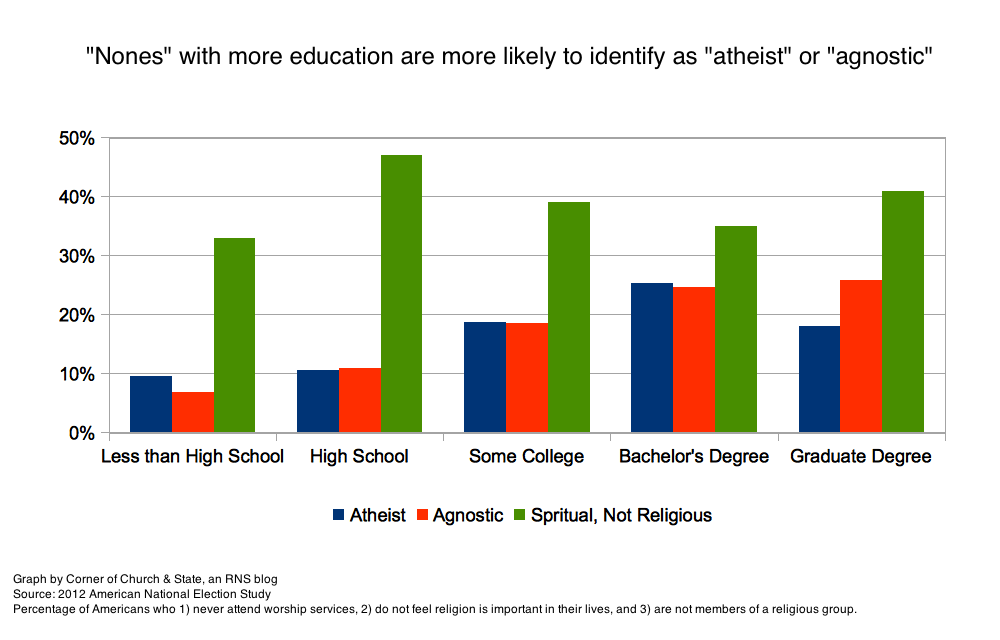
With a little bit of college education, the chances of identifying as an atheist increases dramatically among the nones.
Atheists also face an education gap. “Atheist” and “agnostic” are rare among the “nones” who have not attended college. It is only among college graduates that “atheist” and “agnostic” (together) outnumber the “spiritual but not religious.”
This is a different phenomenon than the gender gap. For the gender gap, it’s a trade-off. women choose “spiritual but not religious” as an alternative to “atheist” or “agnostic;” men do the opposite. For education, the situation is different. People don’t drop “spiritual but not religious” in favor “atheist” or “agnostic” (note that the percentage who see themselves as “spiritual but not religious” doesn’t vary much by education). With more education, those with no religion are more likely to understand what the words “atheist” and “agnostic” mean and identify with them. They change from being people with no identity to being “atheist” or “agnostic.”
But even among highly educated men who have zip to do with religion, “atheist” and “agnostic” aren’t completely accepted. Among this group of nones, just over half identify as “atheist” (26%) or “agnostic” (56%).