






It has been 17 years since Suzette Bronkhorst, pictured here, co-founded the Dutch Complaints Bureau for Discrimination on the Internet, known as MDI. Photo courtesy of Stichting Magenta – Magenta Foundation
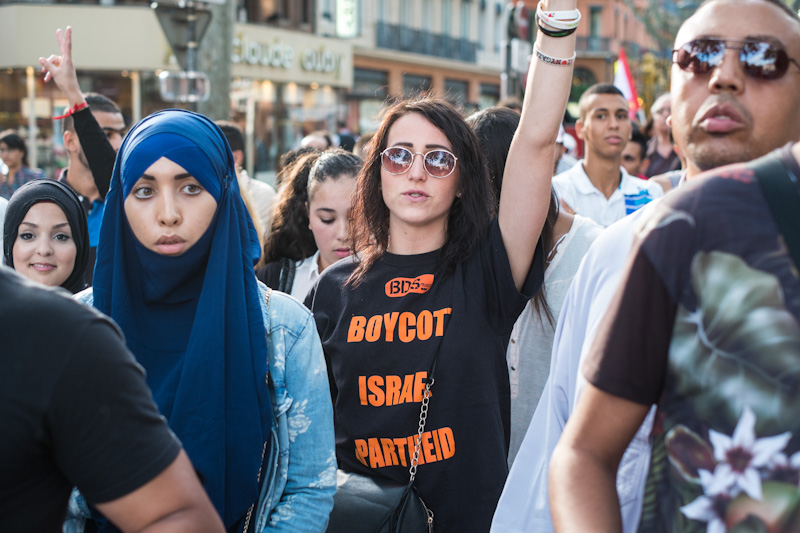
Scroll to the end of this story to view photo slideshow of a peaceful protest in support of Palestine on Thursday (Aug.14) in Toulouse, France.
BERLIN (RNS) It’s been 17 years since Suzette Bronkhorst co-founded the Dutch Complaints Bureau for Discrimination on the Internet, but she said she doesn’t remember the level of anti-Semitic speech on social media platforms ever being this high.
“There are thousands of incidents and we’re getting so many complaints,” she said of her organization, which registers complaints of hate speech online. “There’s been a huge surge since Gaza.”
The Gaza conflict, which has led to the deaths of 1,900 Palestinians and 68 Israelis, has also sparked a wave of counter speech, with organizations like Bronkhorst’s attempting to tackle hate speech by debunking myths and stereotypes on blogs, forums and social media.
“There’s a lot of chatter on the Internet that is not based on fact and there are different ways in which you can do counter speech,” said Bronkhorst, whose organization goes by the name MDI. “For instance, if there’s a discussion on Facebook, you join in and you try to give counterpoints to people who are just ill-informed.”

Magenta Foundation hosts the conference of the International Network Against Cyber Hate at the Jewish Historical Museum in Amsterdam, 2009. Photo courtesy of Magenta Foundation, Amsterdam, Netherlands, 2014.
In one instance, Bronkhorst’s volunteers asked a Twitter user writing “Hamas, Hamas, Jews to the gas” whether he really wanted to murder people by gassing them. The user removed the tweet, apologized and said he didn’t mean it.
In July, the number of Dutch-language anti-Semitic Facebook pages ran into the hundreds, according to MDI, which cannot keep up with the amount of hate-fueled posts, ranging from statements such as “Jews must die” to those praising Adolf Hitler. On Twitter, the hashtag “Hitler was right” appeared more than 10,000 times in July in connection with Gaza and became a trending topic, says MDI.
Sergey Lagodinsky, a lawyer and a member of the Jewish community’s representative assembly in Berlin, said comments by friends on Facebook shocked him.
“It’s hardly tolerable because people are being attacked,” said Lagodinsky. “You have a lot of people who you thought were friends who articulate things in a way which leaves you speechless.”
Berlin’s Technical University has just started a project analyzing around 100,000 Internet texts to see how anti-Semitism spreads online on social media and in comment sections, chatrooms and forums.
“The Internet plays an important role here as more drastic use of language can flourish through links between websites as well as user anonymity,” said Matthias Jakob Becker, a member of the research team.
The team has found that not only Islamist and right-wing circles have resorted to old canards, such as Jewish world-domination conspiracy theories, but so, too, has the educated middle class.
Anti-Semitism is a particularly sensitive issue in Germany. Special police protection is provided for Jewish buildings, ranging from synagogues to bakeries, and the growing anti-Jewish sentiment even prompted the country’s biggest newspaper, Bild, to wade into the fray.
On its website, the newspaper created a button depicting a Star of David and the slogan “stimme erheben: nie wieder Judenhass” (raise your voice: never again Jew hatred) that people could share online. It has also added interviews with celebrities, politicians and ordinary people speaking out against anti-Semitism. Bild encouraged readers to tweet against anti-Semitism under the hashtag “stimme erheben.”
While the campaign ran for just one day, Tobias Froehlich, a representative for Axel Springer, Bild’s owner, said the publication may follow up with similar campaigns.
“You can still find it online and of course, depending on how the news develops, you could see it again in our newspaper,” said Froehlich. “The voice against anti-Semitism isn’t just for one day.”
Members of Germany’s Jewish community said the Bild campaign is a reminder that Jews in Europe are generally safe and that while anti-Semitism is a reality, it’s mainly kept in check.

American freelance writer Giulia Pines Kersthold, photographed at Falkplatz in the Prenzlauer Berg neighborhood of Berlin on June 14, 2014. Photo © Harald Franzen, courtesy of Giulia Pines
“The online world is a tool of propaganda for hate speech against everyone,” said 29-year-old Giulia Pines Kersthold, a Jewish New Yorker and author who has lived in Berlin for six years. But she added: “I have never really felt unsafe as a Jew in Germany and I would say that I still don’t.”
In France, where pro-Palestinian demonstrations in July culminated in attacks on eight synagogues, many Jews are fleeing to Israel.
Between January and June, 2,830 French Jews emigrated to Israel. That number is expected to exceed 5,000 by the end of 2014 — marking the first time in modern history that a full 1 percent of a western Jewish community will move to Israel in a single year, according to the Jerusalem-based Jewish Agency for Israel. In 2013, 3,288 French Jews left for Israel.
Yonathan Arfi, vice president of the Representative Council of Jewish Institutions of France, called the anti-Semitic surge a new phenomenon that has intensified thanks to the Internet.
“It is a space without laws,” he said. “You have many people on the Internet who are Jewish and easily accessible to people who target them.”
Bronkhorst at MDI acknowledges the difficulties but is optimistic and hopes the project will expand to other organizations in the International Network Against Cyber Hate, of which MDI is a member.
“It’s a matter of resources right now,” said Bronkhorst. “We’re going to do it and we can only do it if we all work together to change our neighbor and let our neighbor change another one — one drop at a time to make an ocean.”
(Angela Waters and Jennifer Collins contributed to this report.)
YS/MG END SERENELLI
Click on any photo to begin this slideshow of a peaceful protest in support of Palestine on Thursday (Aug.14) in Toulouse, France. Religion News Service photos by Raphaël Fournier / Divergence