


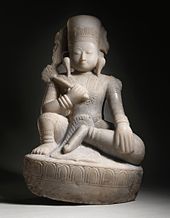


18th-century depiction of Avalokiteśvara Bodhisattva
Having concluded an historic agreement with China to mitigate global climate change, President Obama arrives in Burma today hoping to improve the political and religious climate in that troubled Buddhist country. Progress towards democracy has stalled and, in one of the most disturbing human rights stories of the past few years, the persecution of the Rohingya Muslim minority continues apace.
What the outside world fails to appreciate is just how deeply enmeshed the persecution of the Rohingya is in the larger political situation. Essential reading in this regard is “Breaking Bad in Burma,” a uniquely revealing article by the University of Wisconsin’s Ingrid Jordt.
As Jordt makes clear, Buddhism is the constituting reality of the Burmese state. It confers national identity and determines political legitimacy. Its institutional health depends on Burmese control of economic life. And when any of the above is threatened, as they’ve been in the past few years, anxiety about ethno-religious minorities like the Rohingya rises — and is ripe for exploitation by the powers-that-be.
There’s no question that the current powers-that-be — former military rulers in civilian garb — have been engaged in such exploitation. They have fostered the anti-Muslim activism by Buddhist monks that has so shocked outsiders accustomed to thinking of Buddhist monks as gentle souls dedicated to peace among all peoples. The opening up of the Burmese economy to international capitalism has been used to weaken the capacity of the Buddhist establishment to oppose autocratic rule.
Outsiders have also been disturbed by the conspicuous silence regarding the Rohingya of Aung San Syuu Kyi, the Nobel Peace Prize-winning human rights activist who aspires to be Burma’s next president. But as Jordt makes clear, Syuu Kyi represents a secularized Buddhism more in tune with Western values than with the metaphysics of Burmese statecraft. Her room for maneuver inside Burma has been severely constricted.
In the past, Burmese rulers have been able to shore up their power by playing the anti-Muslim card. But they have also been prepared to back off when it suits their purposes. It may well turn out that, in the face of criticism by the American president and other international leaders, the present regime will take steps to lower the pressure on the Rohingya.
But fundamental change seems a very long way off.