


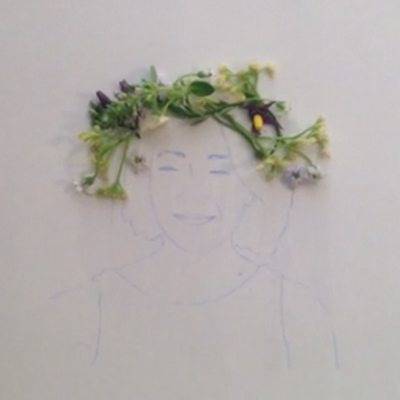


Animation from “The First Day of the Week” courtesy of Sarah Martin
How does one make the invisible visible? This is the question Brooklyn-based filmmaker Sarah Martin wrestled with when she set out to make the “The First Day of the Week,” a one minute film exploring “the relationship between our breath and the breath of our Creator.”
Martin created the film after her faith community, Trinity Grace Church in the Chelsea neighborhood of Manhattan, decided to host an art night themed around the Hebrew word ruach, which translates as wind, breath, or Spirit. She animated by rotoscoping, which is an animation technique linking multiple hand-traced frames. Rotoscoping was created by cartoonist Max Fleischer in 1915 and has been used in cartoons from Betty Boop to the Looney Toons, but it is rarely used by animators today. Martin resurrected the technique for “The First Day of the Week,” which is comprised of 200 pencil and watercolor drawings of a young woman accented by flowers.
“The woman in this film seeks surrender, freedom from chaos and anxiety, and reliance on something greater than herself,” Martin says. “She finds her new identity in the wind or in the Spirit, and she rests in her right to become a child again.”
Martin, who studied film production at Boston University, says she decided early on to focus on the process rather than the outcome. The result was a film she believes is “simple and meditative” but also thought-provoking.
“I want people to consider the power of surrender, and the importance of distancing ourselves from all of our unhealthy distractions to be comfortable in silence,” Martin says. “I hope people will either revisit or consider the beauty of slowing down, breathing, and hearing their hearts.”
View the film here as you meditate on what ruach means to you: