


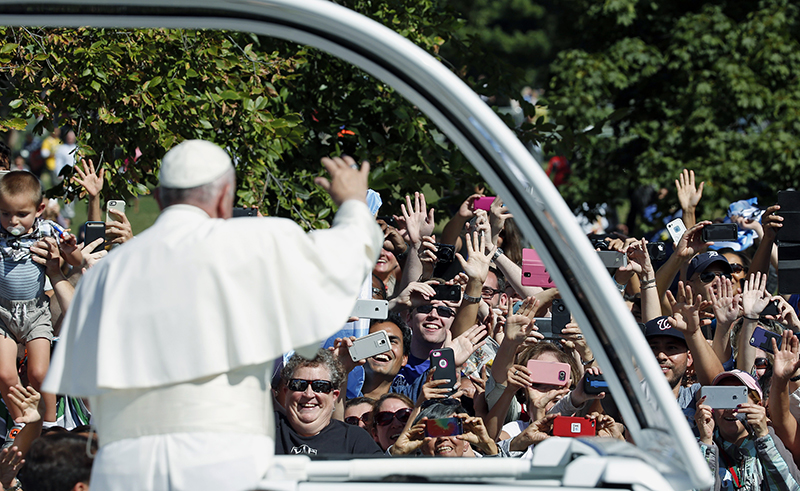


Pope Francis waves from the popemobile during a papal parade in Washington on September 23, 2015. Pope Francis is making his first visit to the United States. Photo courtesy of REUTERS/Pool *Editors: This photo may only be republished with RNS-POPE-MEDIA, originally transmitted on Oct. 7, 2015.
(RNS) Social media took a back seat to personal interviews for journalists covering Pope Francis’ recent U.S. trip, a new study finds.
The Pew Research Center studied the coverage from 12 major news organizations over the first four days of the pope’s September U.S. visit and found that journalists relied more on face-to-face encounters with sources than they have in some other breaking news events.
Only about 12 percent of the stories studied included reports posted to social media outlets such as Facebook and Twitter. And when social media was cited, Twitter was the big winner, with journalists turning to it 83 percent of the time.
The study also found that almost one-third of the stories — 31 percent — cited at least one of the hundreds of thousands of people who turned out for the papal events. The only sources cited more frequently as the events unfolded were Pope Francis or a Vatican official, at 56 percent.
The study is intended to be a “window” showing what kinds of sources journalists rely on when news breaks, said Amy Mitchell, the Pew Research Center’s director of journalism research.
“Journalists could have turned to social media like Facebook and Twitter” for reporting, as they did after the police shooting in Ferguson, Mo., or the Arab Spring uprising in Egypt, Mitchell said. “But what drew reporters in was more of a connection with the public.”
In addition, the report said that despite the number of papal events in Washington, D.C., politics did not dominate papal coverage.
Only about 12 percent of stories cited politicians, while another 12 percent cited President Barack Obama. And when they did, their remarks were more likely to include personal reflections, feelings or observations about the pope than personal political agendas.
Pew’s researchers studied news coverage from Sept. 22-26 from 12 websites identified as among the top 25 sites in comScore’s news and information category. They were Yahoo News, ABC, CBS and NBC News, Fox News, The Huffington Post, CNN, USA Today, Buzzfeed, The New York Times, The Washington Post and the Los Angeles Times.
YS/MG END WINSTON