


WASHINGTON (RNS) Religious organizations are providing more than half of the emergency shelter beds for homeless people in major cities across the country, a new Baylor University study shows.
In a preliminary study of 11 U.S. cities, 58 percent of emergency beds for the homeless were at faith-based organizations. That percentage ranged widely across the cities, with 90 percent of emergency beds in Omaha, Neb., provided by faith groups and 33 percent in Portland, Ore.
“Some cities are able to have much more of a faith-based response than others,” said Byron Johnson, director of Baylor’s Institute for Studies of Religion, at the Wednesday (Feb. 1) release of the findings at the National Press Club. “Not one size fits all.”
The report found that cities with higher participation by religious groups had lower percentages of unsheltered homeless people.
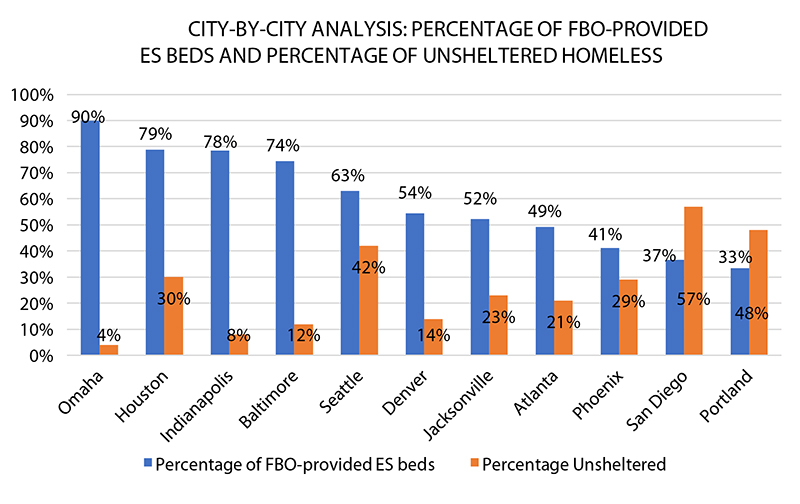
City-By-City Analysis: The percentage of Emergency Shelter beds provided by Faith-based organizations varied significantly by city, with a high of 90% FBO-provided ES beds in Omaha compared to 33% in Portland, OR. Cities with a higher percentage of FBO-provided ES beds correlate with relatively lower percentages of unsheltered homeless individuals. Graphic courtesy of Baylor Institute for Studies of Religion
The report’s findings were based on analysis of data collected by the U.S. Department of Housing and Urban Development and site visits to the 11 cities. Researchers focused on groups such as the Salvation Army, Catholic Charities and rescue missions and not houses of worship, some of which also provide shelter for the homeless.
Researchers also estimated that there was a three-year total of $119 million in taxpayer savings connected to faith-based organizations that provided transitional housing programs in those cities, which provide longer lengths of stay and include mentoring and rehabilitation.
“Certainly there is a value to providing emergency shelter beds in terms of everything from the downtown business community to health concerns,” said report co-author William Wubbenhorst. “But the real value is the degree to which organizations bring about transformation in individuals.”