


Merry Christmas or Happy Hanukkah? For some interfaith families, it’s both


FORT WORTH, Texas (RNS) — When Ethan Klos, who was raised Jewish, and his wife, Ricki, a Christian, were ready to start a family, the Texas couple consulted a rabbi and a pastor about which religion to raise their kids in.
“Pick one,” the rabbi told the couple. “It doesn’t matter to me which one you pick.”
“So naturally,” recalled Ricki Klos, “that’s not what we did.”
The couple decided to raise their family in the Christian and Jewish faiths, alternating Sunday schools between temple and church.
Ethan and Ricki Klos represent the 17% of Americans whose spouse has a different religious affiliation than themselves, according to a 2024 Public Religion Research Institute study. This year, their commitments may be tested, as the first night of Hanukkah and Christmas Day will converge for the first time since 2005.
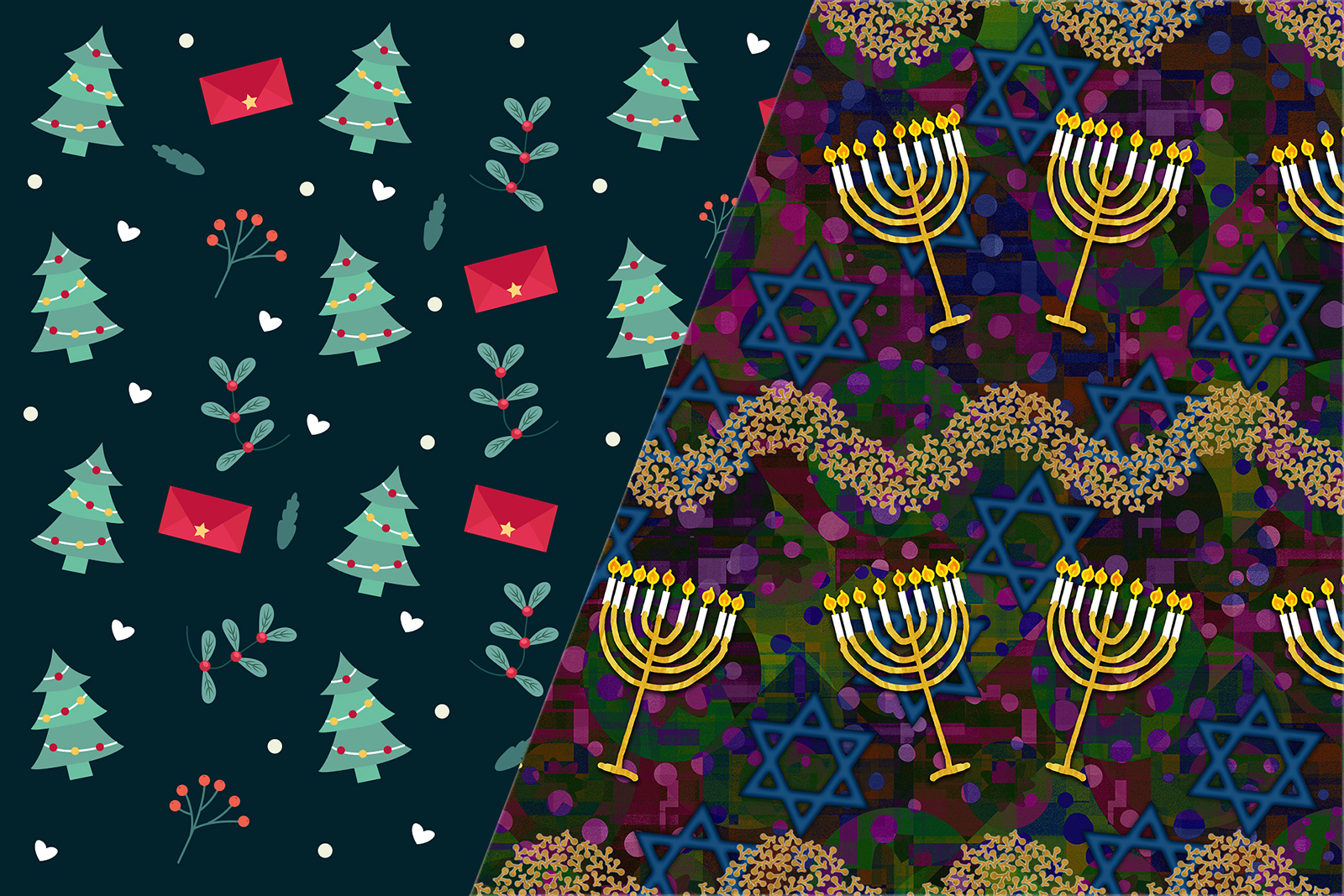
The Klos family has found different ways to honor both religious heritages in their Fort Worth home, where a collection of menorahs rests on a table and Star of David ornaments hang on the Christmas tree. “We’ll have Hanukkah decorations up all over the house, just as much as Christmas,” Ricki said.
The family will participate in the lighting of the candles and say prayers for Hanukkah. They will also read the Christmas story from the Bible, Ricki Klos said.
Interfaith couple Eric and Lauren Wessinger, who also live in Fort Worth, decided to raise their children, now teenagers, as Jews, celebrating Hanukkah as a religious holiday and Christmas as more of a cultural one, Lauren Wessinger said.
It was the best answer for both Eric, who grew up with a Jewish mother and a Christian father, and Lauren, who was raised without a specific faith but said her spirituality has been inspired by her mother, a convert to Tibetan Buddhism.
The family will light the menorah and attend Hanukkah holiday parties as well as have a Christmas tree at home.
The Wessingers said the holiday season can be a time to clear the air on misconceptions about what it means to observe both Christmas and Hanukkah — the notion, for instance, that their kids get twice the number of gifts for observing both holidays.
Being an interfaith family has also given Lauren Wessinger the opportunity to share about her family’s practices to curious friends or congregants, she said. “What I love is when people want to talk about it and ask what our traditions are, and they’re genuinely interested in families who do it differently,” Lauren said.
The Wessingers have also adopted mindfulness practices as a way to honor Lauren’s mother’s Buddhist faith and set intentions for the new year, by making vision boards or journaling.
“Even though we are doing Judaism more than anything, I still very much share the practice of mindfulness with the kids and the philosophies of Buddhism with them in the way that I lead our family and approach challenges and help them see difficulty through that lens,” Lauren Wessinger said.
Though they celebrate each holiday distinctly, the Wessingers cherish the shared days most of all. “It’s about being together in family time and the relationship piece of it,” her husband said. “Everyone’s always off for Christmas, so it’s just a good time to be together as a family, regardless of what your faith is.”
And though raising an interfaith family has not always been easy, Ricki Klos said, “I feel good that they’ve been exposed to two faiths, and they know two faiths very, very well. I don’t regret anything.”
Christmas and the first night of Hanukkah will realign again in 2035 and then in 2054, according to the Jewish calendar website Hebcal.
This article was produced as part of the RNS/Interfaith America Religion Journalism Fellowship.