


Survivors of Hindu-Muslim riots find healing in women's empowerment


DELHI, India (RNS) — Five years after riots swept through her neighborhood in northeast Delhi, the region around India’s capital, 18-year-old Anam Sa still wakes up in the middle of the night flushed, breathing fast, arms shaking.
Sa recalls most clearly how her father collapsed when he saw their three-storied house set on fire by Hindu rioters.
In February 2020, after the government of Prime Minister Narendra Modi passed the Citizenship Amendment Act, which would exclude many Muslims from a fast-track to citizenship, Delhi witnessed a deadly, dayslong wave of violence in which Muslims saw their properties destroyed, mosques and prayer books set on fire. Hundreds of homes and shops were set ablaze by mobs wearing saffron headbands to signify their faith, and more than 50 people were killed.
As rioters stormed into dense and overcrowded neighborhoods in northeast Delhi, the epicenter of the riots, residents fled to their ancestral villages with little on their backs. When the flames subsided, most residents returned without homes, jobs or social security, haunted by memories of smoke, gas cylinders and petrol bombs.
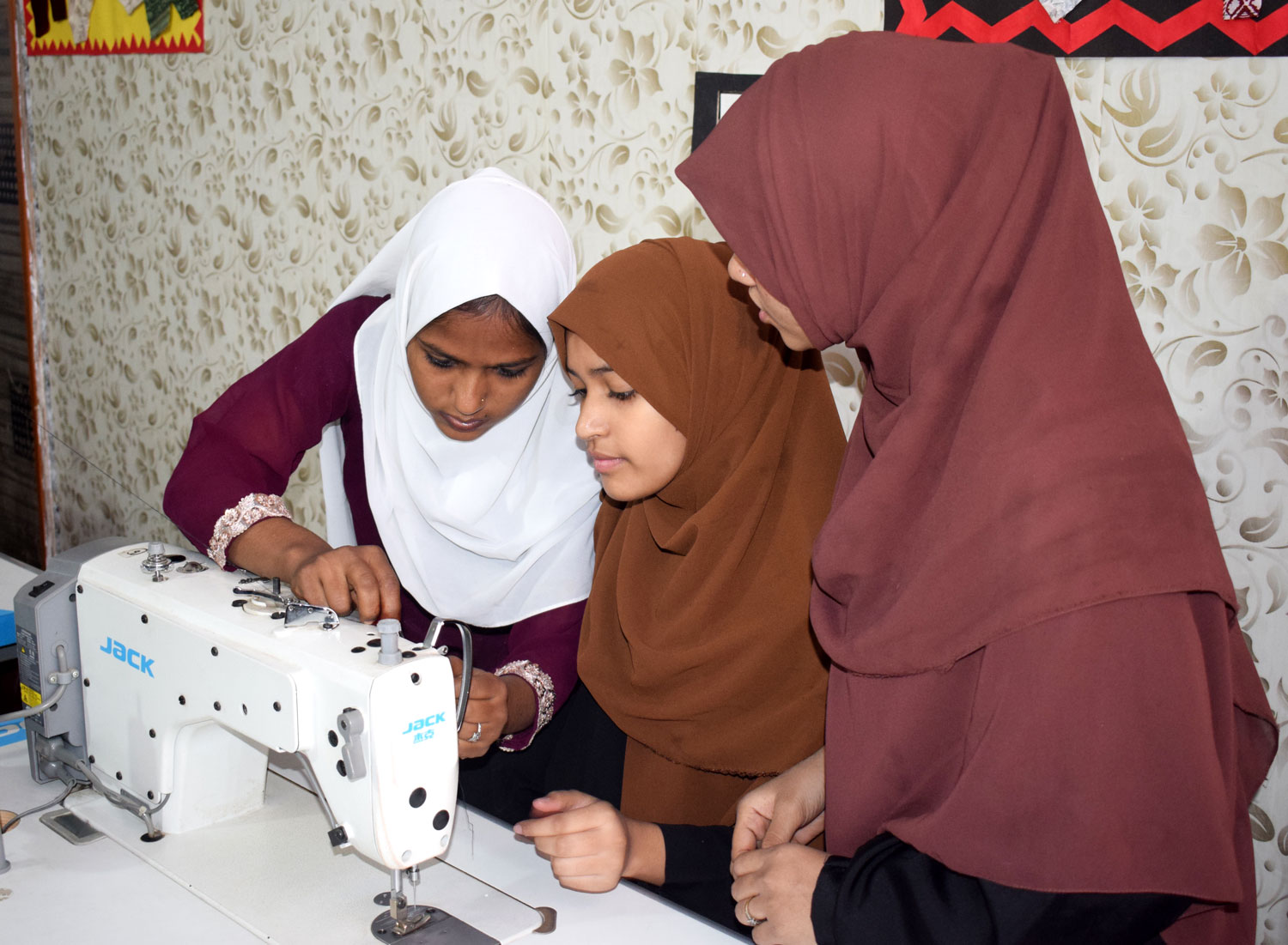
Today Sa is a frequent visitor to Sabaat, a safe space on the outer fringes of Delhi for women survivors of religious hate and violence, where she has begun to heal. “In the last six months, I’ve learnt how to stitch dresses and trousers,” she said, her light-brown eyes kohl-lined. “We stitch fabric here, share our traumas and help each other heal.”
“It’s the women who suffer most in the aftermath of riots,” says Aasif Mujtaba, a social activist and engineer who initiated the women’s empowerment center in the riot-affected area two years ago. “I wanted a place where women could express themselves freely and rebuild their identities.”
Sabaat — the name means ”endurance” — also provides women rare personal space in a largely working-class neighborhood densely packed with one-room tenements. In these houses, lower middle-class Hindus and Muslims coexisted peacefully until the riots wrecked their communal harmony.
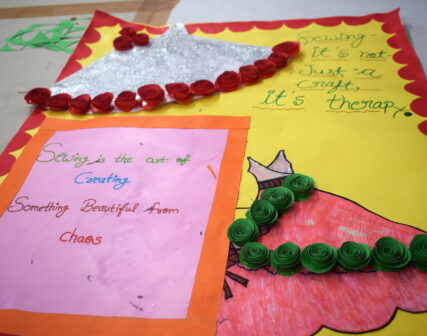
Tailoring students have painted a poster suggesting sewing is therapy and can help them overcome their traumas following the 2020 Delhi riots, at Sabaat in Delhi, India on November 16, 2025. Photo by Priyadarshini Sen for RNS
In Sabaat’s three-story building, with rooms for stitching and other crafts, Hindu and Muslim survivors of the riots turn fabric into outfits, handicraft and tote bags and draw patterns on magnets and tumblers.
“Each stitch carries a story of resilience and healing,” said Shehnaz Bano, a 19-year-old student who survived an attack in which rioters broke into her house with sticks, cylinders and ammunition. “Those memories still haunt me, but my faith in Allah has grown stronger.”
Fearing for their personal safety, Bano and her family fled in the middle of the night for the nearby town of Gorakhpur, where their people have lived for generations. Their faith in humanity, they said, was badly jolted.
At Sabaat, Bano turns fabric into abayas — loose robe-like dresses worn by Muslim women to forefront their religious identity — in a two-hour morning class dedicated to embroidery, sewing and design. The instructor, Farheen Ansari, said her classes have swelled as families, at first reluctant to send their girls out of their homes, were persuaded through house-to-house visits, counseling and conversations on bridging community divides.
“From trauma and suffering we’re seeing so many vulnerable women achieve financial independence,” said Ansari, who instructs her students on ways to start small garment manufacturing units at home after completing their six-month course. They eventually supplement their family incomes by supplying uniforms to schools, selling them online or at local boutiques.
Ansari at times serves as more than a teacher, but as a comforter of her students when memories of the horror five years ago overwhelms them.
Sangeeta, a devout Hindu who sheltered Muslim families during the riots, said working with other survivors has restored the women’s faith in Allah and Hindu goddesses like Durga and Kali, who emphasize the power of women. “The rioters tore mosques down, stamped on prayer books and defaced our holy places,” said Sangeeta, her thin voice recalling past horrors. “But see how we are weaving our gods and goddesses into our work and rising above petty religious divisions.”
By creating items for a greater purpose, they see a deep “spiritual connection” developing among them, allowing them to process their emotions.
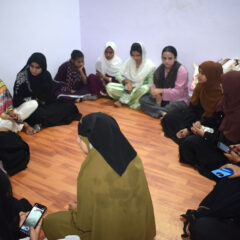
“It’s God’s hand at work,” said Islamuddin Mansoori, the chief coordinator at the safe house who has been watching closely the psychological toll of the riots.
After Mansoori’s own college education was disrupted by the riots’ effect on his family, he resolved to promote interfaith harmony and education in areas most vulnerable to communal tensions.
In the aftermath of the violence, he said, some women were so traumatized that the loud chanting of a religious procession could keep them from leaving their houses. “Women’s mental health has taken a major hit,” said Mansoori. “That’s why we felt the need to build a center that could support them socially, financially and spiritually.”
Their work offers a measure of hope to families still recovering from their losses and those caught up in the long-drawn and complicated struggles for justice and compensation. Sabaat’s founder, Mujtaba, calls it “sabr” — active self-restraint and thoughtful action — by women who’ve remained spiritually steadfast against all oppressions and injustices.
The riots may have driven a wedge between Hindus and Muslims, but Mujtaba believes it has also allowed communities to endure hardship while maintaining their faith. “People are more resilient and their faith has got stronger,” he said. “At Sabaat, women are stepping forward as guides for spiritual renewal of affected communities.”