


Republicans, Southerners, Trump backers mostly likely to support Christian nationalist ideas
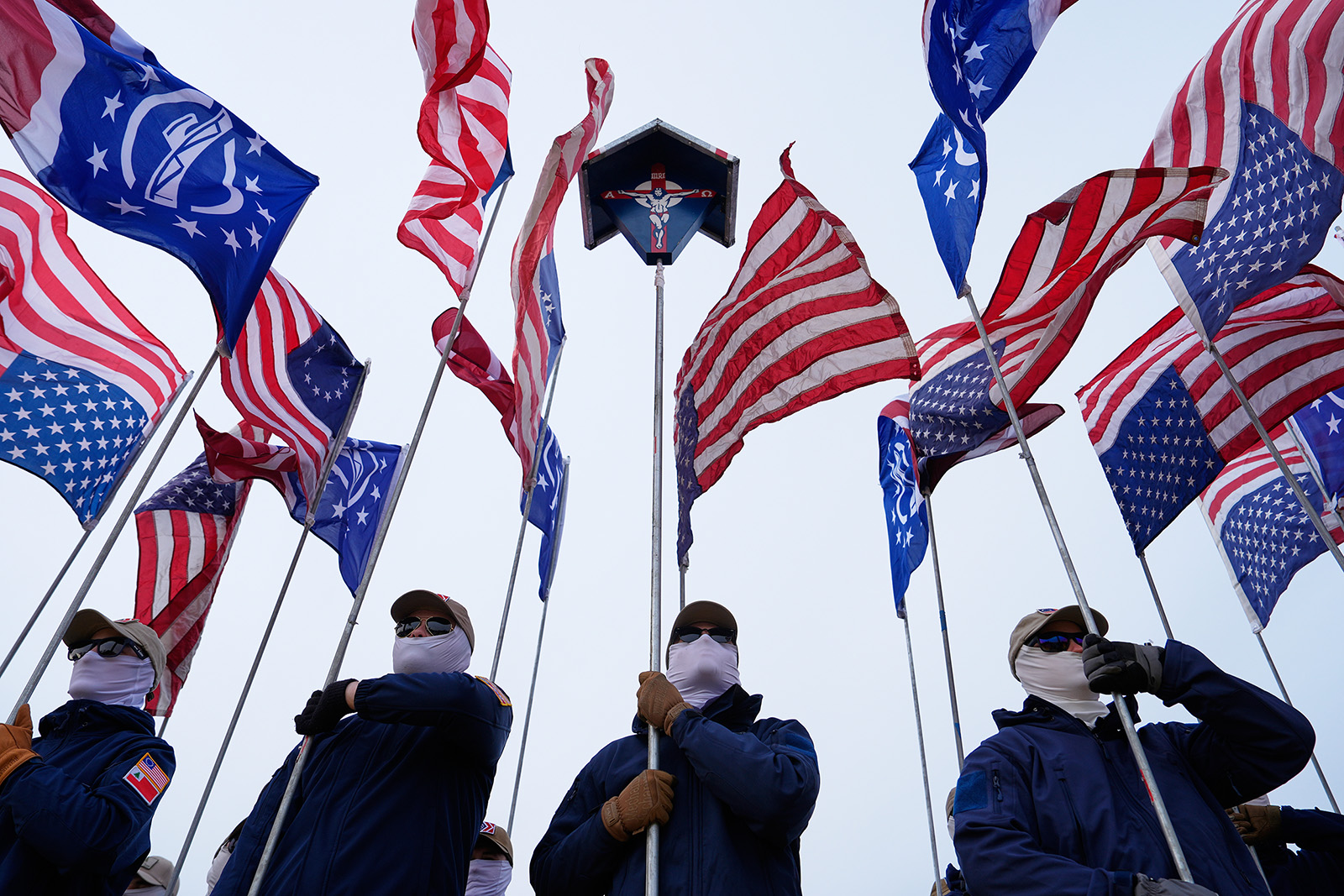


(RNS) — Since the 1950s, Americans have pledged allegiance to the flag and to one nation under God.
But they disagree on which God — or at least which religion — Americans should follow.
About half (46%) of Americans say they prefer a country with a wide variety of faiths. Nineteen percent strongly prefer to live with folks who follow the Christian religion. And the rest (34%) are in the middle, neither strongly agreeing nor strongly disagreeing, according to data from the Washington, D.C.-based Public Religion Research Institute’s American Values Survey.
That divide shows up in a new PRRI report on Christian nationalism, released Tuesday (Feb. 17).
Most (83%) of those who reject Christian nationalism — the idea that America was founded by and belongs to Christians — say they want to live in a pluralistic country. Not surprisingly, those who embrace Christian nationalism, according to PRRI’s measuring index, prefer a nation made up of Christians (73%).

“Who Are More Likely to Support Christian Nationalism, by Religious Affiliation” (Graphic courtesy of PRRI)
The report reveals deep divides about the role that religion should play in the country, said Melissa Deckman, CEO of PRRI.
“It’s a question of American identity,” said Deckman.
Since 2023, PRRI has tried to measure support for Christian nationalism in the U.S., using a series of five questions. Those questions ask if the government should declare the U.S. a Christian nation, if being Christian is important to being an American, if U.S. law should be based on Christian values, if Christians are called to have domination over American society and if the U.S. will fall apart without its Christian foundations.
About 1 in 10 Americans (11%) are what PRRI calls Christian nationalist adherents, meaning they agree or completely agree with all questions, according to the new report, based on data from September 2025. One in 4 Americans (27%) are “rejectors,” meaning they completely disagree with all five statements. Twenty-one percent of Americans are Christian nationalist sympathizers, according to PRRI, meaning they agree with most of the statements, but don’t completely agree with them. Thirty-seven percent are skeptics and disagree — but not completely — with most of the five statements.
Overall, about a third of Americans — including 56% of Republicans, 67% of white evangelicals and 54% of Hispanic Protestants — fall in the adherent or sympathizer categories. Two-thirds, including 82% of Democrats and 87% of religiously unaffiliated, fall in the skeptic or rejecter categories. White Christians (46%) and Christians of color (39%) are more likely to fall into the first two categories than the unaffiliated (13%) and those of non-Christian faiths (13%).

Melissa Deckman. (Photo courtesy of PRRI)
Deckman said those who report reading the Bible or praying more are more likely to fall into the Christian nationalist categories. The idea of having a Christian nation can be seen as aspirational, in wanting America to reflect the equality and justice found in the Bible’s teaching. That’s particularly strong in Black churches, she said.
The new report also takes a state by state look at the responses and found that Americans in the Bible Belt and the Midwest are more likely to fall in the adherent or sympathizer categories, while those who are skeptics or rejectors are more likely found on the coasts. Residents of Arkansas (54%), Mississippi (52%), West Virginia (51%), Oklahoma (49%), and Wyoming (46%) were most likely to fall in the adherent and sympathizer categories.
Residents of states such as Massachusetts (15%), Washington (18%), New Jersey (22%) and New York (21%) are less likely. About a quarter (28%) of those in Minnesota, the site of a recent immigration crackdown, fell in the adherent and sympathizer categories.
“If you overlay the map with the Electoral College map, there’s a very, very strong correlation there,” Deckman said. “In many ways, it helps to illuminate the polarization we see in this country based on geography.”
PRRI found that support for President Donald Trump and his policies was much higher among those in the adherent and sympathizer categories. For example, about two-thirds (67%) of adherents and just over half (53%) of sympathizers agreed with the claim that immigrants are invading the U.S. and “replacing our cultural and ethnic background.” Overall, only a third of Americans agree. Sixty-one percent of adherents and 54% of sympathizers agreed with the U.S. “deporting undocumented immigrants to foreign prisons without due process,” something only a third of Americans overall agree with.
Only about half of adherents (49%) and sympathizers (52%) support birthright citizenship — the idea that the Constitution guarantees citizenship to those born in the U.S. By contrast, 86% of rejecters and 68% of skeptics support that view. Trump signed an executive order shortly after taking office, saying the U.S. would no longer recognize the citizenship of babies born to parents in the country without legal status. The Supreme Court is currently reviewing that order to see if it is constitutional.

“Who Are More Likely to Support Christian Nationalism, by Party Affiliation” (Graphic courtesy of PRRI)
“Christian nationalism is an ideology or worldview that really is connected to partisanship today, and it helps to explain the policies that we’re seeing put into action,” Deckman said. When more than half of Republicans qualify as Christian nationalists, it really tells you a lot about what we’re seeing legislatively and from the executive branch.”