


Iran's reprisals shutter Israel's houses of worship during Ramadan and Purim


JERUSALEM (RNS) — Early Saturday morning (Feb. 28), as Israeli and American fighter jets began striking targets in Iran, every Israeli cellphone issued an air-raid siren alarm, the signal to go immediately to the nearest bomb shelter. Soon afterward, the country’s Home Front Command announced that no public gatherings would be permitted due to fears that Iran would soon retaliate.
The safety ban on public gatherings has shuttered not only the country’s schools, nonessential workplaces and airports, but also its churches, mosques and synagogues. For Muslims celebrating Ramadan and Jews preparing for their holiday of Purim, which begins on Monday at sundown, there is a palpable sense of loss in the closures of their houses of worship. Christians, meanwhile, are looking ahead to Holy Week, which begins at the end of March, with uncertainty.
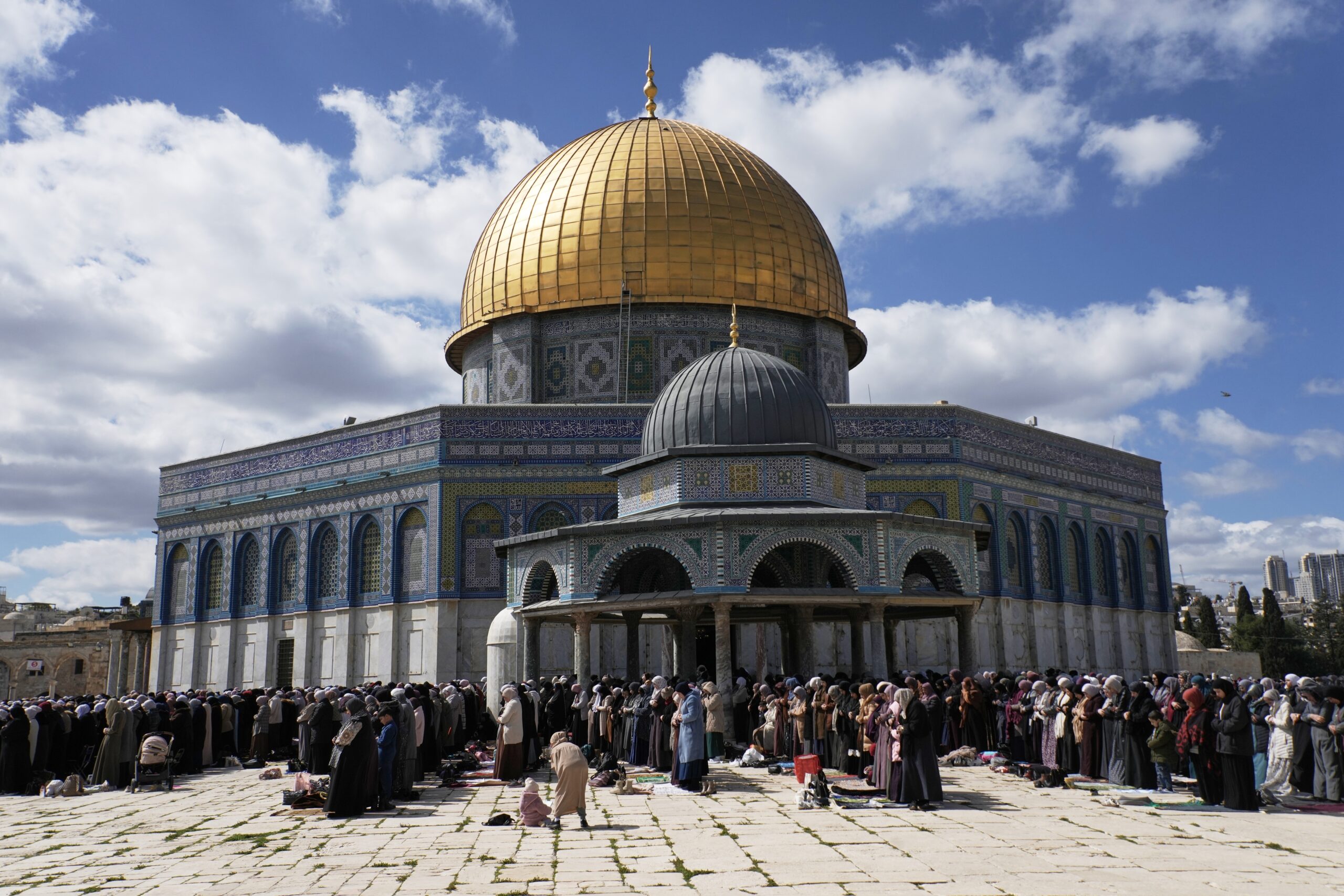
The disappointment was compounded when Home Front Command took the highly unusual step of placing the Old City of Jerusalem, home to the Western Wall, Al-Aqsa Mosque, the Church of the Holy Sepulchre and dozens of other sites held sacred in the three Abrahamic faiths, off-limits to everyone but residents, clergy and essential workers.
On Friday, the day before the attacks, up to 80,000 Muslims were able to pray at Al-Aqsa, but mass prayers this coming Friday appear doubtful. When the sirens wailed on Saturday, the Jewish Sabbath, Jews already in synagogue scrambled to the closest bomb shelter to conclude their prayers, while those preparing to go to synagogue sheltered in place.
On Sunday, Christian clergy throughout Israel held prayers, but to mostly empty pews.
“Priests will celebrate Mass as usual, but no one can come,” said Farid Jubran, the spokesman for the Catholic Patriarchate of Jerusalem, referring to Home Front Command’s new guidelines.

People take shelter in an underground metro station as air raid sirens warn of incoming strikes by Iran, in Ramat Gan, Israel, Saturday, Feb. 28, 2026. (AP Photo/Oded Balilty)
Mohammed El-Masry, a maintenance supervisor from Jerusalem, said he was disappointed by the restrictions. “I understand that congregating could be dangerous, especially for those praying in the courtyard of Al-Aqsa, but I think Iran will do everything possible not to hit the mosque. Of course it’s possible that when a missile is shot down, fragments could fall on the Old City.”
On Sunday, the warhead of an Iranian missile struck an open area a few hundred feet from the Old City, according to news reports.
Until the restrictions are lifted, El-Masry said he and his family will pray at home. “We can hear the muezzin’s prayers from our local mosque, so we will do our best until this conflict ends, inshallah — God willing.”
Purim itself celebrates the survival of the Jewish people in ancient Persia — modern-day Iran — when a plot to annihilate them is foiled. For religious Jews, the fact that the war began on Shabbat Zachor, the Sabbath that precedes the holiday of Purim, seemed both meaningful and fateful. On Saturday, synagogues read a passage of the Torah from Deuteronomy recounting the vicious attack by Amalek, an enemy nation, against the Israelites as they were fleeing Egypt.
Jewish children typically dress in festive costumes in the days leading up to Purim, but this year the schools are closed and the streets are virtually empty. To cheer up the children and reduce their fears during the nearly two dozen attacks that occurred in the war’s first 24 hours, many communal bomb shelters encouraged children and even adults to come in fancy dress. Some shelter-seekers brought guitars and other musical instruments.
“We’re trying to make the best of a bad situation,” a father of two said as he rushed his children — one in a Spiderman outfit, the other in a flowy pink gown, into a Jerusalem shelter.
In the Book of Esther, which is read at services on Purim, the villainous Haman’s plot to destroy the Jewish people is foiled by Esther, the king’s Jewish wife, who is tipped off by her uncle Mordechai. Haman’s evil decree is overturned and he is executed at the end of the story. Iranian Supreme Leader Ayatollah Ali Khamenei, who was assassinated Saturday morning in an Israeli airstrike, was often likened to Haman, who according to Jewish tradition was of Amalek descent.
Rabbi Kenneth Brander, who heads the Ohr Torah Stone educational network, recalled how, as the Zachor passage was being read in his synagogue on Shabbat, the threats described in the ancient text became “not merely historical memories, but living realities.”
“In the Book of Esther, Esther is not given the option of standing on the sidelines while her people’s fate hangs in the balance,” Bander said. “Her uncle Mordechai calls upon her to step forward and accept responsibility for their safety. It reminds us that we overcome the Hamans of every generation only when we stand together, united in purpose, rising above our smaller disagreements.”