


She left Amish life. Now millions watch her cook in Amish dress.
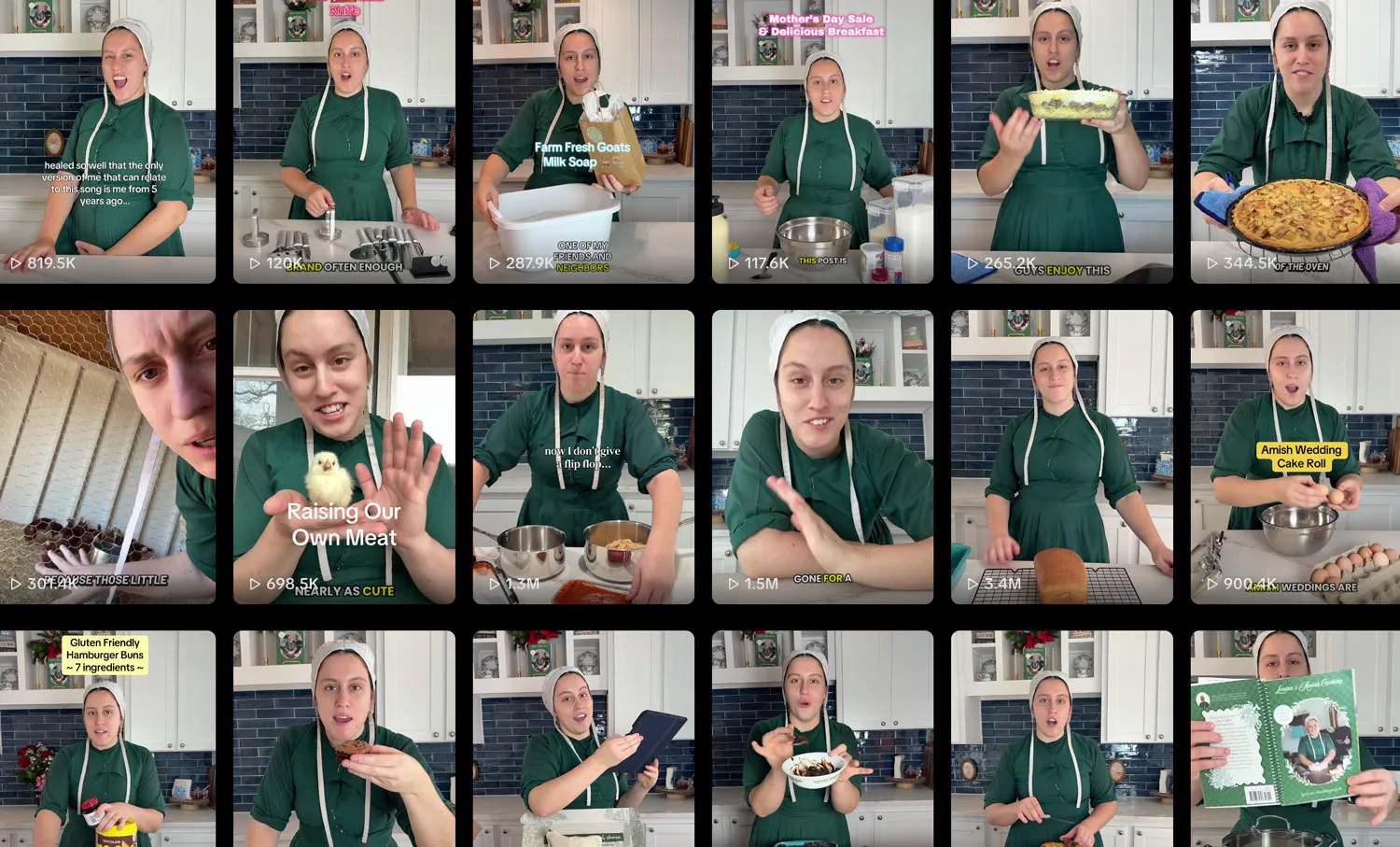


(RNS) — When Lovina Zook put her traditional, dark green Amish dress back on for the video that catapulted her into online fame, butterflies flooded her stomach.
“There was a sense of panic that I’m going to be trapped again,” Zook said.
Zook, now 23, had left her Iowa community of Swartzentruber Amish, one of the faith’s most conservative affiliations, just before she turned 18. Years later, in 2024, she decided to make a video following the “everyone has a backstory” trend on TikTok, where she had started posting casually after growing up in a religious tradition that forbade her from using technology.
At first, she said, she did not know what her backstory was. Then, it clicked.
In the video, Zook appears in workout clothes, mouthing the words, “I’m not just a bitch.” Then the video cuts to a shot of her in a dark green Amish dress: “I’m a bitch with a backstory.” The video has 1.2 million likes and 45 million views on the video app.
Almost immediately, users flooded her comments with questions about her former Amish life, her childhood and her dress.
RELATED: Amid protests at Delaney Hall, a Catholic nun has been offering ‘radical hospitality’
“I answered so many comments those first several days,” Zook said. “That was on a Saturday. By Tuesday, I had over 300,000 followers.”
When Zook left home in 2021, she greased the hinges on the door of her family’s house with vegetable oil so as not to wake her mother, hid behind a bale of hay and fled. She eventually connected with her older brother, who had left the family years earlier. She remembers weighing the decision.
“If I leave the Amish, I’m giving up my chance at heaven,” Zook said she recalls thinking. “I’m never going to go to heaven. I am going to live an evil life, but at least I can live a life where I get to make my own choices.”

Lovina Zook took her first photo in non-Amish clothes a week after leaving the Amish. Photo courtesy of Zook
Zook has become an unlikely TikTok star, using technology once forbidden to her and building an audience of 3.4 million followers. Now in her second trimester of pregnancy with her first child and living in North Texas with her husband, Eli Zook, who is also ex-Amish, Zook films herself cooking Amish food and reinterpreting a tradition she fled, while complicating the internet’s “trad wife” fantasies and outsiders’ romantic ideas about the Amish.
“That dress now does not symbolize hurt,” Zook said. “Now that dress symbolizes freedom.”
Karen Johnson-Weiner, a scholar of Amish women, said that in many Amish communities, which practice forms of Anabaptist Christianity, baptism typically occurs around age 17 or 18. It signifies not only induction into the church, she said, but also a lifelong promise to God to live according to the church’s ordinances.
“When you commit to baptism, you’re saying that you’re going to defend with your life the church and its ordinances, its guidelines,” Johnson-Weiner said.
Zook, who left her family months shy of being baptized, said she felt the pressure building as the date grew closer.
“Things were very, very much piling up. I didn’t want to get baptized, but it was the right thing to do, and because I followed all the rules, I was like, well, I don’t have a choice,” she said. “Once you start instructions, you’re basically a member of the church. And once you’re a member of the church, if you do not follow every rule to a T, you get shunned.”
After leaving the Amish, Zook spent years cleaning houses and traveling with other ex-Amish young adults in Minnesota. She later moved to Texas with Eli Zook, who had left an Amish community in Nebraska at 17.
The two were working long hours — he in construction, she cleaning houses — and expected to keep taking work where they could. But as Zook’s audience grew, she said, she began spending hours going live, answering questions and making videos.
“People were like, you need to cook, you need to make Amish content, like Amish food,” said Zook, who already loved cooking.
One of her first popular cooking videos shows her making “coffee soup,” a common Amish dish made with boiled milk, instant coffee, brown sugar and crushed saltine crackers. On TikTok, she shows how to prepare dishes like poor man’s steak, raisin pie filling and Amish-style fruit pizza. Sometimes, she posts videos answering questions about Amish life and her experiences growing up. Her videos have collectively drawn nearly 100 million views.
She has also published a cookbook, “Lovina’s Amish Cooking,” with more than 200 recipes, some with Amish recipes and others with recipes she developed herself.
Much of the response has been positive, with followers expressing curiosity about the Amish lifestyle and commenting on her cooking methods, her attitude, her direct eye contact with the camera, her accent.
“Never heard her accent,” one TikTok user wrote. Zook grew up speaking Pennsylvania Dutch.
As her pregnancy progresses, she said, she may need to order more green fabric to adjust her traditional dress for comfort.
“We won’t judge or leave if you want to wear comfy regular clothes right now,” one TikTok user wrote.
@lovina_zook2 ingredients and it’s so good. My Amish cookbooks are available over on my website ➡️♬ original sound – Lovina
There is a popular social media genre known as “trad wife,” in which women often share videos of cooking, homemaking, traditional dress and a simpler domestic life. Despite the similarity of Zook’s content, she said she does not identify with the label. She sees it as an unnecessary online category applied to behavior, cooking, cleaning and domestic work — and one that often gets a negative spin.
“You can do trad wife things and not be a trad wife,” she said.
Eli Zook, who works alongside his wife to help produce her books, said she also does not fit the stereotype because she leads much of the business.
“With her business, she has made most of the money that we have, and so, you know, she makes decisions on the front of the business,” he said.
Zook said she does not see her videos as romanticizing the life she left. She said she wears the dress now primarily to show people that she was Amish. “I am sharing my experience with that life,” she said.
Now, she said, she hopes to elevate its good parts, offer others the information and training she did not receive as a child and remain honest about her experience.
“I would never ever ever ever recommend it to someone, to become Amish,” she said. “I would advise against that so strongly.”
Growing up, Zook described a pattern of emotional, psychological and spiritual abuse. She said she was criticized for her weight and her teeth, feared doing the wrong thing and felt suicidal by age 13.
“My parents bullied me,” she said. “Every person in the community made fun of my teeth, and it hurt.”
Johnson-Weiner said that despite the diversity among Amish communities in the United States, gender roles remain constant and girls are often taught domestic skills early.
“In the Amish world, they’re being taught as they grow up to do the things that will make them good and productive church members,” Johnson-Weiner said.
Zook, who now lives in what she describes as a “developing rural community,” said she believes her content resonates because many people were never taught to work with their hands, something she said can ground a person in a life larger than the self. Some recent videos show her teaching viewers how to make butter and to slaughter broiler chickens.
“They want to do things with their hands,” she said.
But she said people can pursue a simpler life without committing themselves to a church they cannot freely leave.
“They can do all of that without binding themselves into a lifelong contract,” she said.

Lovina and Eli Zook celebrated their first wedding anniversary in Hawaii in 2025. They work together to run their business reflecting in different forms on their upbringings in different Amish communities. Photo courtesy of Lovina Zook
For Zook and her husband, leaving the Amish did not mean leaving Christianity. Eli Zook, the oldest boy in his family and the only one of his siblings to leave the Amish, said he struggled with depression and addiction after he left. One night, he said, he collapsed to his knees and prayed.
“I gave up,” he said. “I just cried to God for help, for a way out.”
Both Eli and Lovina Zook said that growing up in Anabaptist communities did not necessarily make them feel close to Jesus or familiar with Scripture. Now, they have been baptized in a nondenominational church, where they hope to raise their child. Even so, they don’t want to discard everything they inherited.
“There’s also a lot of great, wonderful stuff that we’re going to teach them that we learned from the Amish,” Eli Zook said.
Lovina Zook said her family has seen some of her content, though they do not appreciate it. Because she was not baptized into the church she is not excommunicated or shunned, and occasionally she visits, but not often. One relative she wishes could see her life now is her grandmother, who had also left the Amish and died a few years ago.
“I wish she could see how my life turned out,” Zook said. “Because she used to pray for me so much, and she was the most amazing lady.”