

Feeling alienated from queer and Sephardic spaces, LGBTQ Jews build their own communities


NEW YORK (RNS) — For years, Daniel Cayre felt conflicted about his place in Jewish communal and spiritual life.
On holidays like Yom Kippur, he’d go the first evening to a Reconstructionist synagogue that felt welcoming of his gay identity. On Yom Kippur day, he returned to the traditional Sephardic synagogue of his upbringing, where the melodies, spirituality and liturgy reflected his Syrian Jewish heritage.
Neither space felt complete: Most liberal synagogues followed Ashkenazi liturgical traditions, and Sephardic synagogues often leaned more conservative in terms of gender and sexuality.
“I started thinking there had to be a space for Sephardi and Mizrahi Jews seeking LGBTQ inclusion while still wanting traditional liturgy and community,” he said. Sephardic Jews are a diaspora group whose ancestors were expelled from the Iberian Peninsula 500 years ago by the Christian monarchy. Many Sephardic Jews migrated in exile across the Ottoman Empire. A related group, Mizrahi Jews, are those who trace family roots to Arab and Muslim lands; some identify as Sephardic, while others do not. Today, estimates for global Sephardic populations sit around 6.2 million, while Mizrahi populations (which overlap demographically) are estimated at 3 million. An estimated 10% of the American Jewish population identifies as having either Sephardic or Mizrahi roots, with communities today primarily concentrated in Israel and France.
Cayre, a 43-year-old Brooklyn-born real estate developer whose family traces its roots to Syria, is gay, married and a recent first-time father.
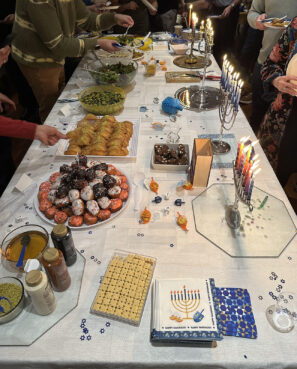
Attendees get food from a Hanukkah table at a Kanisse event in New York City. (Photo courtesy of Daniel Cayre)
As he spoke with others about a lack of spaces inclusive of their whole identity, Cayre realized many shared the same sense of absence. That led him to launch a New York-based modern Sephardic and Mizrahi community called Kanisse in 2021, in time for Yom Kippur, when Cayre and other lay leaders put together an egalitarian language Sephardic maḥzor, a holiday prayer book.
Named after the Arabic and Hebrew word commonly used by many Sephardic and Mizrahi Jews for synagogue, “kanisse,” the community became a space where people of diverse levels of observance and many backgrounds gather for prayer, learning and cultural programming. Kanisse is fully egalitarian, with mixed-gender seating, where people of any gender identity can serve as “shliḥe ṣibbur” — prayer leaders — and receive “aliyot,” an honor where one recites the traditional blessings before and after Torah readings in front of the gathered community. Traditionally, these roles are reserved for men.
Kanisse has become a New York prayer space and community where LGBTQ Sephardic and Mizrahi Jews gather. Nourished by ritual and community, many LGBTQ Sephardic and Mizrahi Jews have similar communal, spiritual and activist grassroots movements — often with little funding, limited infrastructure and a reliance on substantial volunteer labor.
Unlike Ashkenazi Judaism, Sephardic Judaism generally is not organized into denominations such as Reform, Conservative or Orthodox. Communities tend to identify through shared geographic origins — Syrian, Persian, Moroccan, Iraqi and others — and most Sephardic synagogues continue to follow traditional halachic practice, including gender-separated worship. When Kanisse was founded, Cayre said, there were a handful of fully egalitarian Sephardic synagogues in Israel, Spain and the U.K. but none in North America.
“There was a large LGBTQ community that was interested,” Cayre said. “I was looking for a place where I could go with a partner and be fully open, and eventually knew that we were planning on having children and (wanted to be) able to bring a family there.”
While there were other LGBTQ Jewish spaces, Cayre admits, most were predominantly Ashkenazi and often more secular, and he wanted a space that was both religious and Sephardic, but also accessible and inclusive to people of all gender identities and sexual orientations.
“During prayers at Kanisse, I just felt like I could focus on the community and the sense of meditation, without the distractions of any sort of bias or politics,” he said.
Since its founding, Kanisse has grown to a space with hundreds of regular attendees — Sephardi and Mizrahi Jews from New York and New Jersey, Israelis living in the U.S., LGBTQ Jews and plenty of “Jews by choice” — converts — as well as Jews of color who Cayre said have reported not feeling welcomed or represented in traditional spaces.
Today, Kanisse organizes prayer services and communal events regularly. Its liturgies reflect traditions from across the Middle East and North Africa — such as a Baghdadi-Indian Shabbat last month in honor of the traditions of one of the historic Jewish communities of Kolkata, India.
For Ally Setton, a Syrian American educator from New York, being able to chant part of the public Torah reading in the egalitarian Sephardic setting was “the first time I felt deeply connected to my ancestors.”
She described Kanisse as a rare space.
“I think this space has allowed people who would otherwise not be in a prayer- and God-centered community, because they are queer and Sephardic, to be in that community with others,” Setton said.
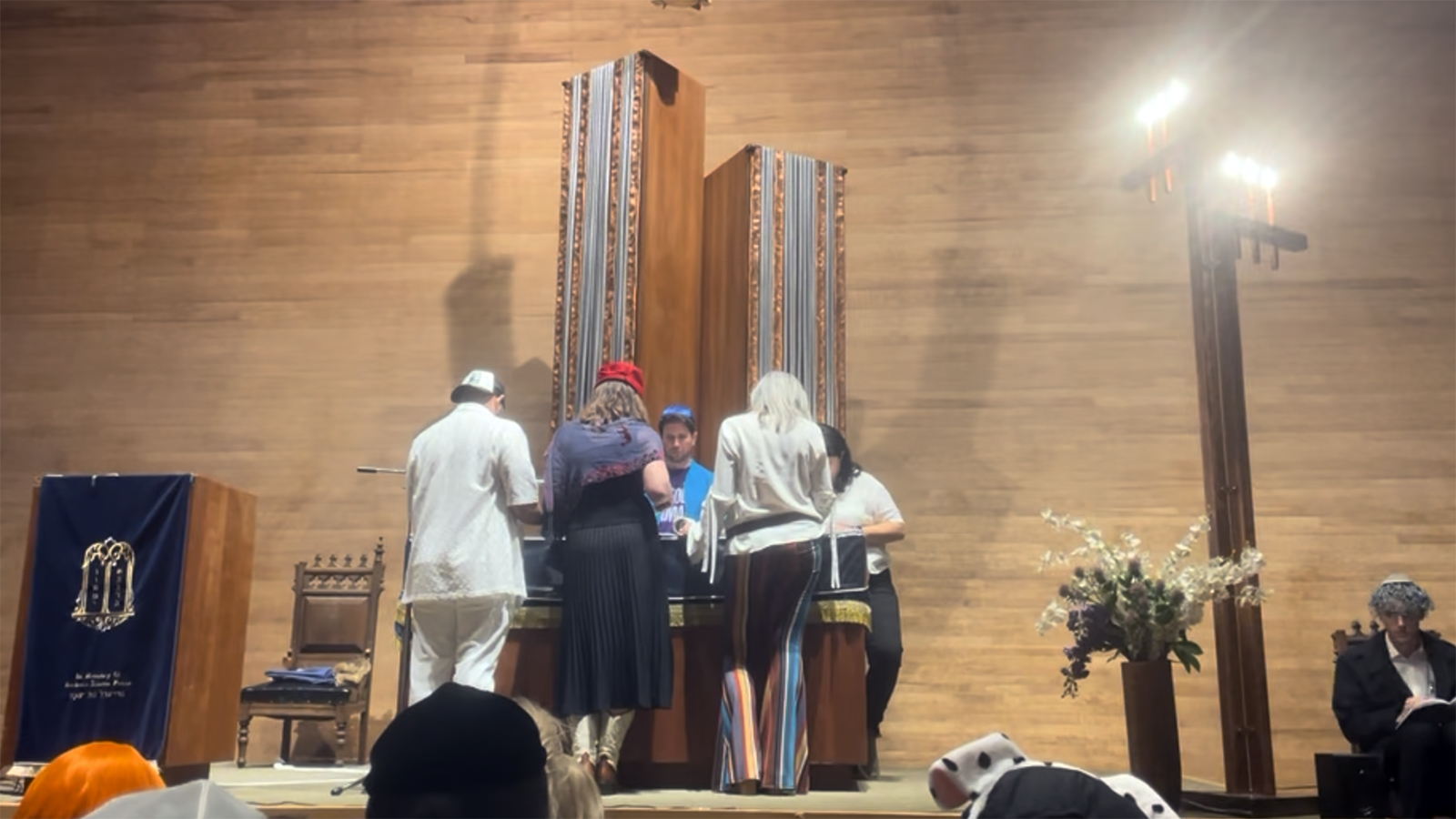
Ally Setton, center in red hat, reads from the Megillat Esther at a Kanisse-organized Purim service in 2024 in New York. (Photo courtesy of Setton)
The emergence of communities like Kanisse reflects an American Jewish tradition of community organizing and building grassroots movements: from Jewish allyship in the Civil Rights Movement to religious “emissary” movements aimed at modern outreach like Chabad-Lubavitch, which relies partially on financial independence and local adaptation; from activism for abortion access in the U.S. to synagogues advocating for people with HIV and AIDS. Similarly, Sephardic Jews, the first Jewish group to arrive in America, have played a role in civic life for centuries.
An estimated 400,000 Jews with Sephardic and Mizrahi heritage live in the U.S., including large communities in New York. Cayre and Setton join leaders in their community who’ve made grassroots efforts outside of traditional models in order to fill unmet needs.
Rebecca Davoudian, a 37-year-old urban planner who’s a regular at Kanisse, said inclusive spaces in New York “reassure people that you don’t have to give up a certain part of your identity to fit into either Jewish spaces or queer spaces.”
Davoudian is one of the founding members of another local LGBTQ Jewish group that built itself from the grassroots level, the Sephardic Mizrahi Q Network, or SMQN. Founded in 2016, SMQN hosts monthly Shabbat dinners, educational programming and community gatherings for LGBTQ Sephardic and Mizrahi Jews and their allies. What began as a small effort has expanded to cities across North America.
“Being an LGBTQ Jew right now is difficult for us,” said Davoudian, who has Persian Jewish roots. “We’re getting more and more pushed out of queer spaces because of our identity, as antisemitism is rising and anti-Zionism is rising.” A majority of American Sephardic Jews have relatives in Israel, where many of them landed after escaping persecution in places such as Iran, Iraq, Syria and Algeria. The wider LGBTQ community, Davoudian said, often misses this at a time when she said Jews and Israelis are singled out for exclusion for their faith and ethnic origins.
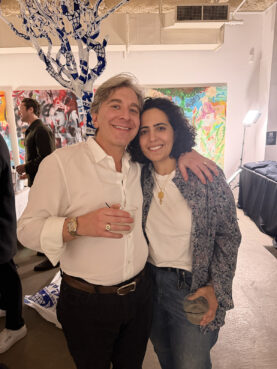
Ian Cohen, left, and Rebecca Davoudian during a Kanisse Shabbat dinner. (Photo courtesy of Davoudian)
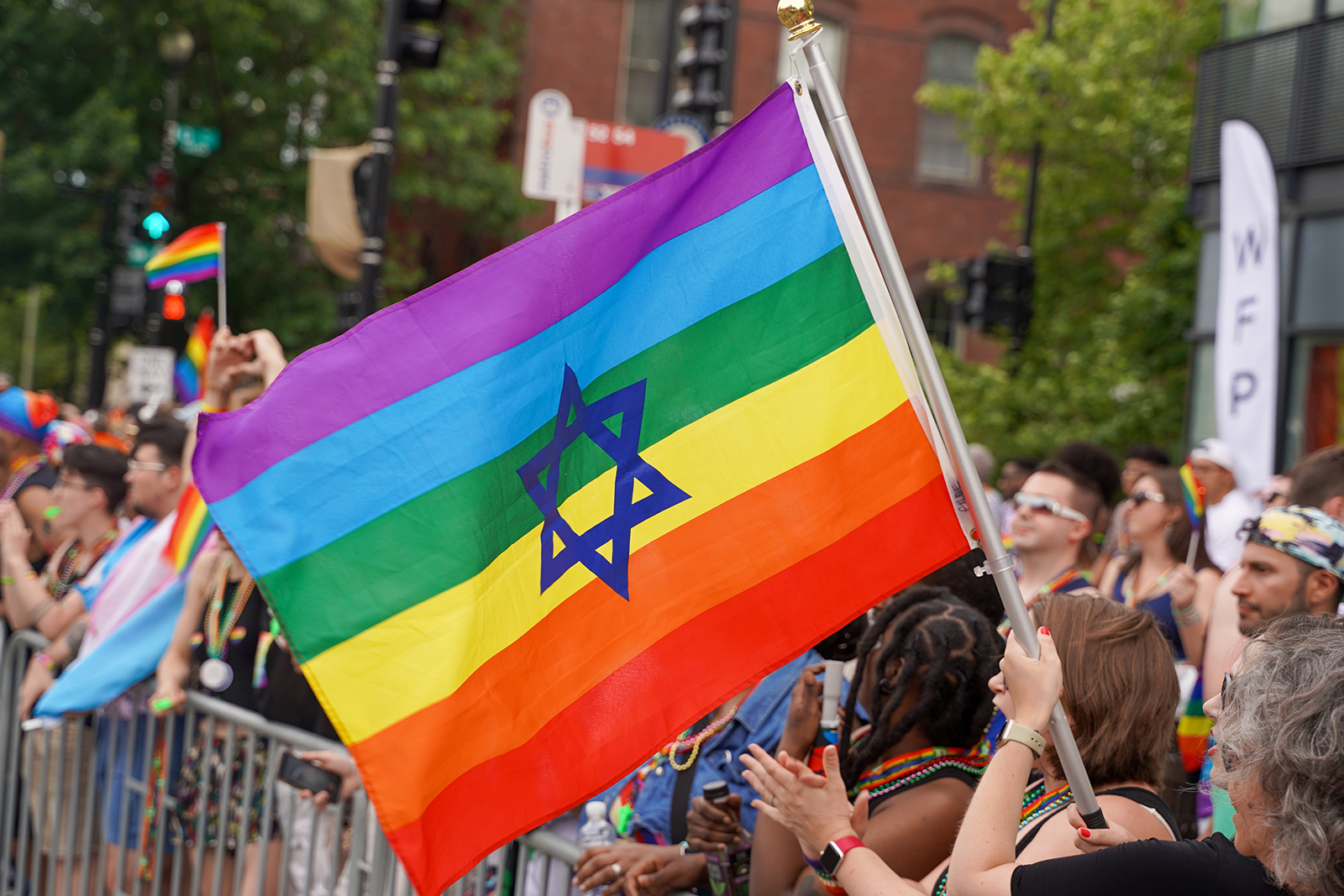
For her, Pride Month is not only about LGBTQ visibility but also Jewish visibility.
“Pride signals to people that we’re not going anywhere,” she said.
Ruben Shimonov, a Bukharian American Jewish educator born in Uzbekistan, is the founding executive director of SMQN and also an artist and community organizer. SMQN is “a powerful case study of grassroots community-building,” he said, “an entire movement that started from an idea, from a sense of urgency, from the will of individuals to make something happen from the ground up.”
SMQN itself grew largely through volunteer labor and hospitality.
Ian Cohen, a mid-40s New York-based Iraqi Jewish artist and educator, has hosted numerous SMQN gatherings alongside his husband, Darryl Murphy, who has Irish Catholic roots.
To honor his family roots, Cohen enjoys cooking Iraqi Jewish dishes for the Shabbat meal. “They are very labor intensive, but every time I make them I think of my ancestors and smile knowing I’m continuing the tradition,” he said.
Across generations of LGBTQ Sephardic and Mizrahi Jews, these grassroots communities also provide mentorship and visibility.
Jacob Tehrani, a recent graduate from New York University’s Stern School of Business, said that when he first moved to New York, he was “blown away” by a large ecosystem of LGBTQ Jewish spaces, including Kanisse and SMQN.
Seeing openly queer Sephardic and Mizrahi leaders mattered, he said.
He also emphasized that such spaces often benefit families as much as LGBTQ individuals, recalling attending a program where parents of LGBTQ Persian Jews met one another and shared experiences with his parents.
As concerns about antisemitism in queer spaces have increased in recent years, Tehrani believes grassroots networks provide an additional source of resilience.
“If we’re being excluded from other spaces,” he said, “we’re still able to create our own spaces and make it work because it’s the same thing our ancestors did.”
That spirit of grassroots organizing extends beyond religious and communal life into advocacy and activism.
Dan Hadad, an Israeli-Canadian community organizer now living in New York, led Queers Against Antisemitism, an online campaign launched after the 2023 Hamas attack on Israel. Hadad credits more than a decade of progressive and queer activism, and the resilience of his Mizrahi background, for equipping him with the sensibilities and convictions that supported the campaign.
Hadad said he saw a need for a distinctly queer, progressive, digital voice addressing antisemitism and Jewish belonging.
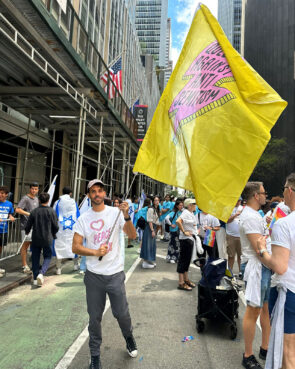
Dan Hadad carries a Queers Against Antisemitism flag in New York City. (Photo courtesy of Hadad)
“There wasn’t really a queer Zionist voice that was nuanced,” he said. The campaign launched an active Instagram presence that reaches thousands across the world, which Hadad said helped reach a particular audience that mainstream Jewish advocacy organizations did not. The campaign received messages of support especially from Generation Z commumities, Hadad said.
The initiative quickly gained followers and attracted support from Jews and allies who felt disconnected from mainstream organizations and others who were not supportive of Israeli policies but looking for constructive ways to engage in conversations about rising antisemitism.
Although the campaign ended earlier this year, Hadad believes it demonstrated the power of grassroots organizing in reaching new audiences. He said he has since launched a new platform, Independent Queer Jewish Voices, a “campy” storytelling Instagram page.
For Tehrani, who is leaving New York after four years to move to his family Los Angeles, leaving is bittersweet, but he said he’s grateful to engage in a new community.
“A decade ago, I never would’ve imagined that in 2026 my parents would be happily joining me at events for queer Jews,” Tehrani said, explaining that as immigrants to the U.S. from Iran, he and his parents have been on a journey from “acceptance to allyship.”