

Vatican-backed priest tours US to visit immigrant advocates, community organizers
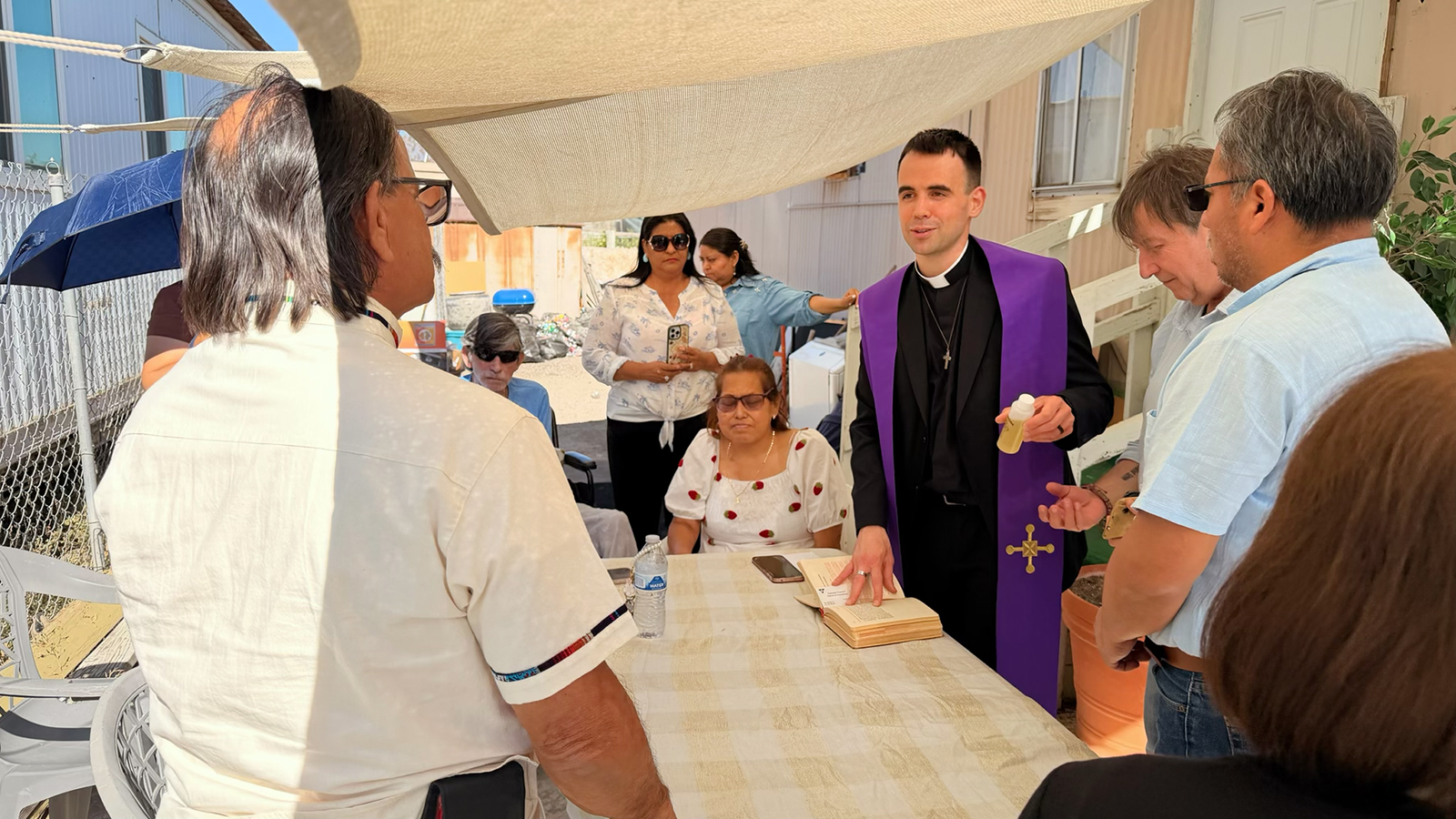


(RNS) — When the news broke that Lorenzo Salgado Araujo had been shot and killed by an Immigration and Customs Enforcement agent as he drove his construction crew to work in Houston last week, a Vatican representative was meeting with immigrant families at a Houston Catholic parish. The families were sharing about the intense levels of fear their community has been experiencing.
“This is completely terrible, and we cannot be silent in front of this,” the Rev. Mattia Ferrari, coordinator of World Meeting of Popular Movements, told RNS about the killing of Salgado Araujo.
On his multi-city tour of the U.S., Ferrari has heard from many immigrants experiencing fear, family separation and even detention. “They are suffering something that is completely unfair, completely unjust,” Ferrari said, calling Salgado Araujo’s death “the top of the sufferings.”
The World Meeting of Popular Movements was first convened at the Vatican with Pope Francis in 2014, and since then the Vatican’s Dicastery for Integral Human Development has “accompanied” the initiative, which emphasizes poor and marginalized people as “protagonists” in the fight for justice.
“ We are here to serve, not to lead,” said Ferrari of the church’s role, highlighting grassroots leadership.
Last fall, Pope Leo XIV told the convening, which has historically called for land, housing and work for poor people, “The Church must be with you: a poor Church for the poor, a Church that reaches out, a Church that takes risks, a Church that is courageous, prophetic and joyful!”

The Rev. Mattia Ferrari, right, meets with youth leaders in the Archdiocese of Seattle, Wednesday, July 1, 2026, during a six-week tour of the United States. (Photo courtesy of Catholics in Communion)
Leo also emphasized that the poor are at the center of the gospel. “Therefore, marginalized communities…must be involved in a collective and united effort aimed at reversing the dehumanizing trend of social injustices and promoting integral human development,” he said.
Ferrari’s tour was planned after Ferrari expressed “curiosity” at last fall’s convening to see and hear from people on the ground who are confronting the “cost of living and immigration tension” in the U.S., said Cecilia Flores, who coordinated the tour in her volunteer role with a coalition called Catholics in Communion, which was founded late last year to respond to the “pastoral emergency” of mass deportations.
Ferrari is now halfway through a nearly six-week tour to 21 cities and regions across California, Washington state, Texas, Colorado, Pennsylvania, Minnesota, Indiana, Michigan, Louisiana, Washington, D.C., New Jersey and New York, carrying the Catholic church’s message of support to faith-based community organizing groups throughout the U.S.
He and his fellow delegation members “sit and listen and ask just such deep questions, but in such a gentle and pastoral and loving way,” said Flores.
Ferrari is traveling with Luca Casarini, the founder of Mediterranea Saving Humans, which has reacted to the deaths of thousands of migrants crossing the Mediterranean by crewing a ship for sea rescues. Ferrari is the group’s chaplain. Leo spent July 4, the 250th anniversary of the U.S. adoption of the Declaration of Independence, at Lampedusa, a common destination for those crossings.
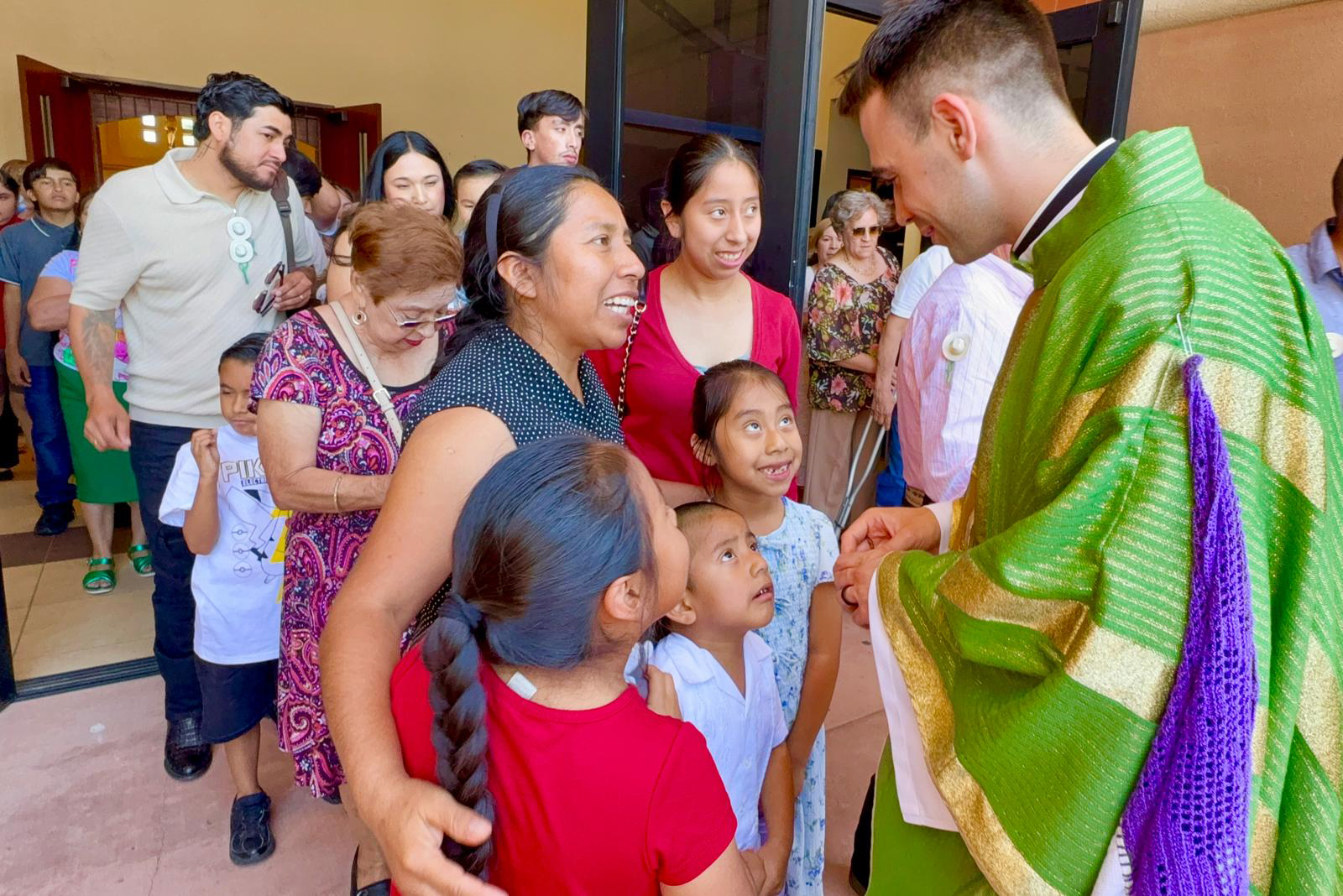
The Rev. Mattia Ferrari, right, greets parishioners after celebraing a Mass at Our Lady of Guadalupe Church, on June 21, 2026, in Mecca, Calif. (Photo courtesy of Catholics in Communion)
The third member of the delegation for the U.S. tour is César Piscoya, an adviser to the Latin American bishops’ conference’s (CELAM) Center for Pastoral Action Programs and Networks. Piscoya, a lay theologian and longtime friend of Leo’s, was a missionary with the Augustinians, Leo’s order, and then worked with then-Bishop Robert Prevost when he led the Diocese of Chiclayo, Peru.
“ Something they keep saying is, they’ve seen a suffering they didn’t really know existed in the United States,” said Flores, who is the executive director of the Catholic Volunteer Network when she isn’t volunteering with Catholics in Communion. “ A lot of people share that the image that they have learned of the U.S., whether that’s through media or how they were told growing up, they get here and they see it’s really not as easy as people might think it is.”
But the delegation is also seeing “ a church that is uniting to take care of one another and to embody what it means to be the body of Christ, to move in defense of the dignity of each person on this earth and in this country,” said Flores.
Across the U.S., immigration has been a core focus of the trip. “ This is a matter of love, a matter of human dignity, a matter of the gospel. Because what these people are suffering — this pain — is also our pain because we are brothers and sisters,” said Ferrari.
But immigration has not been the only issue raised by the tour. In Houston, the delegation visited a dialysis center for people without insurance that The Metropolitan Organization of Houston advocated for, and in Pittsburgh, Ferrari heard from local labor and environmental leaders about the challenges of abandoned gas wells and the transformation of the energy economy.
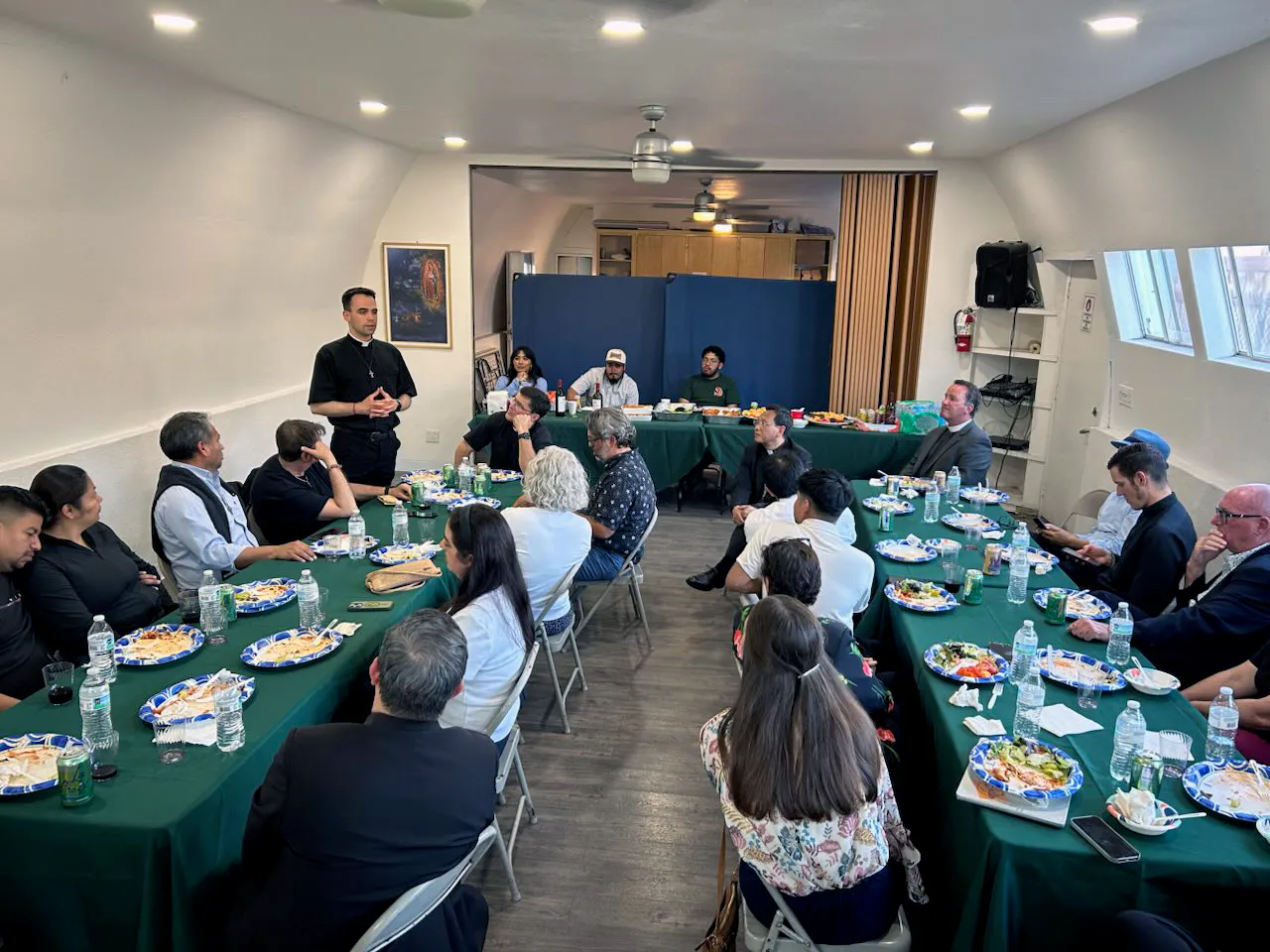
The Rev. Mattia Ferrari, standing left, addresses a gathering of bishops and community leaders, June 22, 2026, in San Diego. (Photo courtesy of Catholics in Communion)
In San Diego, the delegation joined diocesan-backed teams to accompany immigrants to court hearings and ICE check-ins. Ferrari said that he was moved by witnessing immigrants’ initial tears of fear and pain become tears of solidarity when they knew they would be joined by the volunteers.
In Monterey Bay, California, the delegation toured rural farm-working communities and attended an event at a Catholic parish to enroll immigrants without legal status in public healthcare, an initiative that the local Industrial Areas Foundation affiliate Communities Organized for Relational Power in Action had fought for.
Liz Hall, who is the supervising organizer for the IAF in Monterey Bay, recalled Ferrari’s comments that the healthcare initiative showed “the miracle of solidarity.”
“ I don’t think he realized how much that meant to the people in the room to hear someone who came from the Vatican to this very rural, kind of forgotten part of the state” say those words, Hall said.
In Los Angeles, Ferrari’s delegation attended a public hearing hosted by local IAF affiliate One LA where immigrants shared their experiences of the mass deportation campaign, including witnessing violent detentions.
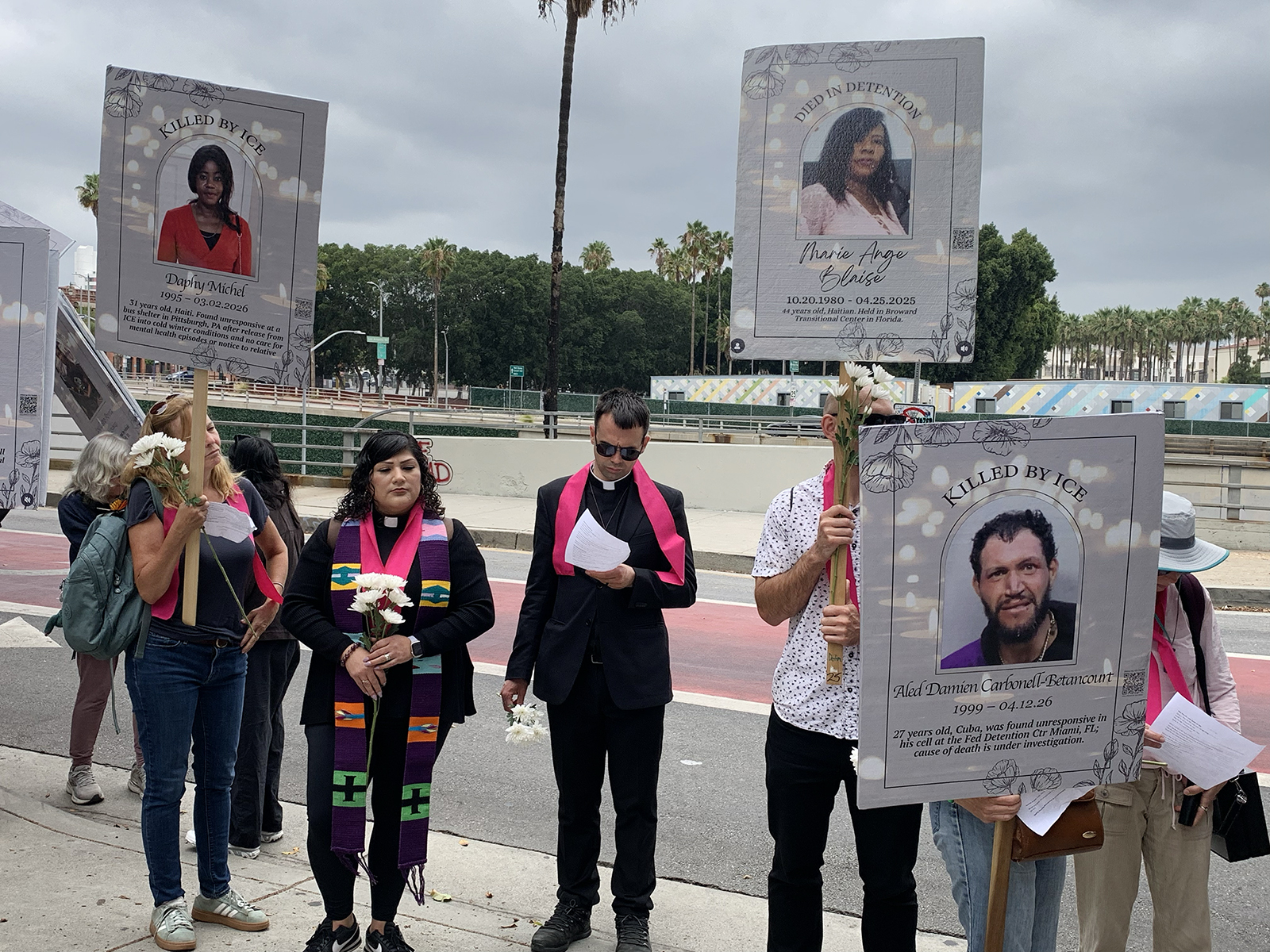
The Rev. Mattia Ferrari, center, coordinator of World Meeting of Popular Movements, attends a prayer vigil in front of the Federal Building in Los Angeles. (Photo courtesy of LA Voice)
Emily, a 21-year-old college student studying civil engineering who asked to be identified by her first name because she does not have legal immigration status, said if she had not already enrolled in university, fear of sharing her information would have prevented her from studying.
“I fear that I might just be studying in class, and because universities are public spaces, they could just come in and unfortunately just get us,” she told RNS.
Testifying to that experience publicly for the first time at the parish she has attended since she arrived from Mexico as a baby was “vulnerable” but empowering, she said. “I just felt so much better, so much, for me to know there were more people (experiencing this) and that the church actually cared about us,” she said.
Robert Hoo, the lead organizer for One LA, said that the impact is widespread. “ It’s recognizing that the Vatican is watching, that the world is watching, that their stories are important not just to themselves and their communities, but that everybody is aware about the injustices that are happening.”
Ortencia Ramirez, a One LA leader who co-chaired the hearing, fought to hold back tears at hearing the experiences of her community. But she too felt hope because of the connection to Leo. “We asked them to take what they observed with the IAF back to the pope, and they agreed that they would,” she said.
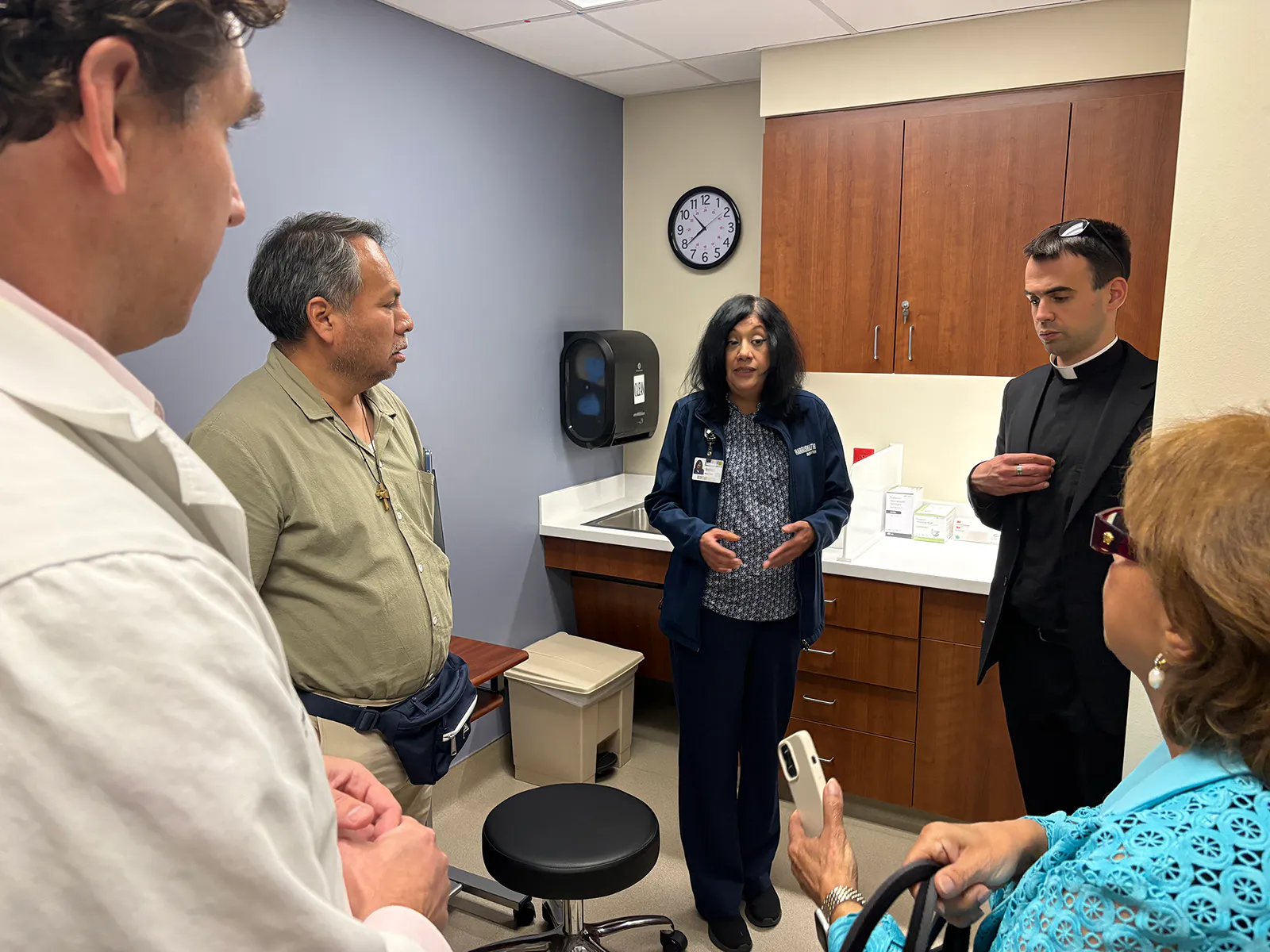
The Rev. Mattia Ferrari, top right, and a touring delegation visit a dialysis center for people without insurance in Houston. (Photo courtesy of Industrial Areas Foundation)
The delegation also participated in a panel of organizers hosted at Dolores Mission, an organizing base for another interfaith group working on immigration, LA Voice, part of the Faith in Action network. Angel Mortel, a lead organizer for the group, said they shared about their efforts to pass California bills imposing high taxes on private immigration detention companies and remove state financial benefits from companies involved in or investing in detention.
For Mortel, the collaboration between LA Voice, One LA and the archdiocese of LA to plan the trip also brought hope for the future. “ This was the first time in my eight years with LA Voice that we’ve done something together,” she said. “ Without that collaboration, it’s just too big a task to take on — to take on the forces that are coming down on us,” she said.
Flores said that connections, resource-sharing and opportunities for formation will be some of the long-lasting impacts of Ferrari’s tour, especially because of the presence of Piscoya, a representative of the Latin American bishops’ conference.
In the majority of cities, Ferrari also met with the local Catholic bishop, and in the few cities where the bishop was unavailable, a staff member.
In Houston, Elizabeth Valdez, director of the IAF in Texas, said that Ferrari and his team were impressed by the key roles that clergy play in forming lay people to be leaders in organizing. “ They had not seen or experienced that anywhere before, even in the visits that they’ve done in other parts of the country,” she said.
But even visiting 21 different cities and regions, Ferrari regretted the parts of the U.S. that he and his delegation were unable to visit. “ We have so much work to do worldwide, so we will be back surely,” he said.