

One year later, people of faith should reckon with Trump’s ‘Big Beautiful Bill’


(RNS) — One year ago, President Donald Trump signed the One Big Beautiful Bill Act into law. Rather than abundance for working families, it has delivered deepening inequality and increased hardship for people already struggling to make ends meet.
Throughout Scripture, we are reminded that societies are judged not by how they treat the powerful but by how they care for those who are hungry, sick, poor and marginalized. As a Quaker lobbyist, I have been taught to assess legislation with simple questions: What does this policy do to the dignity of every person? Will this law strengthen the common good? Will it improve the lives of those most in need and generations to come? And perhaps even, would Jesus support the consequences of this bill?
By these measures, the One Big Beautiful Bill Act has failed.
While the law delivered sweeping tax benefits to wealthy households and corporations, it financed many of those benefits by reducing investments in nutrition assistance, health care and clean energy while dramatically expanding war-like immigration enforcement. One year after its passage, many families are experiencing the consequences through less food in the fridge, health coverage that has disappeared and growing uncertainty about their futures.
Analysis by the Congressional Budget Office found that the law reduces resources for the poorest 10% of households while increasing them for the wealthiest top 1% of Americans — what some economists have described as one of the largest upward transfers of wealth in our nation’s history.
The law included the largest cut to the Supplemental Nutrition Assistance Program in U.S. history. According to the Center on Budget and Policy Priorities, SNAP participation dropped by more than 4 million people during the law’s first months, including roughly 1 million fewer children in the states where data are available.
These declines cannot simply be explained by economic improvement. Unemployment has remained relatively stable. Instead, the law imposed new eligibility restrictions, shifted costs onto states and added administrative hurdles that have made it harder for eligible families to receive food assistance. SNAP has never been a generous benefit. Even before these reductions, assistance averaged only a few dollars per meal. Yet those modest benefits help parents stretch paychecks, help children succeed in school, help older adults remain independent and strengthen local economies. When food assistance shrinks, hunger is only one consequence. Financial stress rises, health suffers and communities become more fragile. The burden of keeping SNAP going now falls harshest on communities already carrying the weight of poverty, racism, rural hospital closures and underinvestment.
Health care tells a similar story.
The law makes deep reductions to Medicaid and Affordable Care Act marketplace coverage. The Congressional Budget Office projects that up to 15 million Americans will lose health insurance over the coming decade because of these changes. While middle-income Americans may not be losing coverage, they have seen healthcare premium costs rise at a rate higher than the national average. The number of uninsured low-income Americans has also increased. For many families, losing coverage means delaying cancer screenings, prenatal care, mental health treatment, addiction services and routine medical care until health problems become emergencies and emergencies become tragedies.
Supporters have defended many of these changes as work requirements or measures to strengthen program integrity. But most Medicaid recipients who are able to work already do, often in low-wage jobs that do not provide reliable health insurance. Others are caring for children or aging parents, attending school or managing disabilities or chronic illness. Adding paperwork does not create jobs. It takes coverage from people who are eligible but cannot satisfy a bureaucracy designed to trip them up.
The legislation also reversed major clean energy investments enacted only a few years earlier in the Inflation Reduction Act. For people of faith, caring for creation is not separate from caring for our neighbors. Communities with the fewest resources are often the first to experience the effects of extreme heat, flooding, pollution and rising energy costs. Decisions that slow the transition to cleaner energy carry consequences that extend well beyond today’s political debates.
The Center for American Progress predicts the One Big Beautiful Bill Act’s changes will raise electricity rates for consumers by nearly 18% by the end of the current presidential term. Energy prices were a major driver of inflation in 2025, and the war with Iran has only exacerbated the problem. The heaviest burden of rising energy costs falls on the lowest-income families, who are simultaneously facing cuts to SNAP and health care programs.
The law also invested unprecedented funding to inhumane immigration enforcement and domestic occupation. The huge cuts to health care, nutrition assistance and clean energy didn’t just go to offset tax cuts. They also paid for $170 billion to the Department of Homeland Security’s militarized immigration enforcement. The consequence has been arbitrary, aggressive and deadly enforcement operations, all while Congress has failed to enact reforms to mitigate the harms of this reckless system. In fact, Congress rewarded Immigration and Customs Enforcement and Border Patrol with an additional $70 billion last month, still without any additional guardrails or accountability measures.
These policy choices are not merely budget decisions. They reveal our national priorities.
For people of faith, this is not fundamentally a partisan question. It is a moral one.
Across religious traditions, we are called to feed the hungry, heal the sick, welcome the stranger and care for creation. These moral commitments are not abstract and should not remain confined to our houses of worship. Public policy is one way we decide whether those teachings remain words we recite or become commitments we keep.
For Quakers, this is not partisan language but a matter of conscience. Congress made a choice last year to finance tax cuts in part by weakening the programs that help people eat and receive care. Congress can make a different choice now. Lawmakers can repeal the harsh eligibility restrictions, restore federal commitments to SNAP and Medicaid, extend affordable marketplace health coverage and invest in the systems that help people access benefits for which they qualify.
The first anniversary of this law offers an opportunity for moral reckoning.
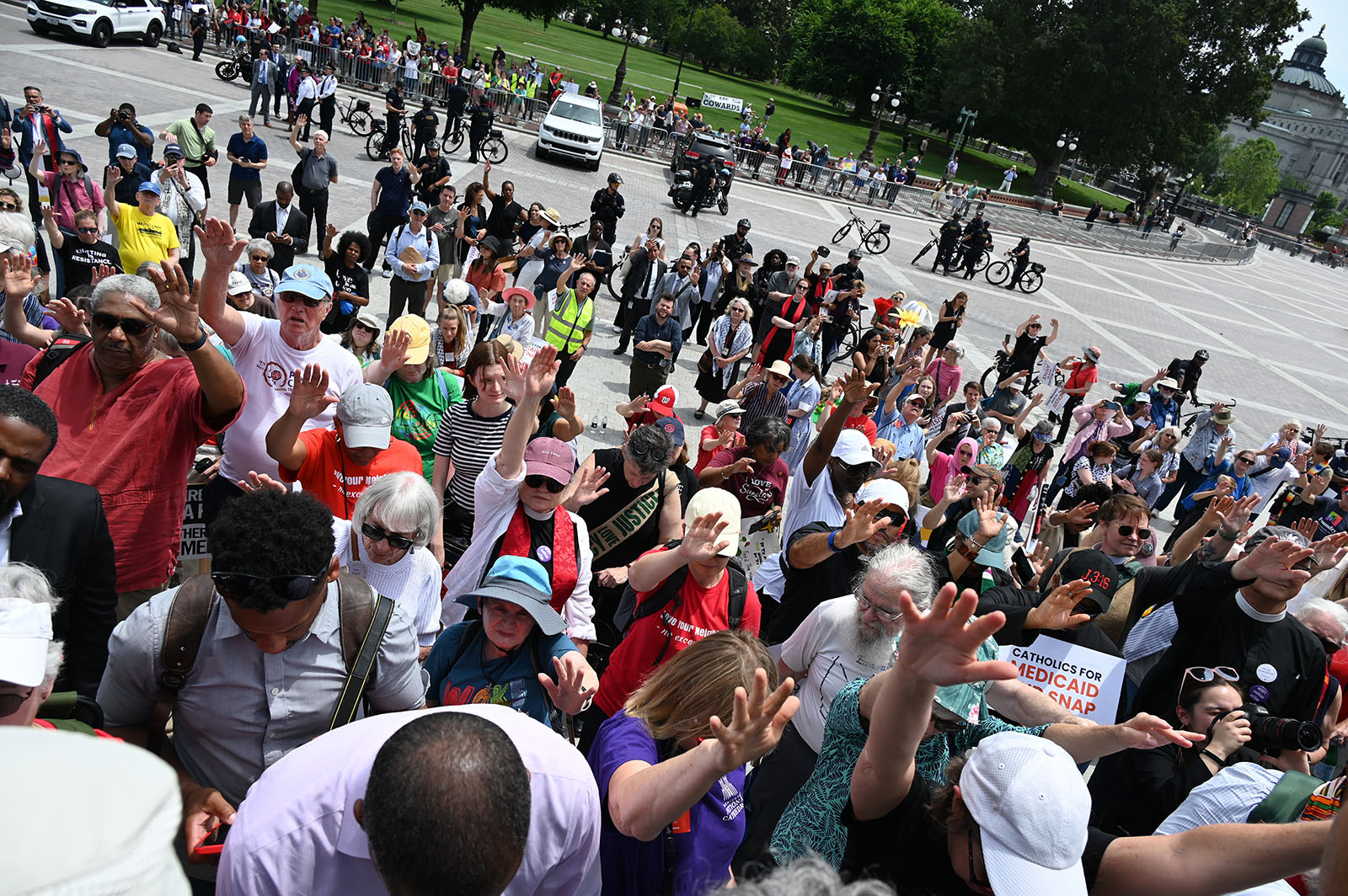
Over the past year, I have watched people of many faiths gather outside the Capitol, meet with lawmakers and remind their communities that every budget is also a moral document. I have seen advocates tell the truth in a culture that rewards distraction. I have seen communities refuse to let neighbors disappear behind statistics.
At its best, our democracy gives us the power to repair what we have broken. The question before Congress now is not whether we can afford to feed families and care for the sick. The question is whether we can afford the moral cost of refusing to do so.
The path forward is clear: Choose people over political theater, compassion over cruelty and the common good over private gain. The measure of this nation will not be the size of the tax cuts it delivered to those who already had enough. It will be whether children had enough to eat, whether patients could see a doctor, whether our environment survived and whether we had the courage to love our neighbors in law as well as in word.
(Bridget Moix is the general secretary of the Friends Committee on National Legislation and leads two other Quaker organizations, Friends Place on Capitol Hill and the FCNL Education Fund. The views expressed in this commentary do not necessarily reflect those of Religion News Service.)