


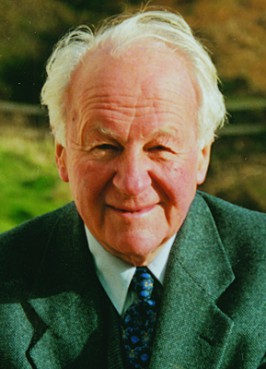
(RNS-JULY28) Rev. John Stott, renowned author credited with shaping much of 20th century evangelical Christianity. For use with RNS-STOTT-OBIT, transmitted July 28th, 2011, courtesy InterVarsity Press.
(RNS) The Rev. John Stott, a renowned and prolific author credited with shaping 20th-century evangelical Christianity, died Wednesday (July 27) in England at age 90.
While not a household name like evangelist Billy Graham, Stott was considered nearly as influential. He wrote more than 50 books, crafted the Lausanne Covenant — a definitive statement that unified evangelicals worldwide — and supported numerous Christian scholars through his organization.
If evangelicals elected popes, they would have chosen Stott, the scholar Michael Cromartie once quipped.
“John Stott never had quite that sort of public face,” said David Neff, editor in chief of Christianity Today, comparing Stott to Graham. “It’s all been networking, institution building, influencing other leaders.”
Graham, who worked with Stott on the 1974 global Lausanne conference that led to the covenant, said: “The evangelical world has lost one of its greatest spokesmen, and I have lost one of my close personal friends and advisors.”
Stott was a mentor to many evangelicals, from up-and-coming pastors to organization leaders.
California megachurch pastor Rick Warren tweeted on Wednesday about Stott’s mentoring role in his life.
“I flew to the UK recently just to pray for him &sit by his bed,” Warren wrote. “What a giant!”
Stott, a disciplined man known to annually read the Bible through for more than 50 years, declined the opportunity to become an Anglican bishop. Instead, he became known as “Uncle John” to many in the evangelical circles he traveled.
“Uncle John, was a great influence in my own theological development,” said the Rev. Geoff Tunnicliffe, general secretary of the World Evangelical Alliance. “His commitment to biblical orthodoxy, global mission and unity in the body of Christ were foundational in my own spiritual journey.”
Stott’s books include “Basic Christianity,” which Neff said rivals C.S. Lewis’ “Mere Christianity,” as well as “The Cross of Christ” and “Christian Mission in the Modern World.” Stott, in writing and speeches, emphasized the joint need for Christian evangelism and social action.
Though known most for his written word, Stott also was hailed as a longtime Anglican preacher, serving as rector of All Souls Church in London for 25 years and as rector emeritus from 1975 until the time of his death.
When the Rev. S. Douglas Birdsall, executive chair of the Lausanne Movement, informed Lausanne leaders that Stott had died, he spoke of his colleague’s multiple passions.
“John Stott’s focus was the cross,” he wrote. “The church was his great love. World evangelization was his passion. Scripture was his authority. Heaven was his hope. Now it is his home.”