


Kenyan Islamic leaders speak out against female genital mutilation
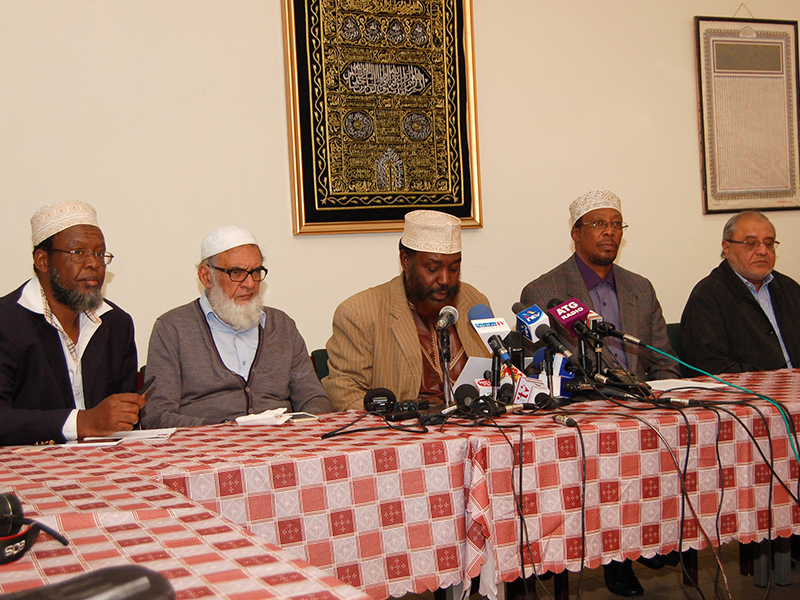


NAIROBI, Kenya (RNS) — Kenyan Islamic leaders are lending support to a national campaign to end female genital mutilation, a practice many in the country wrongly assume is permitted by Islam, they say.
The Islamic leaders joined together Monday (May 7) with representatives from Kenya’s Anti-FGM Board, which was founded in December 2013 to root out the custom. FGM has been banned in the country since 2011 under a law that also makes it illegal to take a girl or woman outside of Kenya to undergo the procedure.
But FGM is still practiced widely in Africa. In Kenya it remains common in the northeastern part of the country, where Islam predominates. Some mainly Christian groups in western and eastern regions of Kenya have also been slow to give up FGM.
“From the source of Islam … we do not find anything that permits it,” Sheikh Rashid Ali Omar, the country’s deputy chief kadhi — or judge in the Muslim court system — said at the news conference called to broadcast Muslim leaders’ anti-FGM stance.
“FGM contravenes the essence and the objectives of Islamic law, which are to protect the welfare of the family, dignity, wealth, health and mental capability of individuals and the community,” he continued.
Omar and other Muslim scholars and clerics emphasized that FGM is a cultural practice and that the Quran rejects such cutting of women’s bodies, though male circumcision is supported by Islamic law.
While FGM did not come out of Islam, it has been adopted by some Islamic communities, the Muslim leaders said.
“We need to differentiate between cultural and religious practices. … The general public takes it to be an Islamic practice. That’s very wrong,” said Omar Al-Bashir, a professor who works for Greenfields International, a local nongovernmental organization that focuses on public education.
FGM is still widespread in Africa despite many campaigns against it, both national and continental. Worldwide, the United Nations estimates that more than 200 million girls and women have undergone FGM, which leads to lifelong physical and emotional pain and sexual dysfunction.
At the meeting, Hibo Wardere, an FGM survivor, said many other women who have undergone the practice feel too ashamed to speak out about their suffering.
“It is a sexual abuse. It brings shame and rips women and girls of their dignity. It should be stopped,” said Wardere.