


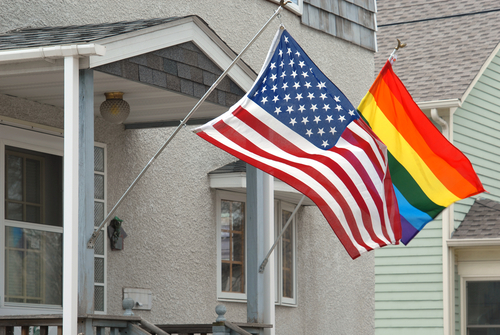


American and rainbow flags blowing in the wind on a suburban porch.
(RNS) A federal judge ruled Tuesday (Jan. 14) that Oklahoma’s voter-approved ban on same-sex marriage violates the U.S. Constitution.
Same-sex marriages won’t happen in the state immediately, though, because U.S. District Judge Terence Kern stayed his ruling pending an appeal. After a similar judicial decision last month in Utah, more than 900 same-sex couples got married in that state before the U.S. Supreme Court halted the weddings until the issue is settled.
Oklahoma Attorney General E. Scott Pruitt called Kern’s ruling “a troubling decision” and said the high court had recently noted “it is up to the states to decide how to define marriage, not the federal government.”
In 2004, Oklahoma voters enshrined heterosexual marriage into the state constitution. Two lesbian couples then sued for the right to marry and to have marriages in other states recognized in Oklahoma.
Kern ruled that the 2004 amendment violated the Equal Protection Clause of the U.S. Constitution, calling the ban “an arbitrary, irrational exclusion of just one class of Oklahoma citizens from a governmental benefit.”
“Excluding same-sex couples from marriage has done little to keep Oklahoma families together thus far, as Oklahoma consistently has one of the highest divorce rates in the country,” Kern wrote in his 68-page opinion.
He noted that Tulsa residents Mary Bishop and Sharon Baldwin, one of the two couples who sued, have “been in a loving, committed relationships for many years. They own property together, wish to retire together, wish to make medical decisions for one another, and wish to be recognized as a married couple with all its attendant rights and responsibilities.”
“Equal protection is at the very heart of our legal system and central to our consent to be governed. It is not a scarce commodity to be meted out begrudgingly or in short portions,” Kern wrote. “Therefore, the majority view in Oklahoma must give way to individual constitutional rights.”
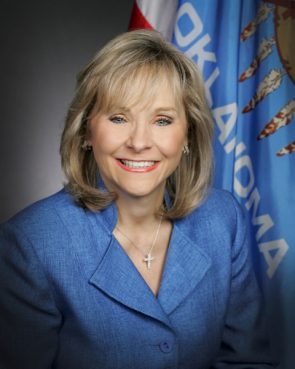
Gov. Mary Fallin criticized the decision, saying, “The people of Oklahoma have spoken on the issue,” with 75 percent of voters supporting the traditional definition of marriage.
Gov. Mary Fallin criticized the decision, saying, “The people of Oklahoma have spoken on the issue,” with 75 percent of voters supporting the traditional definition of marriage.
“I support the right of Oklahoma’s voters to govern themselves on this and other policy matters,” she said in a statement. “I am disappointed in the judge’s ruling and troubled that the will of the people has once again been ignored by the federal government.”
While noting that the Supreme Court has not yet ruled on whether same-sex marriages can be banned, Kern pointed out that the high court “now prohibits states from passing laws that are born of animosity against homosexuals, extends constitutional protection to the moral and sexual choices of homosexuals, and prohibits the federal government from treating opposite-sex marriages and same-sex marriages differently.”
In addition to Oklahoma and Utah, constitutions in 27 other states prohibit same-sex marriages, and lawsuits have been filed in 16 states.
Last week, four same-sex couples in Arizona challenged that state’s definition of marriage as the union of one man and one woman.
(Michael Winter writes for USA Today.)
MG END WINTER