



(RNS) The U.S. Supreme Court will soon rule on the constitutionality of prayer at public meetings. But a new survey finds U.S. voters clearly favor prayer — as long the public prayer is generic and not specifically Christian.

Susan Galloway, a resident of the town of Greece, New York, who filed a lawsuit against the town, speaks to the media after oral arguments at the Supreme Court in Washington, D.C. on Nov. 6, 2013. RNS photo by Katherine Burgess
Fairleigh Dickinson University’s PublicMind survey asked about attitudes on high profile cases before the court, including Greece v. Galloway. That case addresses whether elected officials can open public meetings with religiously specific prayers, such as praying in Jesus’ name.
A Jew and an atheist brought suit in Greece, N.Y., saying the Christian prayers excluded many citizens and violated the Constitution, which bans government establishment of religion. Even when the town began inviting non-Christians to give invocations, the “establishment” issue remained a question.
“(Greece officials) were trying their best not to offend anyone by making prayers as generic as possible. In this survey we asked if this is an acceptable way to approach the problem. Three in four people said yes,” said Peter Woolley, professor of political science at Fairleigh Dickinson in New Jersey.
Most registered voters (73 percent) said “prayer at public meetings is fine as long as the public officials are not favoring some beliefs over others.” And 23 percent said “public meetings shouldn’t have any prayers at all because prayers by definition suggest one belief or another.”
The key, however, is that this case centers on generic prayer that is “harmless, if not uplifting,” said Woolley. “Americans have become more used to the idea that one denomination is not necessarily privileged over another. Even unbelievers — atheists who would say prayer ‘is not for me’ — approved” of allowing nonspecific prayer.
While support for prayer was similar for every age group and both men and women, the most religiously observant were the most inclined to approve of it.
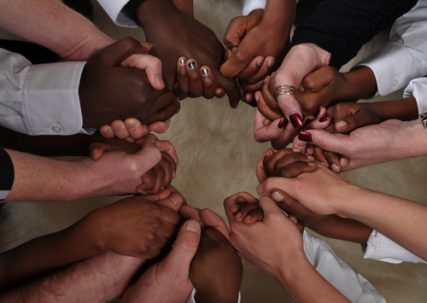
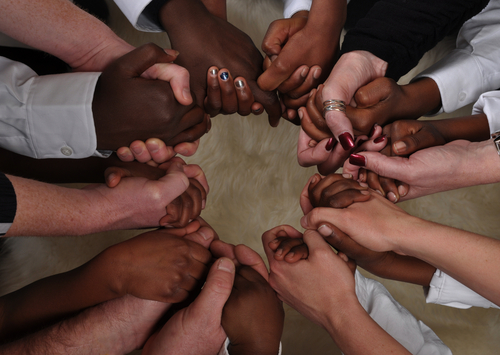
Hands clasped in prayer in a circle.
Among those who attend religious services (aside from funerals or weddings) at least once or twice a month, 86 percent would allow prayer, 11 percent would not.
For those who attend services a few times a year, 73 percent support it but opposition doubles to 26 percent.
But even those who seldom or never go to church backed the prayers at public meetings, with 58 percent approving and 36 percent opposing.
Surveys continually find prayer in general — not specified by denominational distinctions — is hugely popular.
Gallup, Barna Research and Pew Research Center all find that about 8 in 10 Christians (Catholics, Protestants and Mormons) say they pray at least weekly, as do Muslims and Hindus.
But there still remains a vocal minority of people who oppose having officials call on God before calling a public meeting to order.
The Freedom from Religion Foundation, the American Civil Liberties Union and Americans United for Separation of Church and State often send letters to legislators and public officials relaying citizen complaints and asking them to drop the prayer practices.
The FFRF view is that “government prayer is unnecessary, inappropriate and divisive.”
YS/AMB END GROSSMAN