


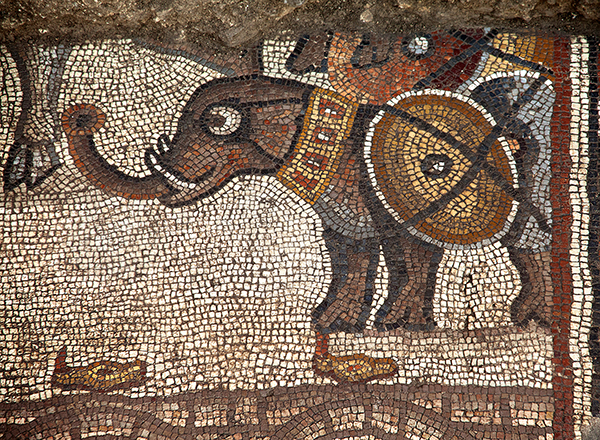


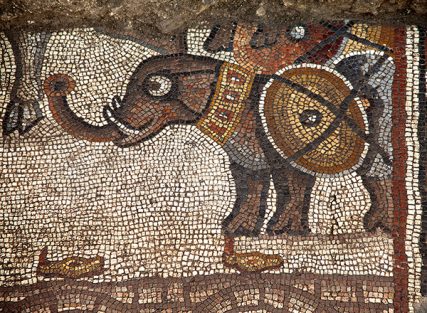
Detail of the elephant mosaic from the Huqoq Exploration Project. Photo courtesy of Jim Haberman, Huqoq Excavation Project
JERUSALEM (RNS) An ancient synagogue mosaic depicting nonbiblical themes — including elephants — has been removed for safekeeping, according to the lead archaeologist who discovered the three-part floor panel earlier this summer.
Jodi Magness, director of the excavations in the ancient Jewish village of Huqoq in the Lower Galilee, said the high-quality, 1,600-year-old mosaic panel, which depicts an array of nonbiblical themes, “has been removed for conservation” until the synagogue is fully excavated in several years’ time.
Magness, a professor of Judaism at the University of North Carolina at Chapel Hill, and her team have been digging at the site every July for four years.
Until now, “all stories found decorating ancient synagogues have been taken from the Hebrew Bible,” Magness said.

A royal figure in the Huqoq mosaic. Photo courtesy of Jim Haberman, Huqoq Excavation Project
The nonbiblical mosaic depicts a three-part story. The lower level contains a dying bull and a dying soldier. The center level depicts several armed men dressed in white and an elderly man carrying what appears to be a scroll. At the top is a Greek ruler flanked by soldiers and elephants in battle gear.
Elephants are not mentioned in the Bible.
Magness speculated that the Greek ruler could be Alexander the Great and the elderly man the Jewish high priest, but said much more research needs to be conducted.
What will happen to this and the other mosaics discovered at the synagogue site “depends largely on funding and on various agencies such as Israel Antiquities Authority and the Israel Parks Authority,” Magness said.
It is also possible that an Israeli museum will acquire at least some of the mosaics and put them on public display.
The important thing, the archaeologist said, “is to protect them from looters and vandals.”
YS/AMB END CHABIN