


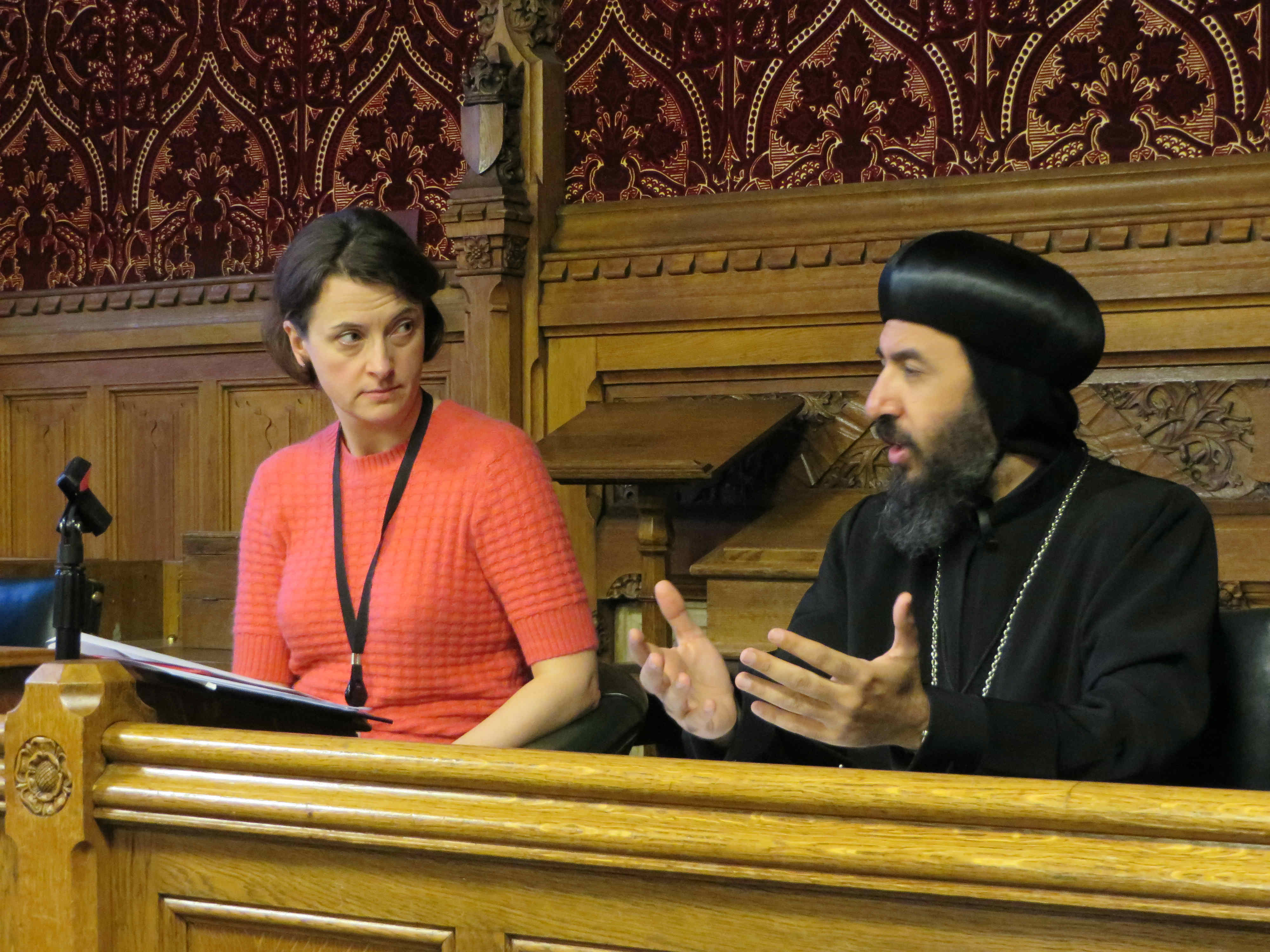


British politicians and faith leaders gathered at the House of Lords Tuesday to discuss the persecution of Christians abroad and the United Kingdom’s “non-functional” path to asylum.
Baroness Elizabeth Berridge (left) and Bishop Angaelos address attendees at the All Party Parliamentary Group on International Religious Freedom’s event on persecuted Christians and asylum seekers at the House of Lords on Tuesday (Oct. 23, 2013) in London.
The recently formed All Party Parliamentary Group on International Religious Freedom convened a meeting of Muslim and Christian representatives to address the hardships many Christians face, especially across Africa and the broader Middle East.
Bishop Angaelos of the Coptic Orthodox Church in the U.K. spoke out against Islamist theocracy in Egypt and the marginalization of Copts.
”Theocracy and democracy can’t work together,” he said. “We must have very pious, religious people, who respect everyone out of their piety, but not people who want to force their religion on others.”
Rubab Mehdi Rizvi, a Muslim barrister and panelist, said the recent attack on a church in Peshawar, Pakistan, “was not just an attack on a church or on Christians alone, but an attack on the heart and soul of Islam itself. Muslims stand together in solidarity with Christians to condemn these barbaric attacks against humanity.”
After hearing these country-specific cases of Christian persecution, Lord Avebury, a Buddhist politician and vice-chair of the Parliamentary Human Rights Group, concluded:
“We need to join up the dots. We need not think about persecution in an individual country and say that it is a phenomenon peculiar to that country, because it’s happening all over the world for the same reasons. We’ve failed collectively to examine extremist ideologies and to see if we can find means by which to tackle them in their countries of origin.”
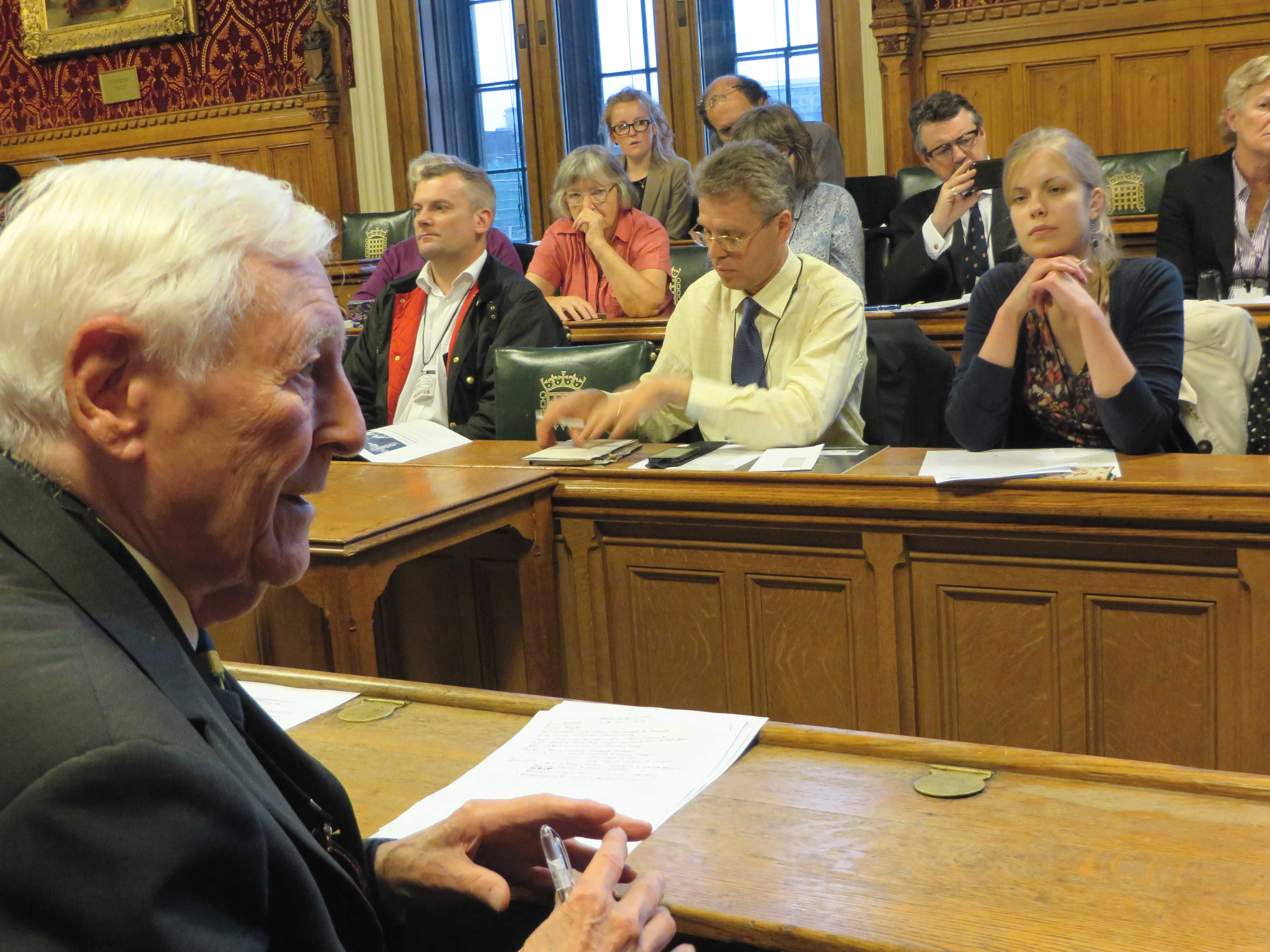
Lord Avebury speaks to attendees at the All Party Parliamentary Group on International Religious Freedom’s event on persecuted Christians and asylum seekers at the House of Lords on Tuesday (Oct. 23, 2013) in London.
Avebruy argued that religious asylum seekers who wish to settle in Britain must prove they have been individually persecuted rather than merely discriminated against as members of religious group.
“If we didn’t have that, then floods of people would enter our country without reason,” he said, adding that “although the immigration service is in chaos at the moment—everybody knows it’s non-functional—the rules by which it operates are good.”
Avebury also leveled heavy criticism against the United Nations and its efforts to address religious persecution:
“[tweetable]The mechanisms in the U.N. are grossly defective.[/tweetable]The U.N. special rapporteurs on freedom of religion or belief and extrajudicial executions are not doing their jobs properly. They don’t answer their telephones. They don’t react to communications about the persecutions, massacres and assassinations of people of the ‘wrong’ religion. I believe that our government has a duty to shake that system up.”
Avebury and the panel’s moderator the Rev Shannon Ledbetter both agreed that the U.N.’s “failure” is due more to the fact that rapporteur Heiner Bielefeldt, who I interviewed last month, works pro bono and part-time in the religious freedom post. They argued that the U.N. should provide greater support for work on religious freedom.
One speaker brought the conversation of Christian persecution closer to home, and not just in regards to asylum. Professor Iain Benson said, “We live in a time of significant secularism. The persecution of Christians isn’t just a phenomenon in Arab or Muslim countries, it’s a phenomenon in western societies under the rule of law.”
His remarks echoed some of the sentiments shared at a conference on religious freedom I attended in Brussels last week.
Benson worked on drafting the South African Charter of Religious Rights and Freedoms, which attracted many signatures but has yet to be signed into law. Several members of the audience and panelists voiced their desire for a similar charter in the U.K. Have a skim of the document. Do you think the U.K., or even the U.S., would benefit from a similar charter? Share your views below.