


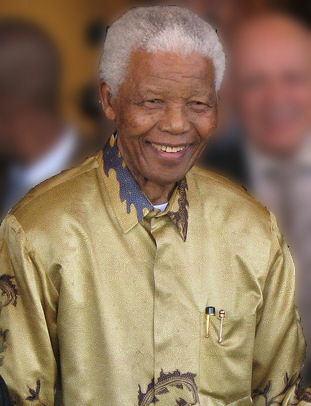


Nelson Mandela in Johannesburg on May 13, 2008.
(RNS) Nelson Mandela, the former South African president who died Thursday (Dec. 5), had a deep connection with religious institutions.
Mandela was educated, first at Clarkebury and then at Healdtown, Methodist boarding schools that provided a Christian liberal arts education.
“Both were important influences on his life,” said Presiding Bishop Zipho Siwa of the Methodist Church of Southern Africa. “Indeed, after his time at Clarkebury, the young Mandela said his horizons had been broadened.”
In Cape Town, retired Anglican Archbishop Desmond Tutu said Mandela was mourned by South Africans, Africans and the international community as a colossus of unimpeachable moral character and integrity.
“He preached a gospel of forgiveness and reconciliation,” Tutu wrote in a tribute on Allafrica.com.
“He showed in his own character, and inspired in others, many of God’s attributes: goodness, compassion, a desire for justice, peace, forgiveness and reconciliation. He was not only an amazing gift to humankind, he made South Africans and Africans feel good about being who we are. He made us walk tall. God be praised.”
Mandela acknowledged his connection to religious institutions and faith groups at various religious meetings across the world.
“It was religious institutions whether Christian, Moslem, Hindu or Jewish in the context of our country, they are the people who bought land, who built schools, who equipped them, who employed teachers, and paid them,” Mandela told the Parliament of the World’s Religions in 1999. “Without the church, without religious institutions, I would never have been here today.”
Mandela told the gathering it was religious institutions that gave his fellow prisoners and him hope during the apartheid era that one day they would prevail.
“Religion was one of the motivating factors in everything we did,” he said.
Soon after his release, Mandela visited the World Council of Churches headquarters in Geneva. The Rev. Olav Fykse Tveit, the World Council of Churches general secretary described the leader’s relationship with the council as a special one.
“This is when he expressed his gratitude for the churches’ support to the anti-apartheid struggle,” Tveit said in a tribute in which he celebrated Mandela as “a liberator who by force of his remarkable personality raised the dignity of Africans after centuries of colonialism, oppression and discrimination.”
Added Siwa in a tribute Friday: “Although we are sad and mourn the passing of a father, an icon and world leader we cannot help but celebrate his life as well.”
YS/AMB END NZWILI