


BYU professor's novel 'A Short Stay in Hell' explodes in popularity — 17 years later
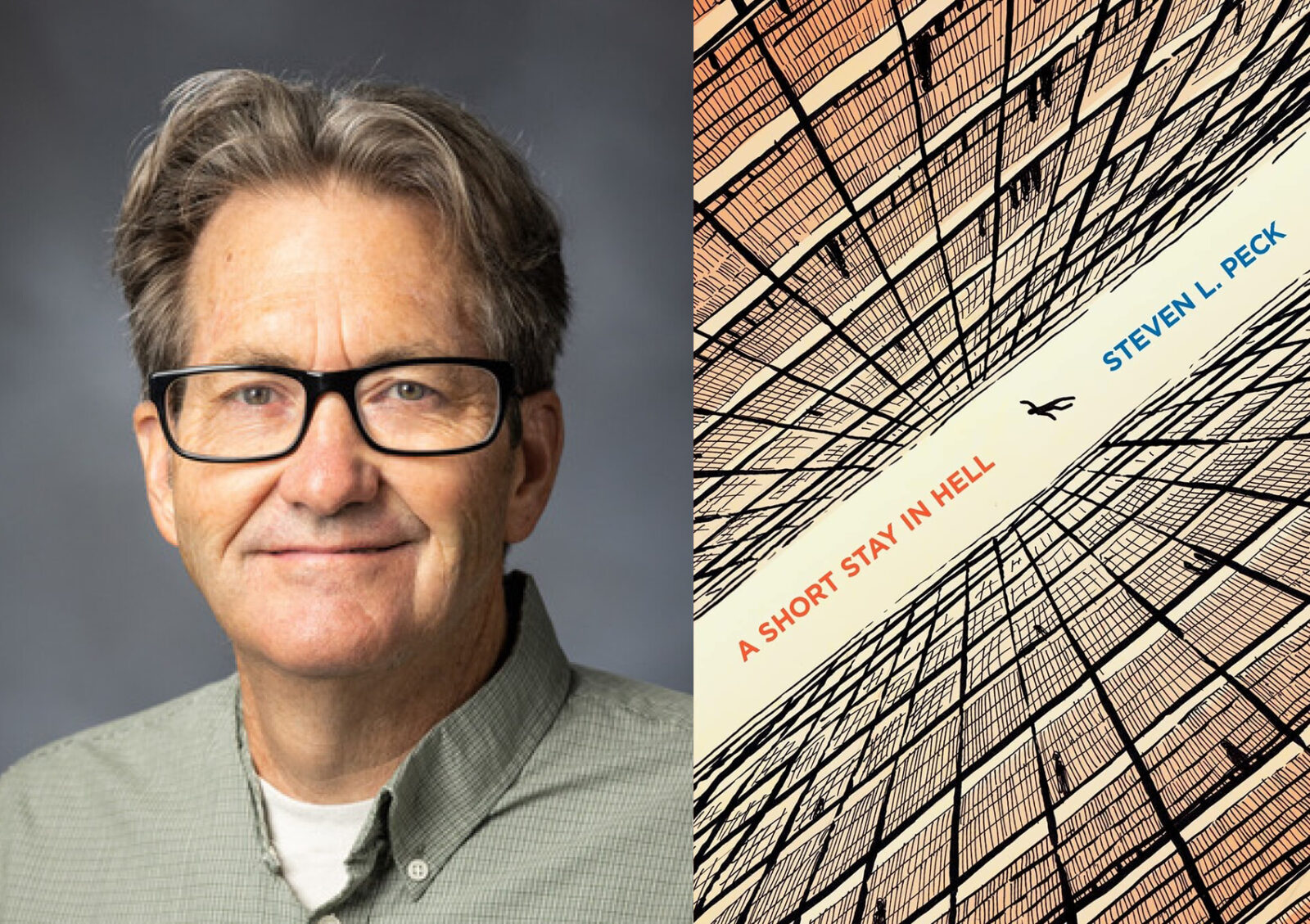


(RNS) — To prepare for my recent interview with Steven L. Peck, I wanted to reread “A Short Stay in Hell,” his 2009 novel that is having a cultural moment. I hadn’t read it in more than a decade, but I’d forgotten to bring my slim paperback copy to Las Vegas, where Peck and I were both attending the Mormon History Association Conference.
No problem, I thought. This is why Libby, the free library app, exists! I would simply check out a digital copy from the Cincinnati library.
No such luck. Peck’s waifish 110-page novel has become so popular that I am currently 62nd on the list to read a digital copy, and my turn won’t come up for another two months.
However, “A Short Stay in Hell” is not a novel you forget. Like, ever. I’m still traumatized by it, 14 years after I first read it. But I’m equally delighted that it’s become an unexpected bestseller because Peck is my friend, and success couldn’t have happened to a nicer guy.
The story is about a guy much like Peck himself: a Mormon dad who has tried to live a good life and expects there will be some kind of joyous afterlife. But when he dies, he finds himself in hell, along with other people from his era and culture.
Peck, a biology professor at Brigham Young University in Provo, Utah, who writes novels as a pastime, is as stunned as anyone that his horror story has become a TikTok and Reddit phenomenon 17 years after it was first published.
It was a long time coming. The book enjoyed modest niche sales in its first decade on the market, and Peck remembers feeling satisfied when it received 100 ratings on Goodreads. He told me, “Oh, wow, I beat 100. How amazing is that?” He’d heard that fewer than 10% of readers will take the time to rate a book on Goodreads or Amazon. If true, that seemed to indicate he might have gotten a thousand readers.
He was happy with that. But around 2024, momentum began to build, with new readers discovering it on social media.
The father of five started hearing from his adult children that his book was “blowing up” on TikTok — the same platform that has taken other novels from relative obscurity, long after publication, into the stratosphere. (Madeline Miller’s “The Song of Achilles” is one such bestseller.)
Peck isn’t on TikTok, but his publisher, Therese Doucet at Strange Violin Editions, called him to confirm that sales of his indie cult classic were indeed exploding.
Today, “A Short Stay in Hell” has more than 91,000 ratings on Goodreads and has been translated into 15 languages. There’s been a slew of recent accolades, including one Peck never expected: In May it was republished as a Vintage Classic in the United Kingdom, joining an elite pantheon of authors such as Virginia Woolf, Fyodor Dostoevsky, Toni Morrison and Herman Melville.
“I never thought it would be a Vintage because I thought I had to die first,” Peck said. (You don’t, though it’s rare-ish. Margaret Atwood and Haruki Murakami are both also on Vintage’s list, and like Peck they are very much alive.) He is believed to be the first Latter-day Saint author to receive this honor.

Novelist Steven L. Peck took this selfie at Mauna Loa on the Big Island of Hawaii. (Photo courtesy of Peck)
This success is surprising because the novel is so very dark. “If you did a word cloud of what people say about the book, the big word in the center would be ‘disturbing,’” he laughed.
At first, hell doesn’t seem so bad for the book’s main character, Soren Johansson, because there’s no physical torture. Everyone has food to eat – even Cap’n Crunch! – and there’s no disease. Yet a “short stay” there is a cruel cosmic joke because it’s essentially impossible to leave. No one does. Instead, they lose both their humanity and their hope as years turn into centuries and then millennia, and then, well, we don’t have a word in English for “trillions of years” because the very concept lies so far outside our imaginations.
Here’s what hell is: a total absence of creativity, novelty and diversity. Hell is billions upon billions of years of futility and boredom. Nothing new can ever happen there. Everyone in your hell looks the same, and every endless day feels the same. You can’t learn anything new, or build or paint or write.
For Peck, this total absence of creativity is the total absence of God.
“To me, the story had some really interesting theological implications because I always saw God as wildly creative,” he said. “I always liked the idea of an open universe, one where God is learning.”
Precedents for this can be found in classical Mormon theology, and in the Bible. “In the Scriptures, often God is surprised by things,” he said. “And in evolutionary biology, to me, there’s nothing necessary about anything that appears, whether it’s a mahogany tree or a redwood or a giraffe.”
Peck points to the climax of the Book of Job, when Job puts God on trial to answer for all of Job’s sufferings. Rather than defending himself, God’s response is to teach Job how little humans understand about the universe.
“The thing I take from Job is that God loves diversity in all its forms,” Peck said. “He loves the diversity of plants and animals. He loves the diversity of people. And I get this sense that that’s one of the main features of God because the universe is constantly creating novelty.”
I asked Peck why, after all these years, his novel has touched such a nerve in the culture. Readers’ reviews talk about existential angst: a sense of unspoken dread that their lives don’t have real meaning. “I think it’s tapping into something that doesn’t get articulated very often,” he said.
Another factor may be that it exposes people’s mounting terror of being bored. We don’t want to have time to think, even for a moment.
“It’s an age where our attention spans are getting shorter and shorter,” he said. “We’re quick to turn to our phones. But how do you keep from being bored in endless monotony?”
For himself, Peck hasn’t had much time to be bored. The self-professed introvert confessed that he’s “a lot more anxious” now that there’s much more to navigate in his life as an author. He has an agent (Monica Meehan at DropCap Inc.) and an eager fan base, and there’s talk of Hollywood interest in this book and his four other backlist novels.
“I’m just kind of staring at it in wonder,” he said. “But it’s weird. It’s really weird.”