


In JD Vance's faith memoir, the most telling words are ‘My Way’



(RNS) — The Catholic vice president of the United States did not come from a well-born or wealthy beginning — yet, through hard work and determination, he rose to high office. His Catholic faith both guides his public life at the highest levels of government and also maintains his connection to the people he knew growing up.
I am talking about Joe Biden. And the comparison with JD Vance is instructive.
Consider for a moment how Biden has talked about his Catholic faith. “My religion is just an enormous sense of solace. And some of it relates to ritual, some of it relates to comfort and what you’ve done your whole life.” For Biden, faith is rooted in family, memory and long practice — and shaped by profound loss. Empathy, Biden once told Stephen Colbert on The Late Show, is what we gain from loss. Biden wears his faith easily in an unfussy way, like his own skin.
JD Vance has a different way. The words “relevant” and “relevance” recur with disconcerting frequency in Vance’s new memoir, “Communion: Finding My Way Back to Faith,” much as though he is searching in religious faith for the solution to some practical problem.
Parenthood, Vance tells us, made him want “to build a culture of virtue, within my own family, within my community, and within our entire society.” He laments how world leaders had “taken God out of their postwar oaths and alliances, and they wondered why so much else had been lost as well.” He confesses that “My big fear isn’t death but that we inherited a great civilization and are slowly letting it fall into disrepair.”
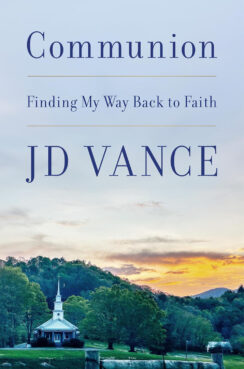
“Communion: Finding My Way Back to Faith” by JD Vance. (Courtesy image)
For Vance, Catholic faith provides the solidity he sees slipping away everywhere around him.
Long stretches of “Communion” do not touch on religion almost at all except so far as the case for religion generally is reinforced by the challenges faced by workers, by families, by children, by parents or anyone else who is suffering under the economic system that has rewarded Vance so well for critiquing it. And to Vance’s credit, the passages where he describes the Catholic Church’s teachings about labor, economic justice and human dignity are quite good. Even his exploration of the migration issue’s complexity is evenhanded and thoughtful. I recognize a Catholicism I know in those pages. But there remains a fundamental problem.
Near the book’s end Vance recounts coming upon a crumbling old church building and wondering, “How long would its current congregation last?” His diagnosis is an impending “civilizational death,” and here is where Vance’s way reveals itself. Though Vance does not name it, Samuel Huntington’s “clash of civilizations” thesis haunts his book. In particular, Vance seems to agree with Huntington that civilizations are fixed things with “objective elements” that do not change, and so conflict is built into history.
It does not enter Vance’s mind that what looks like “civilizational death” might just be civilizational change, or that the Catholic Church has weathered countless changes across 20 centuries. Instead, Vance seems to feel personally responsible for preventing anything from challenging his civilization or changing the church. Things must remain as they are.
I could be tempted to read Vance’s desire for a solid, unchanging world as a response to the traumas he has described from his younger life. While those traumas certainly are part of the story, I think Vance’s strange account of Catholic faith is more closely related to where he finds himself today.
Vance is preoccupied by the distance he traveled from Appalachia to Silicon Valley. Questions of status and cultural distance pervade his thinking. Mere pages after praising the authenticity of his Ohio family and friends, he shares the unnecessary detail that he got news of the Pennsylvania grand jury report “while we played with our toddler on a Lake Annecy beach,” underscoring how Meemaw’s grandson knows the Haute-Savoie.
Vance both craves elite status and is repelled by it. His life today is built on defending the working-class people he grew up with from an elite class he has jumped in with both feet to join. He writes about being uncomfortable talking to a therapist because he didn’t like talking “to a stranger” about “how crazy my homelife was.” Later he wrote a book to tell every stranger who would read about it. He knows his children will join “our country’s ruling class” because of the privilege they were born into. Yet he complains that those “elite institutions” he is leading them toward are “intellectually and spiritually broken.”
It is obvious Vance is conflicted, and he seems to be using faith to reconcile the tension. Vance, whose intelligence got him an education that lifted him from rural poverty, takes the same stubbornly intellectual path in his return to faith. He read and discussed his way into the Catholic Church, name-checking Augustine, Aquinas, Chesterton and Lewis along the way. Vance praises the “hierarchy and sense of authority” he found in the intellectual richness of Catholicism.
I would like to think Vance can find some lasting comfort in all of this. I wish him well. But Vance’s Catholicism seems a little too instrumentally useful to nurture the deep “solace” Joe Biden once talked about with such peaceful conviction. The restlessness is not gone from Vance’s story. The telling of it finds him trying a little too hard to exert too much control over everything around him.
C.S. Lewis wrote in “Mere Christianity”: “Nothing that you have not given away will really be yours.” That means giving up not only money and possessions, but the whole illusion of control that tells us we can save civilization or keep the church right where we want it. This is the “little way” of humility — of a faith that believes civilization’s questions were settled on a hill outside Jerusalem 2,000 years ago. The gates of hell shall not prevail (Matthew 16:18).
The emphasis of “Communion” is a little too much on “My Way.” I think that is not the way that leads toward solace.
(Steven P. Millies is the author of “Joseph Bernardin: Seeking Common Ground” and “A Consistent Ethic of Life: Navigating Catholic Engagement With U.S. Politics.” The views expressed in this commentary do not necessarily reflect those of Religion News Service.)